You’ve probably been here before: three subcontractor bids in hand, all formatted differently, one buried exclusion buried three pages deep in a PDF attachment, and a leveling sheet that’s technically complete but tells you almost nothing about actual scope coverage. The issue usually isn’t the estimator. It’s that the software handed them a side-by-side table when what they actually needed was document intelligence.
Bid leveling construction software has improved a lot over the past few years, but the gap between what vendors promise and what tools actually do remains wide. Most platforms handle bid collection and basic display reasonably well. The harder part, reading unstructured proposals, detecting scope gaps, and normalizing pricing across bids with different inclusions, is where a lot of them still fall short.
What Bid Leveling Software Actually Needs to Do
The goal isn’t just to put three numbers next to each other. It’s to make a defensible apples-to-apples comparison when the underlying proposals were written by different subs with different assumptions about what’s in scope. That’s a much harder problem than column formatting.
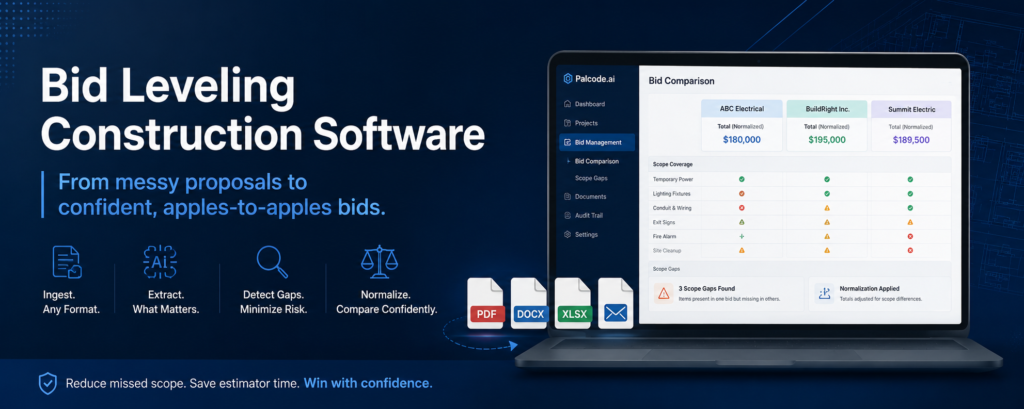
A tool worth evaluating should handle the full post-receipt workflow. That starts with ingestion: the software should accept PDFs, Word docs, Excel submissions, and email attachments without requiring manual conversion first. If your team is cleaning up files before they can even enter the system, you’ve already lost time.
From there, scope extraction is where real capability separates itself from marketing copy. The tool should pull inclusions, exclusions, alternates, and qualifications directly from proposal text, not just store the documents. There’s a meaningful difference between a platform that attaches a PDF to a record and one that actually reads it.
Side-by-side comparison matters too, but it’s table stakes. Scope gap detection is the feature that earns its keep on complex projects, specifically flagging items present in one bid but absent in another, especially when those gaps are buried in attachments rather than the main pricing section. That’s the failure mode that leads to post-award disputes and budget surprises.
Normalization closes the loop. A platform that shows you raw totals side by side without reconciling scope differences is giving you incomplete information. Bid A at $180,000 may actually be more expensive than Bid B at $195,000 once you account for what Bid A left out. The software should surface that math, not leave it to the estimator to reconstruct manually.
The Weaknesses Most Vendors Won’t Advertise
The most common failure mode is a platform that stops at collection. It gathers bids in one place, displays totals, maybe formats a comparison matrix, and calls that leveling. It isn’t. It’s organization, which has value, but it doesn’t reduce missed-scope risk or save meaningful estimator time on the review itself.
Manual PDF handling is the clearest sign of this problem. If estimators still have to open every attachment, read through qualifications pages, and manually enter scope notes into the platform, the software is essentially a wrapper around a spreadsheet. That’s worth naming plainly, because several platforms in this category are exactly that.
Blind spots in attachments are a related issue. Subcontractors routinely bury exclusions in cover letters, addendum responses, or qualification sections that aren’t part of the main pricing table. Tools that only parse the structured pricing data miss these entirely. That’s the part most teams underestimate when they demo a product on a clean sample file versus a real messy proposal package.
Version control is another underappreciated weakness. Bid cycles involve addenda, revised proposals, and last-minute substitutions. If the platform doesn’t track those updates cleanly, you end up leveling against a superseded number without realizing it. That’s a process failure the software should prevent, not one it silently enables.
Audit trail depth matters more than it looks on a feature list. On GMP projects, public work, or anything with owner visibility into the procurement process, the team needs a clear record of why a bid was leveled a certain way and which source text supported each adjustment. Platforms with weak audit functionality create exposure that shows up later, not during the demo.
Questions to Ask Before You Buy
When you’re comparing vendors, the demo environment is almost always optimized for clean inputs. Push on the edge cases instead.
- Can the tool ingest real subcontractor proposals in their native formats, or does everything need to be preprocessed first?
- Does it extract scope items automatically from proposal text, or does it only store and display documents?
- Can it identify missing scope and exclusions without the estimator doing a line-by-line manual review?
- Does normalization actually adjust totals for scope differences, or does it just reformat raw numbers?
- Can your team override AI outputs and trace each extracted item back to the source text?
- Does the audit trail hold up for owner review or GMP documentation?
That last question about overrides is worth pressing specifically. Any AI-assisted extraction will produce errors on unusual proposal formats. The question is whether estimators can correct those errors efficiently and whether the system records the correction. A platform that surfaces AI outputs with no transparency into the underlying source is harder to trust and harder to defend.
How AI Is Changing This Workflow
The realistic picture isn’t that AI eliminates the estimator’s judgment. It’s that document intelligence handles the extraction and flagging work so the estimator can focus on the decisions rather than the data entry. That’s a meaningful shift for teams managing high bid volume with limited staff capacity.
Adoption is still uneven. Some platforms have built genuine document-reading capability into their leveling workflows. Others have added AI labeling to what is essentially the same rule-based parser they had before. The difference shows up when you run a real proposal through the tool, specifically one with ambiguous scope language and exclusions formatted inconsistently across pages.
The shift from spreadsheet-based leveling to AI-assisted workflows is happening faster on the GC side than most vendors anticipated, partly because bid volume has increased and partly because the cost of a missed-scope item has gotten harder to absorb. Teams that get this right aren’t just faster. They’re producing comparisons that hold up under scrutiny, which matters when the owner or the legal team comes asking later.
The practical implication for buyers: prioritize demonstrated document-reading capability over feature breadth. A platform that genuinely reads proposals and flags scope gaps for two trade packages will deliver more value than one with a broader feature set that still requires manual PDF review for every bid received.
| Capability | Basic Bid Collection Tools | Full Bid Leveling Platforms |
|---|---|---|
| Multi-format ingestion (PDF, Word, Excel) | Often requires manual cleanup first | Accepts native formats without preprocessing |
| Scope extraction from proposal text | Stores documents only, no extraction | Pulls inclusions, exclusions, and qualifications automatically |
| Scope gap detection | Not available, relies on manual review | Flags items present in one bid but missing in another |
| Bid normalization | Side-by-side raw totals only | Adjusts totals to account for scope differences |
| Audit trail | Minimal or none | Traces each leveling decision back to source text |
| Version control for revised bids | Manual tracking required | Tracks addenda and revised proposals cleanly |
Frequently Asked Questions
What’s the difference between bid collection software and actual bid leveling software?
Bid collection tools gather proposals in one place and display totals side by side. Bid leveling software goes further by reading the documents, extracting scope items, detecting gaps between bids, and normalizing pricing to account for different inclusions. If the platform still requires estimators to manually review every PDF and retype scope notes, it’s functioning as a collection tool regardless of how it’s marketed.
How long does it typically take to implement bid leveling software on a GC team?
Implementation timelines vary by platform complexity, but most cloud-based tools can get a small preconstruction team up and running within a few weeks. The bigger time investment usually isn’t the technical setup. It’s adjusting the team’s workflow so that document ingestion and scope review actually happen inside the platform rather than alongside it in a separate spreadsheet.
What does bid leveling construction software typically cost?
Pricing generally falls somewhere between $300 and $1,500 per month for mid-market GC teams, depending on seat count and feature depth. Platforms with genuine AI document extraction tend to sit at the higher end of that range. It’s worth separating out what you’re actually paying for: a few vendors bundle leveling into a broader bid management suite, which can look cheaper on a per-feature basis but may not include the specific document-reading capability you need.
Can bid leveling software handle proposals that are formatted inconsistently across subs?
This is the real test, and the answer depends heavily on the platform. Tools built around structured templates struggle when a sub submits a cover letter with embedded exclusions or a non-standard pricing layout. Platforms with document intelligence that reads unstructured text handle these cases better, though even the stronger tools will occasionally misread an unusual format. The key is whether the estimator can easily review and override extracted items with a clear link back to the source text.
Is an audit trail really necessary for everyday commercial work, or only for public projects?
It matters more broadly than teams usually expect before they need it. GMP projects, value engineering reviews, and any situation where an owner questions a subcontractor selection all benefit from a documented record of the leveling process. Even on straightforward private work, having a clear trail of which scope items were adjusted and why protects the team if a sub later disputes the award basis.
See What Real Bid Leveling Looks Like in Practice
If your current process still involves manually reading through PDF attachments to find buried exclusions, or rebuilding scope comparisons in a spreadsheet after the bids come in, there’s a better path. Palcode.ai is built specifically for commercial GC and preconstruction teams who need accurate, defensible bid leveling without adding hours to every trade package review. Book a demo to see how it handles real proposal documents from your actual workflow.