You’ve probably run into this already: the low bid looks clean on paper, the number fits the budget, and then six weeks into construction someone discovers an entire system was never priced. That’s a scope gap, and it’s rarely a small line item. It’s the kind of miss that turns a competitive bid into an expensive renegotiation.
A scope gap is any piece of work that belongs in a bid package but wasn’t quoted. The problem isn’t always that a subcontractor cut corners intentionally. More often, the gap lives in ambiguous interface language, an addendum that got missed, or a coordination note that both trades assumed the other would handle.
Why Scope Gaps in Construction Bids Are So Hard to Catch
The challenge with scope gap analysis in bids is that a proposal can look complete financially while carrying a real coverage hole underneath. The lowest bidder isn’t always the most capable or the most thorough. Sometimes they’re just the one who priced the least.
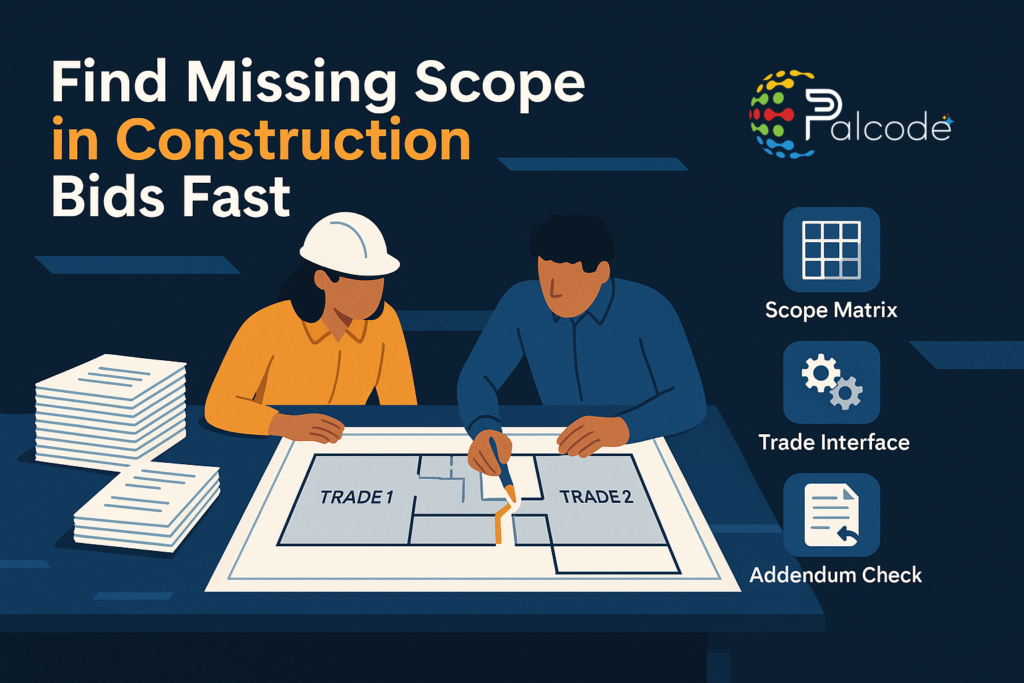
Trade interfaces are where this gets dangerous. Think about where electrical connects to mechanical controls, or where plumbing terminates and a specialty subcontractor’s scope begins. Neither trade’s bid explicitly excludes the connection work. Neither explicitly includes it either. That gap sits quietly until someone has to perform the work and realizes there’s no budget for it.
Addenda make this worse. Every reissued drawing set is what one industry framework calls a “silent gap factory” because estimators sometimes process addenda against old scope sheets rather than updated ones. A revised spec section can change the responsible party for a system, and if that change doesn’t get reconciled, the work falls through the cracks entirely.
A Structured Approach to Scope Gap Detection
Catching these issues before signing requires a deliberate, repeatable process. The following steps are grounded in how experienced estimating teams actually work through bid scope review.
Build an Inclusion/Exclusion Matrix for Every Bidder
Document exactly what each bidder stated as included and what they explicitly excluded. Don’t rely on memory. Place these lists side by side and look for the items where Bidder A assumes another trade is responsible while Bidder B prices it directly. That asymmetry is usually where the gap lives.
Walk the CSI Divisions
Walk each CSI MasterFormat division in order. Start at Division 03 Concrete, work through Division 09 Finishes and beyond, and confirm that every bidder has priced the relevant work. If a division is entirely absent from a low bidder’s proposal, treat it as a flag, not an assumption that it was intentionally excluded.
Cross-Reference Specs Against Drawings
Spec sections that say “coordinate with Section XX” require you to actually read Section XX and confirm someone owns that work. On the drawing side, one-line diagrams in electrical and riser diagrams in plumbing show you exactly where systems connect. Every connection point is a potential boundary dispute. Verify that the scope on both sides of each connection is assigned to a specific bidder.
This is also where a structured construction bid analysis process pays off, because informal comparisons tend to miss exactly these kinds of specification-to-drawing conflicts.
Reconcile Every Addendum
Before finalizing any comparison, confirm that the latest drawing revisions and all issued addenda are reflected in each bid. This step is tedious, and that’s why it gets skipped. But a revised spec that reassigns scope from one trade to another can quietly invalidate a bid that was accurate against the original documents.
Issue Targeted RFIs Before You’re Locked In
When you spot an ambiguous boundary, ask for clarification in writing before the bid is finalized. An RFI that asks “please clarify responsibility for [specific item]” is far less expensive than a change order asking the same question after the subcontract is signed. Don’t proceed on verbal assurances. If the clarification matters, it needs to be in writing and incorporated into the bid.
Compare Against the High Bidder
This step is the one most teams skip, and it’s often the most revealing. During buyout, walk through what the high bidder included that the low bidder didn’t. That delta tells you whether the price difference reflects efficiency or exclusions. If the high bidder priced $85,000 in commissioning support that the low bidder left out entirely, the “low” bid isn’t actually lower.
Where Scope Gaps Most Often Hide
Certain categories show up repeatedly in bid scope review as the places where coverage breaks down.
- Trade interface boundaries: Controls and BAS integration, insulation scope on mechanical systems, commissioning support responsibilities
- General requirements: Permit and inspection fees, temporary facilities, testing, and cleanup are frequently assumed rather than explicitly priced
- Assumption-based scope: Any item documented only as an assumption in a bid is unpriced work waiting to become a change order
- Document misalignment: Cases where the spec scope and the drawing scope describe different work, or where drawing details conflict with equipment schedules
That last one is underestimated. When a spec and a drawing tell different stories about the same system, the gap isn’t just financial. It becomes a dispute about interpretation, and those are expensive regardless of who’s technically right.
What Missing Scope Actually Costs
The stakes are concrete. One documented case from the estimating field involves a $340,000 pre-bid mistake that traced back to a failure to reconcile which spec division owned a specific scope of work. That’s not a rounding error. It’s the kind of miss that changes a project’s financial outcome.
From a legal standpoint, GCs carry responsibility for packaging bid documents clearly enough to minimize ambiguity. But subcontractors are equally exposed when they don’t explicitly document their scope boundaries. If a gap surfaces post-signing, the right move is to stop work, photograph the condition, and notify the GC in writing immediately rather than performing unpriced work hoping it gets resolved later. It usually doesn’t.
How AI Is Changing Scope Gap Analysis
Manual bid scope review is time-consuming and error-prone, particularly on multi-trade projects where the document set spans dozens of spec sections. AI-based document intelligence tools are starting to close that gap in a practical way.
The most useful applications pull structured scope items directly from blueprint PDFs and specification documents, then flag where a bidder’s submission doesn’t address a required line item. Some platforms can also parse inclusion/exclusion language across multiple bid submissions and surface asymmetries that would take an estimator hours to find manually. That’s the part most teams underestimate: it’s not just speed, it’s the coverage. A human reviewer working under deadline pressure will miss things. A systematic document comparison can’t catch that.
Adoption is still uneven. Teams on complex commercial projects tend to see the most immediate value, particularly where the bid package involves eight or more trades and the interface boundaries are genuinely complicated. Simpler projects may not justify the setup time. But as these tools become more accessible, the estimating teams that build scope gap detection into their standard bid leveling workflow will have a measurable advantage in avoiding the change orders that erode margin on otherwise well-priced projects.
Frequently Asked Questions
What exactly is a scope gap in a construction bid?
A scope gap is a piece of required project work that a bidder failed to price, even though it’s included in the drawings or specifications. It doesn’t mean the bidder made a math error. It means that work simply isn’t covered by anyone’s quote, and it will show up as a change order once construction begins.
How do I know if a low bid is missing scope or just more competitive?
Compare the low bidder’s inclusion and exclusion list against the higher bids line by line. If the price gap is explained by efficiency or better supplier pricing, the scope coverage should be roughly equivalent. When the delta comes from items that higher bidders explicitly priced and the low bidder never mentioned, that’s a coverage gap, not a competitive advantage. Talking through what the high bidder included during buyout is one of the most reliable ways to validate this.
What does it cost to implement AI-based scope gap detection tools?
Lighter tools run a few hundred dollars a month. Platforms handling full bid leveling and document intelligence at scale move into custom enterprise agreements. Most teams find the more relevant number is what a single missed scope gap costs in change orders, which can run into six figures on a complex commercial project. That context tends to reframe the software cost conversation quickly.
What should I do if I find a scope gap after the subcontract is already signed?
Stop the affected work immediately and document the condition with photos before proceeding. Notify the GC in writing right away rather than performing the unpriced work and hoping it gets sorted out later. Verbal agreements to “figure it out” rarely hold up, and performing work outside your contract without documented authorization puts you in a weak position if the issue escalates.
Are trade interface boundaries always the biggest source of scope gaps?
They’re consistently among the highest-risk areas, particularly where electrical connects to mechanical controls or where commissioning responsibilities span multiple trades. But general requirements like permit fees, temporary facilities, and testing are also frequently left out by bidders who assume those costs are covered elsewhere. Checking both areas systematically is more reliable than prioritizing one over the other.
See How Palcode.ai Surfaces Missing Scope Before It Becomes a Change Order
If your team is still catching scope gaps manually during bid leveling, you’re working harder than you need to and likely missing some anyway. Palcode.ai uses document intelligence to parse bid submissions, flag unpriced scope items, and surface coverage gaps across your trade packages before you sign anything. Book a demo to see how it fits into your preconstruction workflow.