You’ve probably run into this already: three subcontractor proposals, three different formats, and a Friday afternoon deadline to produce a bid tab that actually means something. One sub included temp power. Another excluded it entirely. The third didn’t mention it at all. Sorting that out in Excel, manually, is where preconstruction hours quietly disappear.
That’s the problem bid leveling construction software is now built to solve, and the tools doing it have changed significantly over the past few years. This isn’t about moving a spreadsheet into a browser. The shift is toward software that reads proposals, interprets scope language, and flags the differences that actually matter before award decisions get made.
What the Spreadsheet Approach Gets Wrong
The traditional method is well understood: pull line items from PDFs, paste them into a shared Excel file, reconcile scope differences manually, and drop in plug numbers wherever a sub went quiet on a particular item. Estimators have done this for decades, and it works, up to a point.
The limits show up fast on complex projects. Proposals arrive in different formats across different versions. Manual transcription introduces entry errors. And when six bidders submit on the same scope, the comparison matrix gets unwieldy enough that subtle exclusions start getting missed. That’s not a capacity problem or a skill problem. It’s a structural one. The format itself doesn’t scale.
The bigger risk isn’t the time lost. It’s that a missed exclusion in the leveling process can turn into a change order after award, often worth more than whatever was saved by moving quickly through the bid tab.
How Bid Leveling Construction Software Actually Works Now
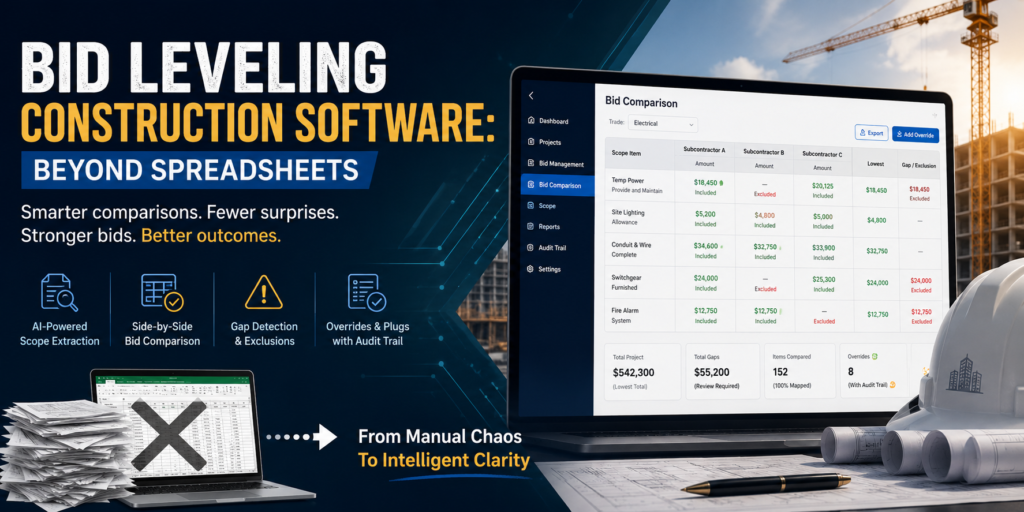
Modern platforms automate the parts of that process that don’t require estimator judgment. A capable tool today can ingest a subcontractor proposal, extract inclusions and exclusions, map line items to a common scope framework, and produce a structured side-by-side comparison, without requiring someone to manually copy a single number.
The more sophisticated AI-native tools go a step further. They normalize scope language across bids, so a GC isn’t comparing raw totals that reflect different assumptions. Instead, they’re comparing bids on the same basis, with gaps explicitly called out for review. That’s the part most teams underestimate: the value isn’t just speed, it’s the consistency of the comparison itself.
Several platforms also support override and plug functionality, so an estimator can adjust or add numbers where a sub’s proposal left something out, and the system preserves an audit trail of those decisions. That matters for internal review and for documenting why a particular award recommendation was made.
Where the Market Splits
The current tool landscape divides into a few distinct categories, and understanding which category a tool belongs to matters for evaluating fit.
Traditional bid management platforms like BuildingConnected, SmartBid, and Procore’s bid management offerings focus primarily on the outreach side: invitation management, response tracking, and collaboration. Bid comparison is often a secondary feature rather than the core. These tools do a lot well, but deep scope leveling usually isn’t where they lead.
Dedicated leveling products like PreconSuite and DESTINI Bid Day sit closer to the tabulation and comparison function. PreconSuite, for instance, emphasizes side-by-side comparison with custom bid forms and the ability to override numbers during leveling. DESTINI Bid Day is similarly focused on the structured bid tab workflow that estimators actually use on bid day.
Then there’s a newer category: AI-native tools like Melt Bid, Bridgeline, Struvia, Consight, Nivel, and Downtobid. These are built around automated scope extraction and normalization. They ingest PDFs and Word documents, then build a structured comparison matrix with gaps highlighted. The pitch is that they handle the reading-and-extracting work that consumes the most estimator time, not just the storage and display of bids.
The practical question for any team evaluating these tools is whether they need better bid outreach management or better leveling and tabulation. Those aren’t always the same product.
What AI Workers Actually Means in This Context
The phrase shows up in vendor marketing, and it’s worth grounding it. In practice, AI workers in bid leveling means software agents that perform repetitive tasks traditionally handled by estimators or coordinators: reading proposals, identifying exclusions, normalizing scope language, and organizing the comparison. It’s task automation applied to document-heavy preconstruction work.
It’s not autonomous award selection. Every credible tool in this category is designed to assist human review, not replace it. Estimators still evaluate the output, verify it against the original proposal documents, and make the final call. The tools are removing the transcription and initial parsing work, not the judgment.
That distinction matters when evaluating these platforms. A tool that produces a well-structured, AI-generated comparison still needs an estimator to confirm that the gaps it flagged are real, and that the normalized scope matches what the sub actually said. The step-by-step leveling process changes in speed and format, but not in the need for professional review.
Practical Workflow Impacts Worth Knowing
Teams adopting these tools tend to report a few consistent changes to their workflow:
- Bid tabulation time drops because line-item transcription is handled by the software rather than done by hand across multiple PDFs.
- Scope gaps become explicit rather than something an estimator catches only if they read every proposal carefully enough, which shifts where risk actually lives.
- Comparison quality improves when normalization puts bids on the same scope basis instead of comparing raw totals that embed different assumptions.
- Version control gets cleaner when the tool serves as a single record of bid submissions and leveling decisions rather than a folder of email attachments and revised Excel tabs.
The downstream benefit that tends to get overlooked is the award recommendation itself. When the leveling output is cleaner and more consistent, the conversation with project leadership about which sub to select is grounded in better data. That’s where bid leveling connects directly to project risk, not just preconstruction efficiency.
How This Part of Construction Is Likely to Keep Changing
AI-assisted scope extraction is already in production use at a number of GC firms. The near-term direction, based on where the leading tools are investing, is tighter integration between leveling outputs and budget systems so that scope gap detection ties directly into cost impact rather than staying siloed in the bid tab. There’s also movement toward tools that can handle addenda and scope revisions without requiring a full re-run of the comparison.
Adoption is still uneven. Larger GC firms with dedicated preconstruction departments have moved faster. Many mid-size teams are still evaluating whether the setup investment is worth it relative to their current spreadsheet process. For firms running a high volume of trade bids across multiple projects simultaneously, the math usually favors software. Understanding your own exposure to scope gaps in the current process is usually the clearest way to frame that evaluation.
The tools that will win long-term are the ones that fit inside the estimator’s actual workflow rather than requiring a parallel process. Speed matters, but so does whether the output is something the team trusts enough to act on.
| Category | Example Tools | Primary Strength | Leveling Depth | Best Fit |
|---|---|---|---|---|
| Bid Management Platforms | BuildingConnected, SmartBid, Procore | Bid outreach and response tracking | Basic side-by-side comparison is secondary | Teams prioritizing invitation management and sub-communication |
| Dedicated Leveling Tools | PreconSuite, DESTINI Bid Day | Structured bid tabulation with override and plug support | Strong; built around the leveling workflow | Estimators who need a formal bid-day comparison tool |
| AI-Native Scope Extraction | MeltBid, Bridgeline, Struvia, Downtobid, Nivel, Consight | Automated scope extraction and normalization from unstructured proposals | High; gaps flagged automatically across bidders | Teams with high bid volume or complex multi-trade scopes |
Frequently Asked Questions
How long does it typically take to set up bid leveling software before it’s useful?
Most platforms can be configured for a basic workflow within a few days, though AI-native tools that require training on your scope templates or trade divisions may take longer to tune. The setup investment tends to pay back quickly on complex projects with six or more bidders per trade, where manual transcription alone can consume a full day of estimator time. Simpler outreach-focused platforms usually have a shorter ramp because they don’t require the same depth of scope configuration.
Can bid leveling software handle proposals that arrive in different formats?
Yes, that’s one of the core problems these tools are built for. AI-native platforms are designed to ingest PDFs and Word documents, then extract and normalize scope language regardless of format. Traditional bid management tools are generally less flexible here and tend to work best when subs submit through a structured online form rather than freeform documents.
What does bid leveling software actually cost for a mid-size GC?
Pricing in this category runs roughly from a few hundred dollars per month for simpler bid management tools to several thousand per month for AI-native platforms with full-scope extraction. Most vendors in the AI-native segment price based on project volume or user seats rather than a flat rate, so costs scale with how actively the platform gets used. Asking vendors for a per-project cost comparison is usually more useful than comparing headline subscription prices.
Does AI-assisted leveling replace the estimator’s review or just reduce manual work?
Every credible tool in this space is designed to assist estimator review, not replace it. The AI handles extraction, normalization, and initial gap flagging. The estimator still verifies the output against source documents and makes the final award recommendation. The value is in removing the transcription and parsing work so that estimator time can focus on the judgment calls that actually require construction knowledge.
How do you know if your current spreadsheet process has scope gap problems worth fixing?
A practical signal is change orders or post-award scope disputes that trace back to exclusions missed during bid review. If your team regularly discovers after award that a sub’s price didn’t include something the bid tab implied it did, that’s a leveling quality issue. Another signal is how long your estimators spend reconciling proposals manually on each bid cycle; if that’s consistently more than a few hours per trade, the structural cost is real even when no gaps get missed.
See What Bid Leveling Looks Like When the AI Does the Parsing
If your team is still transcribing line items by hand and chasing scope gaps after award, Palcode.ai was built specifically for that problem. The platform handles scope extraction, bid comparison, and gap detection so your estimators can focus on the decisions that require real construction judgment. Book a demo call to walk through how it fits your current preconstruction workflow.