
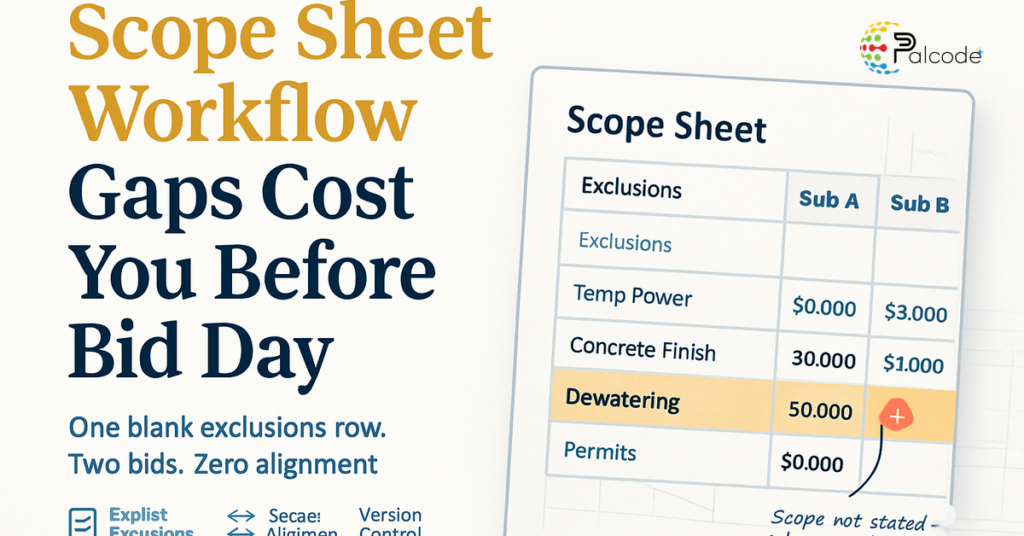
You’ve probably run into this already: bids come in across a wide range, two subs priced completely different scopes, and now you’re chasing clarifications instead of leveling numbers. That gap usually traces back to the scope sheet, specifically what it captured before pricing started. If your current workflow is a static checklist that one estimator fills out alone, it’s already missing the conditions that cause the most expensive misalignments.
This isn’t a writing exercise. A scope sheet workflow built for bid cycles has to do real structural work: capturing exclusions and assumptions early, standardizing what every estimator reviews, and building in enough stakeholder input that nothing critical gets priced inconsistently across a trade package.
Why Most Scope Sheet Workflows Break Down Before Bids Arrive
The most common failure isn’t a missing field. It’s that the scope sheet reflects one person’s interpretation of the project on a single day, with no mechanism to challenge or validate that interpretation before the ITB goes out.
Incomplete scope capture is the real risk in pre-bid work. A structured scope statement process defines objectives, deliverables, exclusions, constraints, assumptions, and approvals before pricing begins. That’s a materially different artifact than a checklist a senior estimator fills out from memory the morning bids are due.
When exclusions aren’t stated explicitly, subs and estimators fill the gap with assumptions. Those assumptions don’t align. And when pricing comes back, you’re comparing bids that don’t actually represent the same scope, which means your scope gap analysis during bid comparison is doing damage control instead of routine review.
What a Real Scope Sheet Workflow Requires
A repeatable structure across every bid
Different estimators interpreting the same project differently is a process problem, and a consistent format is the fix. The workflow should follow the same structure for every project: goals, deliverables, timeline, stakeholders, and a section specifically for exclusions and constraints. Repeatable structure isn’t about bureaucracy. It’s what lets you level bids with confidence because every sub received the same understood scope.
Explicit exclusions, not assumed ones
One of the most expensive estimating errors is pricing work that was never actually included. Good scope documents state out-of-scope items, exclusions, and assumptions as named, listed items, not buried in prose. That single practice prevents more scope creep misunderstandings than any other structural choice in the workflow.
A breakdown that matches how estimators actually price
Your workflow should move from high-level scope down into the specifics estimators need to put a number on: labor type, work conditions, trade-specific standards, permits, submittals, and closeout requirements. Starting at a high level and stopping there leaves too much for individual estimators to infer. That inference gap shows up directly in bid spread.
Stakeholder review built in, not optional
A scope sheet shouldn’t end with one person filling out a form. Involving the right stakeholders, validating the scope with them, and defining who has approval responsibility are the steps most teams skip because they feel slow. That’s the part most teams underestimate: the review step catches assumptions that a solo estimator would never know to flag.
Version control with a change record
Scope changes happen before bid day. The question is whether your workflow shows what changed, when, and who approved it. Without a version record, an addendum that modifies the original scope can go unrecognized by a sub who’s working from the original document. Maintaining version control and revisiting the scope document through the lifecycle of the bid cycle is not optional on anything but a very simple project.
Schedule context visible to estimators
Timeline and milestones belong in the scope document, not in a separate email chain. When estimators can see schedule dependencies and duration assumptions, they price accordingly. Without that context, you’ll get bids with conflicting duration assumptions built in, which surfaces as a pricing discrepancy that’s hard to unpack during leveling.
A Pre-Bid Scope Sheet Checklist You Can Use Now
Before the next ITB goes out, run your scope document against this list. Each item should be answered by the document itself, not by what someone on the team happens to know.
- Project objectives are defined in plain, measurable terms
- Deliverables are listed concretely, not described in category language
- Exclusions are stated explicitly as a named section
- Assumptions and constraints are documented, not implied
- Labor type and work conditions are captured early
- Permits, submittals, and applicable standards are included where relevant
- Timeline and milestones are visible within the document
- Stakeholder review and approval are part of the workflow, not an afterthought
- Version history is tracked, with changes tied to approvals
If four or more of those items depend on someone’s institutional knowledge rather than what’s written in the document, the workflow has a structural problem worth fixing before the bid cycle opens. A deeper look at preconstruction workflow gaps that affect margin can help frame where the scope sheet fits in the broader pre-bid process.
How AI Is Changing Scope Sheet Workflows in Practice
The most practical shift happening right now isn’t AI writing scope sheets from scratch. It’s AI extracting structured scope items directly from blueprint PDFs, grouping them by trade, and flagging what’s missing relative to a standard scope for that project type. That’s useful because the extraction step is where most manual scope sheet workflows lose time and introduce inconsistency.
Teams that have adopted this approach tend to report that the scope document is more complete before stakeholder review, not after. That changes the nature of the review from gap-filling to confirmation, which is a meaningfully faster meeting. The adoption reality is that most teams still use the AI output as a structured starting point, with an estimator validating it, rather than skipping review entirely. That’s a reasonable place to land for now, given where model accuracy is on trade-specific scope capture.
What it doesn’t solve is the approval and version control problem. That still requires a defined process, regardless of how the scope was first generated.
Read more
- Preconstruction Checklist: Is Your Process Losing Margin?
- Scope Gap Construction Bids: Find Missing Scope Fast
| Workflow Element | Static Checklist Approach | Structured Scope Statement Approach |
|---|---|---|
| Exclusions handling | Implied or omitted | Explicit named section, required before ITB |
| Stakeholder input | One estimator, no formal review | Defined review step with named approvers |
| Version control | Ad hoc, often email-based | Tracked changes tied to approvals |
| Schedule context | Separate document or verbal | Milestones embedded in scope document |
| Assumptions documented | Estimator-dependent | Required field, visible to all reviewers |
| Bid leveling impact | Wide spread, hard to reconcile | Tighter scope alignment, faster comparison |
Frequently Asked Questions
How long does it take to build a proper scope sheet workflow?
Most teams can build a functional structured workflow in two to three weeks if they start from a template and adapt it to their trade mix. The bigger time investment is the first few bid cycles using it consistently, since the value compounds as estimators and stakeholders internalize the format. Teams that treat it as a one-time setup rather than an ongoing process tend to see it drift back toward the checklist approach within a few months.
What’s the difference between a scope sheet and a scope of work?
A scope sheet is typically the internal estimating document used before and during the bid cycle to capture what’s included, excluded, and assumed for pricing. A scope of work is usually the formal document that flows to subcontractors or into a contract. The two should be consistent, but scope sheets are often more granular and trade-specific than the contract-facing scope of work.
Does AI-generated scope capture actually replace estimator review?
Not yet, in practice. AI tools that extract scope items from blueprint PDFs produce a useful structured starting point, but estimators still validate the output for trade-specific accuracy and project context. The real gain is speed on the extraction step and more consistent coverage before the first human review, not the elimination of that review.
What’s the cost of switching from a checklist to a structured scope workflow?
The upfront cost is mostly time: building the template, running a training session with estimators, and getting two or three bid cycles of practice in before the format feels natural. Dedicated scope sheet or scope extraction software typically runs from a few hundred to a few thousand dollars per month depending on team size and feature depth. Most teams find the first avoided scope dispute or leveling correction pays back that cost quickly.
Which roles should own scope sheet sign-off before an ITB goes out?
At minimum, the lead estimator and the project executive or preconstruction manager should both sign off. On complex multi-trade projects, trade-specific scope sections benefit from review by someone with field knowledge for that trade. The key is that sign-off is a named step in the workflow with a defined person, not an implicit assumption that the estimator covered it.
See How AI Pulls Structured Scope Directly from Your Blueprints
If your scope sheet workflow still depends on estimators reading through full drawing sets and manually building out scope by trade, you’re spending time your bid cycle doesn’t have. Palcode.ai’s Scope Sheet Generation extracts structured scope items per trade directly from blueprint PDFs, so your team starts stakeholder review with a complete first draft rather than a blank form. Book a demo to see how it works on a real project type your team bids.