You’ve probably run into this already: a subcontractor comes in with a number that looks off, and when you dig into it, the scope sheet didn’t say what you thought it said. Maybe the firestopping responsibility was implied but never assigned. Maybe exclusions were used to paper over a real gap instead of resolving it. The scope sheet looked complete, but it wasn’t defensible when it needed to be.
That’s the core evaluation problem. A scope sheet isn’t judged by how long it is or how many line items it has. It’s judged by whether it can stand up to a bidder’s question, a change order dispute, or an interface conflict between trades.
What a Scope Sheet Is Actually Supposed to Do
A good scope sheet serves three distinct functions. It tells the subcontractor what’s included and what’s excluded. It also defines where that subcontractor’s work stops and the next trade’s begins.
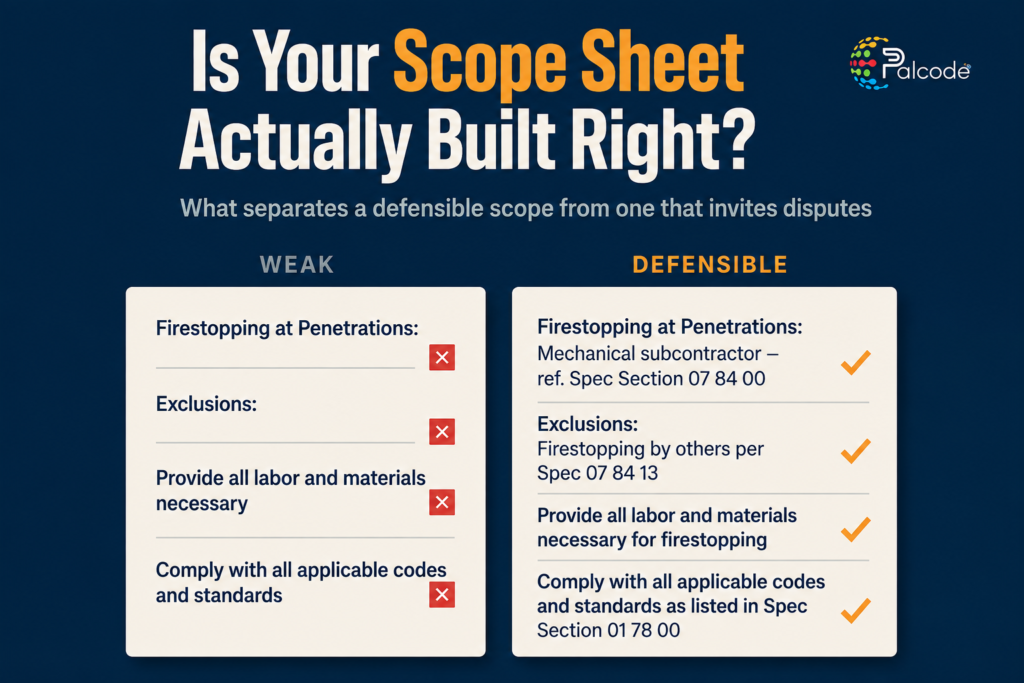
That third function, the handoff boundary, is the one most scope sheets skip or treat as obvious. It isn’t. Backing for toilet accessories, firestopping at penetrations, access panels, trims, and patching after rough-in are all classic interface items that fall through the cracks when no one names them explicitly. The document also needs to point back to actual contract documents, so the scope is traceable and defensible rather than just descriptive.
Signs Your Scope Sheet Is Actually Working
A few specific traits consistently separate strong scope sheets from weak ones. The scope should be built from the current drawing set and specifications, not copied forward from a prior project with light edits. It should be organized by trade or package, with one scope per trade and no language blurry enough to apply to more than one.
Named boundaries matter more than most teams acknowledge. The document should state, explicitly, where one subcontract ends. Explicit exclusions belong here too, but only to clarify what’s not included, not to hide scope that was never resolved. Sheet numbers, spec sections, and addenda dates should be cited where the scope references design intent, so the reader can verify the source.
One useful test from Provision AI’s scope-gap guidance: “per plans and specs” is weak language. Every clause should be traceable to a drawing, detail, or specification reference. If you can’t point to the exact sheet or section, the wording probably needs revision before issue.
The Warning Signs That Are Easy to Miss
The most common failure is vagueness dressed up as thoroughness. Phrases like “provide all labor and materials necessary” with no tie to project documents invite disputes rather than prevent them. Equally problematic is the scope sheet that over-relies on exclusions as a substitute for actually defining the work.
Other red flags worth checking:
- The same responsibility appears in more than one trade scope without a clear assignment.
- Interface items like backing, penetrations, or access panels aren’t addressed anywhere.
- The scope doesn’t distinguish between items clearly shown in drawings versus items that are reasonably inferred.
- Coordination obligations, phasing constraints, and submission requirements are missing entirely.
- There’s no formal review step before issue, so errors stay hidden until pricing or construction.
That last point is the one most teams underestimate. A scope sheet that was never reviewed by someone senior before it went out carries every error all the way to award.
A Practical Review Framework Before You Issue
One way to evaluate completeness is to organize the scope into four buckets. Explicit scope covers items clearly shown in drawings or specs. Inferred scope addresses items not drawn in detail but reasonably required for completion. Coordination scope captures interfaces with other trades and phasing sequences. General requirements cover submission, safety, testing, and closeout obligations.
If any of those four buckets is empty, the scope sheet likely has a gap. This structure also helps reveal whether scope gaps in the bid set are concentrated in one trade package or spread across several.
Before issuing, run through these six questions:
- Does every major line item map to a single trade, with no ambiguity about ownership?
- Are sheet numbers, spec sections, and addenda references current and specific?
- Have the handoff points between trades been named, not assumed?
- Are exclusions being used to clarify, not to substitute for missing scope?
- Does the scope tell bidders how to respond, including clarification format and alternates?
- Has someone with senior review authority signed off before issue?
A “no” on any of these means the scope isn’t ready.
Where Scope Sheet Problems Actually Surface
Poorly built scope sheets don’t usually announce themselves during the bid window. They show up as low bids that missed something, or high bids from subs who priced the ambiguity, or change order claims during construction that reference a clause nobody can defend. The cost isn’t abstract. It’s real dollars paid to resolve what should have been specified upfront.
Provision AI recommends forcing ambiguity to the surface during the bid window itself, through pre-bid calls and time-stamped assumption emails. That approach converts vague scope language into documented assumptions before award, which is far easier to manage than a mid-project dispute. This is also where preconstruction workflow discipline pays off: a structured review process before bid issue catches the same problems a change order would otherwise resolve at full construction cost.
How AI Is Changing Scope Sheet Production
The manual process of extracting scope line items from blueprint PDFs, trade by trade, is genuinely slow. On a mid-size commercial job, building accurate scope sheets for 15 to 20 trades can consume days of estimator time, and the output quality still depends heavily on who did the work and how much time they had.
AI document intelligence tools are starting to change that. Systems that parse drawing sets and generate structured, trade-specific scope items directly from PDFs reduce the time spent on first-pass extraction. The more realistic near-term benefit isn’t speed alone. It’s consistency: a machine-extracted scope sheet based on current drawings is less likely to carry forward assumptions from a prior job than one built from a template. The technology doesn’t replace the senior estimator’s judgment on interfaces and exclusions. It handles the extraction layer that consumes the most time before that judgment can even be applied.
Read more
- Scope Gap Construction Bids: Find Missing Scope Fast
- Preconstruction Checklist: Is Your Process Losing Margin?
| Evaluation Criterion | Strong Scope Sheet | Weak Scope Sheet |
|---|---|---|
| Source of scope language | Built from current drawings and specifications | Copied from prior project template with light edits |
| Trade assignment | One scope per trade, clear single-owner lines | Blurry language that could apply to multiple trades |
| Interface items | Backing, penetrations, and access panels explicitly assigned | Interface items assumed or absent |
| Exclusions | Used to clarify what is not in scope | Used to paper over unresolved or missing scope |
| Document traceability | Sheet numbers and spec sections cited throughout | Per plans and specs used as a substitute for real references |
| Pre-issue review | Senior review completed before bid issue | No formal review; errors surface during pricing or construction |
| Bid window management | Ambiguity forced to surface via pre-bid calls and assumption emails | Ambiguity left open until award or construction |
Frequently Asked Questions
How long should a scope sheet be for a commercial construction project?
Length depends on the complexity of the trade package, not a target page count. A mechanical scope for a mid-size commercial job might run several pages to cover equipment, coordination items, and phasing constraints, while a simpler architectural trade could be adequately covered in one. The right length is whatever it takes to define the included work, explicit exclusions, and handoff boundaries without leaving anything to assumption.
What’s the most common mistake estimators make when writing scope sheets?
Copying scope language forward from a prior project is probably the single most common source of errors. The prior project’s drawings, spec sections, and trade package assumptions rarely match the current job exactly, and outdated language can imply responsibilities that don’t apply or miss ones that do. Building from the current issue of the drawings catches this before it becomes a pricing or construction problem.
Can AI tools actually generate scope sheets, or do they still need significant manual review?
Current AI tools can reliably handle first-pass extraction of scope items from blueprint PDFs, particularly the structured, trade-specific line items that consume the most estimator time. The parts that still need senior judgment are interface assignments and coordination obligations between trades. Think of it as a division of labor: AI handles the extraction layer, the estimator handles the decisions that require project-specific context.
How much does scope sheet software typically cost, and is it worth it for smaller GCs?
Purpose-built scope generation tools generally run from a few hundred to several thousand dollars per month depending on seat count and features. For smaller GCs, the breakeven question is usually framed as staff time: if one estimator spends two to three days per bid cycle on scope extraction alone, that time cost often exceeds monthly software costs within a single project. The more relevant variable is bid volume, since efficiency gains scale directly with how many packages need scope sheets per month.
How do you handle scope sheets when addenda change the drawings after the initial scope is issued?
Addenda that affect scope need to trigger a revision to the affected trade scopes, not just a blanket “see addendum X” note. The revised scope should update specific clause references and cite the new sheet or spec section. Tracking which clauses changed and why matters for the bid record, since bidders seeing a revised scope mid-window need to know what actually changed rather than re-reading the entire document.
See What Scope Sheet Generation Looks Like When the AI Does the Extraction
If your estimators are still pulling scope items manually from PDFs, trade by trade, the time cost adds up fast across a full bid cycle. Palcode.ai’s Scope Sheet Generation reads your blueprint PDFs directly and outputs structured, trade-specific scope items, so your team starts from a defensible first draft instead of a blank template. Book a demo to see how it handles a real drawing set.