
You’ve probably run into this already: three bids come in, one is noticeably lower than the others, and everyone in the room wants to know why. Sometimes the answer is genuine efficiency. More often, that sub excluded a material scope item, priced a different fixture spec, or assumed the GC carries insurance costs that every other bidder folded into their number. The bid leveling process exists to surface exactly that difference before it becomes a change order.
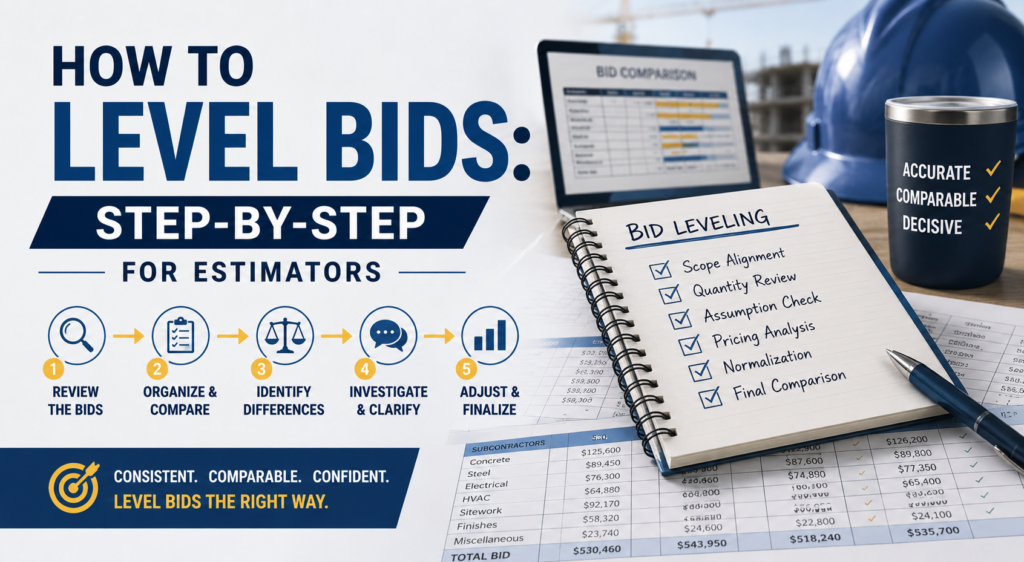
Bid leveling is the structured process of normalizing subcontractor proposals against a single, agreed-upon scope baseline so that every number you’re comparing reflects the same work. Done right, it turns a set of apples-to-oranges quotes into a true competitive ranking. Done poorly, or skipped entirely, it leaves real cost exposure buried in the exclusions section of whatever bid you award.
Why the Lowest Number Is Often the Wrong Number
The core problem with reading bids at face value is that the low bidder frequently gets there by excluding something. Those gaps don’t show up until the project is underway. That’s when the sub submits a change order for an item they never priced, and the owner’s contingency takes a hit that was entirely preventable.
Line-by-line review across all bidders tends to surface discrepancies that a quick read of each bid individually would miss entirely. That’s the part most teams underestimate. It’s not about being diligent enough on any single proposal; it’s about what only becomes visible when you lay them side by side against a fixed scope baseline.
How to Level Bids: The Six Core Steps
Step 1: Lock Down a Granular Scope of Work Before Bids Go Out
The leveling process starts before a single bid is received. If your scope is vague, subcontractors will fill in the gaps with whatever assumptions benefit their price, and you’ll spend the back half of bid review trying to reverse-engineer what each of them actually included.
A scope line like “Install lighting” isn’t workable at this stage. A leveling-ready scope line specifies fixture type, quantity, and labor expectations. Testing requirements and insurance obligations need to be spelled out separately, in their own lines. Every division should be broken into specific deliverables and system-level responsibilities. This baseline becomes the row structure of your leveling sheet, so the more granular it is, the more defensible the comparison becomes.
Step 2: Build a Standardized Leveling Sheet
Don’t let subcontractors’ formats drive your review. Their proposal layouts will vary, and if you try to compare them on their own terms, you’re already working against yourself.
Set up your sheet with scope baseline items as rows on the left and bidders as columns across the top. Below the main matrix, include a section for submitted totals and plug adjustments for omissions. The final normalized totals go below that. Whether you’re using Excel or dedicated bid leveling software for construction, the structure should be yours, set before you open the first proposal, not adapted after the fact to match whatever came in.
Step 3: Analyze Inclusions and Exclusions Line by Line
This is where the actual bid analysis happens. For every row in your scope baseline, mark each bidder’s position with one of three designations:
- INC — the item is included, either explicitly stated or reasonably implied by the bid language
- EXC — the item is explicitly excluded in their proposal
- UNCLEAR — the bid is ambiguous and requires a clarification before you can score it
Then look for the mismatches. Bid A includes site paving; Bid B excludes it. One sub has a testing allowance; another doesn’t mention it. These discrepancies are exactly what the leveling sheet is built to expose. Reviewing each bid in isolation, you’d likely miss half of them.
Step 4: Plug Omissions to Normalize the Totals
When a bidder excludes an item that the scope requires, you don’t disqualify them. You add a plug. A plug is a reasonable cost estimate for the excluded item, sourced from market rates or historical data, added to that bidder’s total to make the comparison fair.
The formula is straightforward: leveled price equals stated price plus the sum of each omitted item priced at a benchmark unit cost. Document where each plug number came from. That audit trail matters when someone asks why Bidder C’s normalized total is $47,000 higher than their submitted price, and it protects you if the award is later questioned.
If a scope gap creates real project risk beyond just a pricing adjustment, treat it separately rather than folding it into the plug total. The bid leveling template structure you use should have a dedicated column for risk items so the distinction stays visible.
Step 5: Issue Targeted Clarifications in Writing
Before you finalize any numbers, resolve the UNCLEAR items. Send written questions to the relevant subcontractors, and be specific. Reference the exact drawing sheet or specification section when you can. A question like “Please confirm scope” gets a useless answer. A question like “Your proposal doesn’t address the rooftop condensate drain shown on M-401. Is that included in your mechanical scope?” gets a real one.
Keep each clarification email short. A long list of questions tends to produce a long list of vague answers. Limit each round to the material issues, and update the leveling sheet immediately when a response comes back. Relying on memory to reconcile clarifications with a spreadsheet later is where things quietly go wrong.
Step 6: Calculate Normalized Totals and Rank the Bidders
Once you’ve entered original pricing, added plugs for omissions, and logged the results of clarifications, the normalized bid for each subcontractor is: submitted price plus the sum of plugs plus any adjustments from clarification responses. Simple arithmetic, but only meaningful if the inputs are clean.
Rank the bidders by that normalized total, not by their submitted price. The ranking often looks quite different from the raw numbers. A bidder who came in 8% below the field can easily land in the middle of the pack once their exclusions are priced in. Run the completed leveling sheet through a final review with your operations team before making an award. Price is one input; completeness of scope coverage is another, and the two don’t always point the same direction.
Practical Notes on Making the Process Work
Every plug and assumption in your leveling sheet should have a visible note explaining the logic. If a different estimator picks up the file three weeks later, the reasoning needs to be self-explanatory without a verbal briefing.
Completeness of assumptions matters as much as price accuracy. A bidder whose scope assumptions align closely with yours is lower-risk than one who came in cheaper by carrying a narrower interpretation of the drawings. That alignment is worth factoring in before you sign a subcontract, not after.
How AI Is Changing the Bid Leveling Steps
Most estimating teams still run this process in Excel, and the manual version works. It just takes time. On a large trade package with four or five bidders and a detailed scope, leveling can consume a full day or more of estimator capacity per trade. That’s a real constraint when bid cycles compress and multiple packages close simultaneously.
AI-assisted tools are starting to handle the document parsing side of this: pulling line items from subcontractor proposals into a structured comparison format automatically and flagging inclusions and exclusions without manual entry. Accuracy is good enough now that it’s changing how teams staff bid review. The judgment calls on plug values and risk treatment still require an experienced estimator. What automation is genuinely removing is the rote extraction work, which frees up that estimator capacity for the decisions that actually require it.
Frequently Asked Questions
What’s the difference between bid leveling and bid comparison?
Bid comparison is simply reviewing multiple proposals side by side. Bid leveling goes further by normalizing each proposal against a fixed scope baseline, adding plugs for excluded items, and resolving ambiguities through written clarifications. The result is an adjusted total for each bidder that reflects identical scope coverage, not just a ranking of numbers as submitted.
How long does the bid leveling process typically take?
On a complex trade package with four or five bidders and a detailed scope, manual leveling in Excel can take a full day or more per trade. Simpler packages with fewer line items tend to move faster, often a few hours. Teams using software that auto-parses bid documents cut that time meaningfully, though finalizing plug values and reviewing clarification responses still requires an estimator’s judgment regardless of the tool.
What is a ‘plug’ in bid leveling?
A plug is a cost estimate added to a bidder’s total for a scope item they excluded from their proposal. It’s priced using market rates or historical data and documented with its source. Rather than penalizing a bidder by disqualifying them for an omission, you price in the gap so all normalized totals represent the same scope of work.
Do I need special software to level bids, or does Excel work?
Excel works for most teams and is still the dominant tool for manual bid leveling. The real tradeoff is setup time and the risk of formula errors when managing multiple bidders across a large scope. Purpose-built bid leveling software can auto-populate the comparison matrix from bid documents and flag discrepancies automatically, which matters most when your team is handling several packages at once under a tight bid cycle.
When should I issue clarifications versus just adding a plug?
Use a plug when a scope item is clearly excluded and the cost to add it back is straightforward to estimate from market data. Issue a clarification when the bid is genuinely ambiguous and you can’t tell whether the item was included or interpreted differently. Plugging an unclear item without asking risks mispricing it, and the clarification response often reveals an assumption that changes the comparison materially.
See How Bid Leveling Works With AI Behind It
If your team is manually building leveling sheets for every trade package, Palcode.ai is worth a closer look. The platform parses subcontractor proposals, structures the comparison matrix automatically, and flags scope gaps so your estimators spend their time on decisions rather than data entry. Book a demo to see how it fits into your actual bid review workflow.