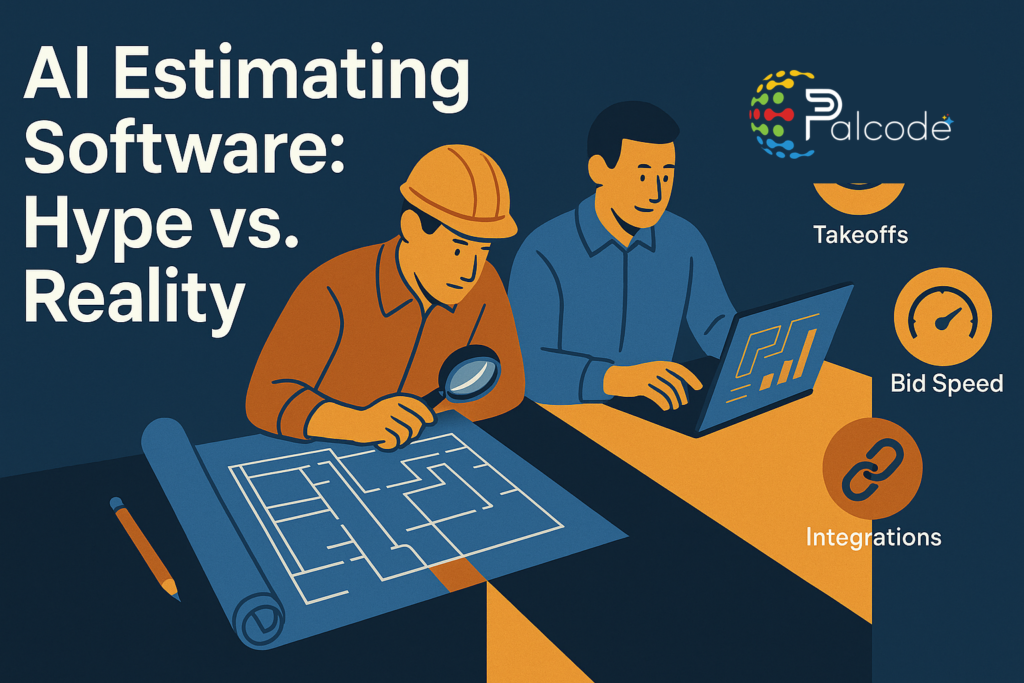
You’ve probably run into this already: a vendor demo showing flawless AI takeoffs on a clean residential floor plan, followed by a pitch promising 98% accuracy and zero estimator involvement. Then you get back to your desk and wonder how any of that applies to a mixed-use commercial project with 14 trade packages and a six-week bid window. That gap between the demo and your reality is exactly where this evaluation lives.
The good news? AI estimating software for construction has matured enough to deliver real, measurable value on the right workflows. The frustrating part is the market is still full of overreach. Here’s how to tell the difference.
Where AI Estimating Software for Construction Actually Stands in 2026
Top-100 general contractors now exceed 60% adoption of AI estimating tools, and the technology has crossed the 95% accuracy threshold that makes outputs trustworthy without exhaustive manual re-checking. That’s a real milestone. Historically, any AI output below that threshold required so much validation time that the labor savings evaporated.
The functions where AI has proven its value are specific: quantity takeoffs using computer vision, cost modeling against historical data, and bid preparation speed. Those three areas alone used to eat up 50–80% of preconstruction bandwidth. A peer-reviewed study found AI tools improve estimate accuracy by over 20%. Completion time dropped roughly in half. Independent benchmarking shows more grounded figures — InEight Estimate coming within 1.8% of ground-truth and STACK within 3% of baseline on tested project types.
Those numbers matter more than marketing claims. That’s the part most teams underestimate when evaluating software.
The Best AI for Construction Estimating: A Real Platform Breakdown
The market has consolidated around a handful of credible platforms, but they’re built for very different buyers. Matching the tool to your actual project mix matters more than chasing the highest headline accuracy figure.
Togal.AI was built by estimators for estimators, and it shows in how it handles computer vision on floor plans. Their claimed 98% accuracy on floor plan takeoffs is possible — but it requires validation against your specific project types. It’s not a universal number.
InEight Estimate is the enterprise choice. It’s the platform with the strongest independently tested accuracy — that 1.8% ground-truth variance — but it comes with an enterprise price tag and a setup footprint to match. If you’re a top-50 GC evaluating platforms, it belongs on your shortlist. Smaller shops may find the cost structure hard to justify.
STACK performs well on commercial takeoffs and tested within 3% of baseline independently. Its limitation is integration depth. Without connecting it to your project management and ERP systems, you’re adding a layer rather than replacing one.
Kreo sits in an interesting middle spot — compelling features at a more accessible price point for mid-size firms. Its PDF and machine vision capabilities are strong. The cost module needs validation before you rely on it for contractually binding estimates.
Buildxact is worth a freemium trial if your workflow is heavily PDF-based, but its AI takeoff depth doesn’t hold up for complex commercial work. Handoff.ai is the clearest pick for residential remodelers with client-facing feature needs, and it shouldn’t be evaluated against commercial estimating platforms. Different tool, different job.
The highest-value AI construction cost software in any category connects to AI takeoff workflows that feed directly into project management platforms like Procore and scheduling systems. Without those integrations, you’re creating a parallel workflow rather than replacing one.
AI vs Traditional Estimating: Where the Real Tradeoffs Sit
The AI vs traditional estimating debate has mostly been settled in AI’s favor for takeoff labor. With the right tool on the right project type, a 70–90% reduction in takeoff hours is achievable. Teams that integrate properly — rather than bolt AI on top of existing manual processes — can realistically hit 8–12x ROI within the first 12 months.
Where traditional estimating still wins is judgment. AI accelerates detection of quantities and flags missing items, but it’s not contractually defensible without human oversight on those calls. The practical model is hybrid: AI handles the computational load, experienced estimators handle interpretation and sign-off. Tools that are transparent about what they’ve assumed — and flag those assumptions for review — are the ones worth buying.
Scope gap detection is one concrete example. An AI tool that surfaces a missing fire suppression scope item from a drawing set is genuinely valuable. One that confidently misclassifies a structural element without flagging the uncertainty? That creates a much more dangerous problem than a manual takeoff would have.
Claims Worth Ignoring
“No human oversight needed” is the most dangerous one. Any tool making this claim is describing a workflow that’s neither practical nor defensible on a commercial project. The tools that highlight assumptions and record them for team review are the ones actually built for estimating work.
“98% accuracy out of the box” needs context. Accuracy improves as a system learns from your specific project history and document types. Baseline performance on unfamiliar project types tends to land in the 85–90% range, which is still useful — but it’s not the headline number.
General-purpose AI tools like ChatGPT or Claude can parse specifications and generate preliminary cost summaries. That’s real utility for early-stage work. But they don’t do automated takeoffs, don’t have real-time pricing updates, and missing-item flagging isn’t there either. They’re useful for parsing. They’re not a substitute for a specialist estimating platform when accuracy and scope completeness matter.
How to Actually Choose: Practical Evaluation Criteria
Before you schedule demos, get specific about your biggest pain point. Takeoff labor, scope coverage gaps, and bid preparation speed all point toward different platform priorities.
- Demand independent benchmark data — not just vendor-provided accuracy claims. InEight’s 1.8% variance figure exists because someone tested it against ground-truth.
- Verify integration compatibility with your existing PM and ERP stack before signing anything. Integration gaps don’t show up in demos.
- Run a hybrid workflow from day one. Keep estimators in control of interpretation and use AI for the computational work.
- Track how the tool handles unfamiliar project types. Accuracy on your first five projects will be lower than accuracy on your fiftieth.
Carbon tracking is also becoming a real evaluation criterion. Some platforms are beginning to track embodied carbon alongside cost. If your clients or markets are moving toward carbon reporting requirements, that capability is worth factoring in now rather than later.
Where AI Construction Estimating Is Heading
The near-term trajectory is integration depth, not accuracy gains. Most platforms are already close enough on accuracy to meet practical needs. The differentiator over the next 18–24 months will be how well AI estimating feeds into BIM environments, scheduling, and real-time cost benchmarking. Teams that adopt now and accumulate project history will have a meaningful head start — model accuracy compounds with data.
The firms getting real ROI are the ones treating AI as a force multiplier for experienced estimators. Full automation without human validation isn’t a near-term destination for commercial work. Any vendor telling you otherwise is selling something the technology doesn’t yet support.
| Platform | Best Fit | Independently Tested Accuracy | Cost Tier | Key Limitation |
|---|---|---|---|---|
| InEight Estimate | Large GCs, enterprise | Within 1.8% of ground-truth | Enterprise (higher cost) | Setup footprint excludes smaller firms on budget |
| STACK | Commercial takeoffs | Within 3% of baseline | Mid-range | Integration depth with PM systems needs verification |
| Togal.AI | Estimators, floor plan-heavy work | Claims 98%; validate against your project types | Mid-range | Commercial depth requires project-specific validation |
| Kreo | Mid-size firms, residential | Not independently published | More accessible | Cost module needs validation before binding use |
| Buildxact | Small contractors, PDF workflows | Not independently published | Freemium available | Limited AI takeoff depth for commercial projects |
| Handoff.ai | Residential remodelers | Not independently published | Lower tier | Not suited for commercial estimating workflows |
Frequently Asked Questions
How accurate is AI estimating software for construction compared to manual takeoffs?
Independent testing puts the best commercial platforms within 1.8–3% of ground-truth on tested project types, which typically beats manual takeoffs on speed and is competitive on accuracy for familiar project types. A peer-reviewed study found AI tools improve estimate accuracy by over 20% compared to traditional methods. Baseline accuracy on unfamiliar project types tends to land in the 85–90% range and improves as the system learns from your historical data.
What does AI estimating software typically cost, and is it worth it for mid-size GCs?
Enterprise platforms like InEight sit at the higher end of the market. Mid-range tools like STACK and Togal.AI are more accessible, and Buildxact offers a freemium trial. For mid-size GCs, the ROI case is real — teams that integrate properly typically see 8–12x return within the first 12 months, driven by takeoff labor reductions in the 70–90% range. Integration costs and learning curve time should factor into your budget planning alongside the license fee.
Can general-purpose AI tools like ChatGPT replace construction estimating software?
For preliminary spec parsing and rough quantity generation, general-purpose AI has genuine utility. It can’t replace specialist platforms for contractually defensible estimates because it lacks automated takeoffs, real-time pricing data, and scope gap detection. The pragmatic approach is using free AI tools for early-stage spec review while relying on a specialist platform for anything that ends up in a bid.
How long does it take to get reliable results from AI estimating software after implementation?
Most platforms deliver usable output from day one, but accuracy on your specific project types improves meaningfully over the first several months as the system learns from your historical data. Teams that run hybrid workflows from the start — keeping estimators reviewing AI assumptions rather than expecting full automation immediately — tend to reach reliable performance faster. Expecting production-level accuracy on the first unfamiliar project type is where most early implementations run into trouble.
Do AI estimating tools work for commercial construction or mainly residential?
Several platforms are built specifically for commercial work, with InEight and STACK being the clearest examples backed by published benchmark data on commercial project types. Togal.AI also handles commercial work, though its strongest results are on floor plan-heavy workflows. Handoff.ai and Buildxact are better suited to residential and small contractor needs. That distinction matters — commercial estimating involves multi-trade scope management that residential-focused tools aren’t designed to handle.
See How AI Estimating Fits Your Preconstruction Workflow
If this evaluation raised more questions about where AI actually fits in your bid process, that’s a useful signal. Palcode.ai works directly with GC preconstruction teams to show how AI-powered scope extraction, bid leveling, and budget integration work against real project documents — not sanitized demos. Book a call to see it running on your actual workflow.
About the Author
Mohit is the Founder and CEO of Palcode.ai — an AI-powered platform helping general contractors automate preconstruction, sub outreach, and bid management. Before building Palcode, he spent years inside the problem, watching estimators lose weeks to manual follow-ups that software should have handled a long time ago. Explore More Blogs Here.