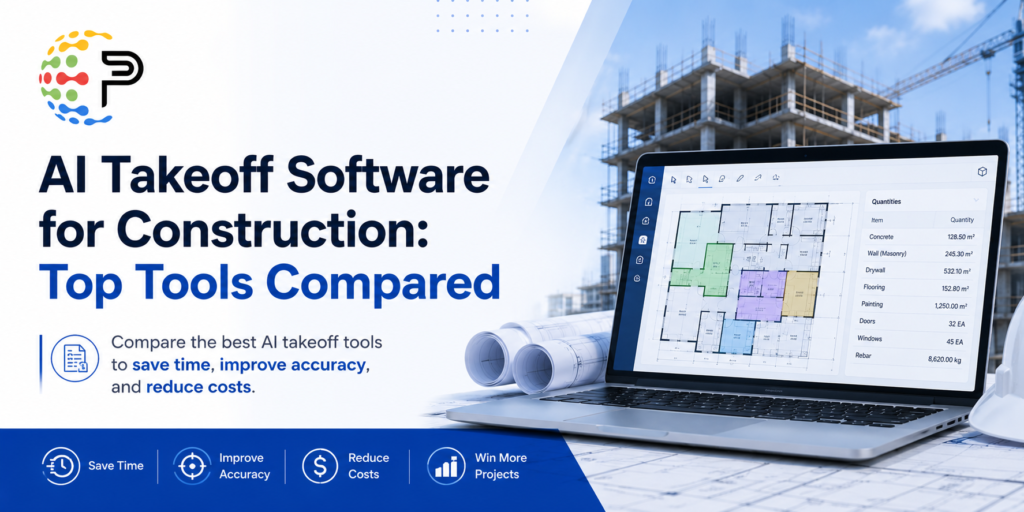
If you’re still scaling floor plans by hand or clicking through PDFs with a manual tool, you’ve probably felt the gap widen between what your team can realistically produce in a week and what the job pipeline demands. AI takeoff software for construction has moved well past the pilot stage. Several platforms now consistently report 95–98% accuracy on floor plans and cut takeoff time by 50–80% compared to manual methods. The real question isn’t whether to adopt one. It’s which one is actually built for how your estimating team operates.
What Separates True AI Takeoff Tools from Older Autocount Software
This distinction matters more than most comparisons acknowledge. Tools like PlanSwift use autocount functionality, but that’s rule-based pattern matching, not machine learning. True AI takeoff platforms detect room boundaries, interpret spec legends, and cross-reference data across drawing sheets without requiring manual input at each step.
You’ve probably run into this already: a legacy tool counts lineal feet fine on a clean plan, then falls apart when drawings have overlapping layers or unconventional symbols. That’s precisely where the newer platforms pull ahead, and the output quality difference becomes visible fast when you’re working through a mixed drawing set on a tight deadline.
Read More : How to Create and Manage a Construction Submittal Schedule
The Leading AI Takeoff Software for Construction Estimators
Below is a breakdown of the six platforms that consistently come up when estimating teams are actively comparing options. Each has a distinct positioning, and the differences are meaningful enough to affect the buy decision.
Togal.AI
Togal.AI is probably the most cited platform in this category right now. It reports 98% accuracy on floor plans and delivers takeoffs roughly 5x faster than manual methods. The software was built by estimators, which shows in how it auto-detects, measures, and labels rooms, walls, and fixtures without requiring the user to define every element first. That kind of automatic recognition saves real time on mid-size commercial projects where you’re working through dozens of sheets.
The limitation worth knowing: complex 3D drawings or non-standard symbols can require manual override. It’s not a dealbreaker for most projects, but it does mean you won’t fully eliminate review time on unusual drawing sets.
Beam AI (iBeam)
Beam AI takes a fundamentally different approach. Rather than giving estimators a self-service interface, it functions more like an outsourced AI-powered takeoff service with QA review built into delivery. Accuracy sits at approximately plus or minus 1% of in-house results, and outputs arrive within 24–72 hours depending on project complexity.
Teams using it report saving 15–20 hours per week, which translates to bidding roughly 3x more jobs with the same staff. That’s the part most teams underestimate when evaluating cost per takeoff. Beam AI is best suited for high-volume residential or commercial estimators who need bid-ready precision without building internal AI competency from scratch.
Kreo Software
Kreo targets the full estimating workflow, not just quantity extraction. It cross-references data across drawing sheets and auto-generates bills of quantities from a PDF or CAD upload. The reported speed advantage is significant: bids completed 10x faster than traditional methods. Pricing starts around $129/month, which makes it accessible for smaller teams that need integrated takeoff and cost estimation without a per-seat enterprise contract.
eTakeoff with SnapAI and Togal.AI
eTakeoff’s dual-AI approach is genuinely differentiated from everything else in this comparison. It pairs SnapAI, which handles pattern recognition for lines and measurement points, with Togal.AI for room-level detection. The combination covers edge cases that either tool would miss alone, and estimated time savings land around 50% compared to manual takeoffs.
If your projects regularly involve mixed drawing quality or incomplete plan sets, this pairing deserves serious consideration. Single-method AI tools tend to degrade faster on messy inputs, and that’s exactly where eTakeoff’s dual approach holds up.
Handoff
Handoff positions itself as an all-in-one platform merging AI estimating with broader business management, from lead tracking through to payment. The appeal for small-to-mid firms is consolidation: replacing three to five separate software subscriptions with one. Pricing is custom bundled, so evaluating ROI requires a direct conversation rather than a published rate card.
CountBricks
CountBricks targets material quantity accuracy specifically. It’s a spreadsheet replacement for estimators whose primary concern is margin protection on material costs. At $29/user/month it’s the most accessible entry point in this comparison, though the narrow focus means it won’t serve as a standalone solution for most commercial estimating workflows.
Know More : Electrical Contractor Bidding Software: Which One Is Right for You?
How AI Is Actually Changing Estimator Capacity
The productivity math isn’t abstract. When a platform cuts takeoff time by half or more, the downstream effect is that the same estimating team can pursue more work without adding headcount. That’s the actual ROI case, and it tends to be more compelling than accuracy percentages alone once you run the numbers against your current bid volume.
Adoption is also moving faster than most observers expected. Post-2023 AI takeoff tools already outperform the autocount functionality in legacy platforms, and the gap is widening as training data improves. The practical reality is that most teams start with one platform on a single project type, validate the accuracy on real drawings, then expand. Full replacement of manual review doesn’t happen immediately, and the vendors who set that expectation honestly tend to retain customers longer.
Integration is a legitimate factor in any evaluation. Platforms that connect with existing ERP systems, BIM environments, or estimating tools like Accubid reduce friction in the workflow handoff. A takeoff tool that outputs in a format your estimating software can’t ingest directly creates a different kind of manual work, just later in the process. That friction partially offsets the speed gains, so it deserves as much weight in the evaluation as accuracy does.
The cost of quantity takeoff errors compounds through the bid cycle in ways that often aren’t visible until a project is already underway, which is part of why the case for investing in the right automated tool tends to close quickly once teams actually run the comparison.
Which AI Takeoff Platform Is Right for Your Team?
The honest answer depends on two things: your volume and your drawing complexity. For pure takeoff speed on standard commercial floor plans, Togal.AI is the leading choice. For volume-driven accuracy with managed QA, Beam AI is the more reliable option. Kreo wins on integrated cost estimation. eTakeoff’s dual-AI setup handles the edge cases the others don’t.
Most platforms offer free trials in the 7–15 day range. Running a real project through the system, not a sample file, is the only reliable way to validate whether the accuracy claims hold on your specific drawing types. Budget another week after the trial to compare output against a manual check before committing to a subscription.
| Platform | Accuracy | Speed Advantage | Best Fit | Approx. Pricing |
|---|---|---|---|---|
| Togal.AI | 98% on floor plans | 5x faster than manual | Standard commercial takeoffs at scale | From $299/user/month |
| Beam AI (iBeam) | Plus or minus 1% of in-house results | Saves 15–20 hrs/week; bid 3x more jobs | High-volume estimators needing managed QA | Custom (service model) |
| Kreo | High (cross-sheet data) | 10x faster bids | Teams needing integrated cost estimation | From $129/month |
| eTakeoff with SnapAI | ~50% time reduction | Dual-AI covers edge cases | Mixed or incomplete drawing sets | Custom (patented AI) |
| Handoff | High | Unified workflow (lead to payment) | Small-to-mid firms consolidating tools | Custom bundle |
| CountBricks | High on material quantities | Faster material bidding | Material cost estimators replacing spreadsheets | From $29/user/month |
Frequently Asked Questions
How accurate is AI takeoff software compared to manual estimating?
Leading platforms like Togal.AI report 98% accuracy on floor plans, while Beam AI targets plus or minus 1% of in-house results with QA review built into delivery. Manual estimating accuracy shifts significantly based on estimator experience and drawing quality. The more meaningful comparison is consistency: AI tools produce repeatable outputs on high-volume drawing sets where human fatigue becomes a real factor.
How long does it take to get started with AI takeoff software?
Most platforms offer 7–15 day free trials, and setup is generally lighter than enterprise construction software because these tools are built around PDF or CAD upload workflows rather than deep system integration. That said, validating accuracy on your actual project types takes at least one full trial project. A sample file won’t tell you much about how the tool handles your specific drawing conditions.
What does AI takeoff software typically cost?
CountBricks starts around $29/user/month at the entry level. Kreo begins at roughly $129/month, and Togal.AI starts at $299/user/month. Beam AI and eTakeoff use custom pricing based on volume. The cost comparison only makes sense against time savings: a platform saving 15–20 hours of estimator time per week tends to pay for itself quickly against a per-user rate.
Can AI takeoff tools handle complex or non-standard drawings?
Platforms differ meaningfully here. Togal.AI handles standard floor plans well but may require manual overrides on non-standard symbols or 3D drawings. eTakeoff’s dual-AI approach, which pairs SnapAI with Togal.AI, was specifically designed to address edge cases that single-method tools miss. If your project mix regularly includes unconventional or incomplete plan sets, that distinction should drive your platform choice.
Do AI takeoff tools integrate with estimating software like Accubid or Autodesk?
Integration capability varies by platform and is worth verifying before committing. A takeoff tool that requires reformatting output before it enters your estimate adds friction that partially offsets the speed gains. The integration question deserves as much evaluation weight as accuracy does, so ask vendors specifically about export formats and any existing connectors before signing up.
See How AI Fits Into Your Actual Estimating Workflow
If you’re comparing AI takeoff software and trying to figure out where it connects to bid leveling, scope gap detection, or budget integration, Palcode.ai is built for exactly that handoff. Book a demo to walk through how your current preconstruction workflow maps to what the platform handles automatically. Book a Demo
About the Author
Shikha is a Senior Product Growth Marketer at palcode.ai, where she focuses on driving product adoption and improving user engagement through strategic, data-driven marketing. She contributes to product growth initiatives through market research, user behavior analysis, growth experimentation, and the development of best practices that help teams improve customer experience and product performance. Her work focuses on turning complex product concepts into actionable insights that support adoption, retention, and long-term growth. Explore More Blogs Here.