You’ve got three bids on a mechanical package. One comes in 18% lower than the other two. On paper, that’s a clear winner. In reality, it may be a setup for a brutal change order conversation six weeks into framing. That gap between the submitted number and the true cost of work is exactly what bid leveling in construction is designed to expose.
Bid leveling isn’t a formality. It’s the process that determines whether the number you’re awarding actually reflects the scope you need.
What Bid Leveling Actually Means
Bid leveling is the systematic process of reviewing and adjusting subcontractor proposals so they can be compared against a common scope of work. Every sub interprets drawings differently. Some include permits, others don’t. Cleanup is the same story: one sub prices it, the next assumes it’s someone else’s problem. Without normalization, you’re comparing assumptions. That’s it.
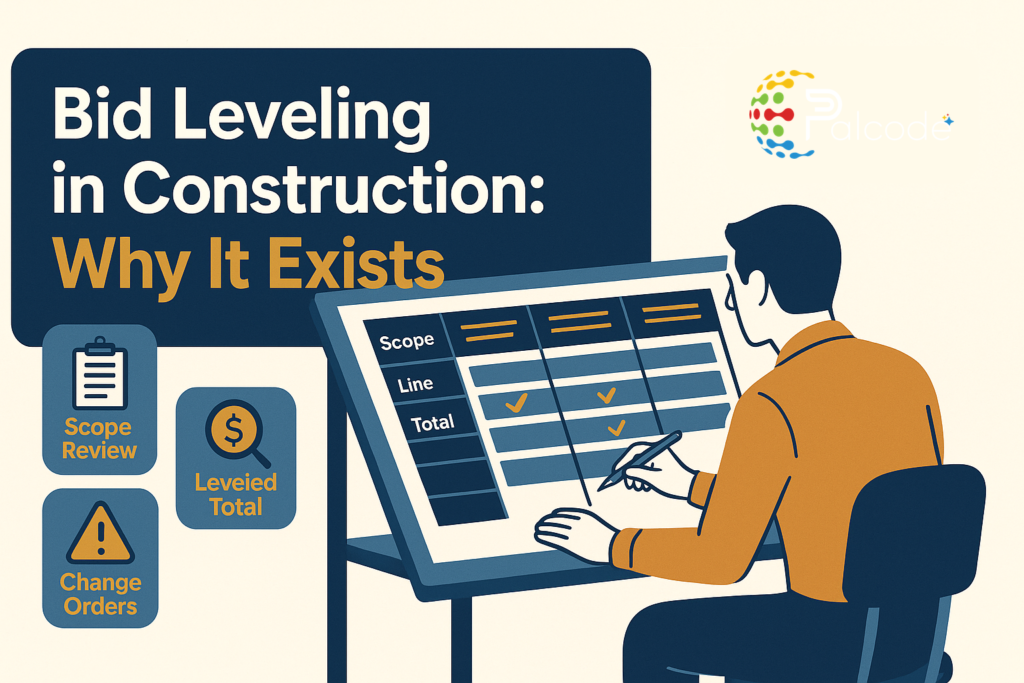
The output of a leveled review is usually a bid leveling matrix: a structured sheet with subcontractors across the columns and scope line items down the rows. Each cell captures whether a line item was included, excluded, or left ambiguous in that sub’s proposal. Dollar adjustments get applied to missing scope so that every bid reflects the same work, and only then do you compare totals.
That adjusted figure is sometimes called the “leveled total,” and it’s often meaningfully different from the submitted number. A sub who bid $340,000 might level out to $378,000 once excluded items are priced in. The sub who bid $361,000 might level to $364,000. Suddenly the decision looks different.
Why the Bid Leveling Process Exists in the First Place
The core problem is scope ambiguity. Construction documents, even well-coordinated ones, leave room for interpretation. A sub reading Division 23 specs will make judgment calls, and those calls won’t all land in the same place. Those calls aren’t always wrong, they’re just different across bidders. And different assumptions produce different prices for different scopes, which means you’re never actually comparing like to like unless you force it.
There’s also the competitive pressure issue. Subs who want to win work have an incentive to sharpen their pencil, sometimes by trimming scope rather than trimming margin. That’s not dishonest; it’s a rational response to a process that historically rewarded the lowest number without scrutinizing what that number covered. Bid leveling resets that dynamic by making scope coverage as visible as price.
Beyond cost, the process creates a documented record of what each bidder included at the time of award. That paper trail matters when disputes arise later. If a sub claims a line item was never in their scope, the leveling sheet from the bid phase is your first line of defense.
What Happens When You Don’t Level Bids
Most estimators already know this, but it’s worth being concrete about the failure modes. Skipping the bid leveling process doesn’t just introduce risk in the abstract. It tends to produce specific, expensive problems.
Change Orders That Didn’t Have to Happen
A sub who excluded permits, temporary power, or final cleaning from their bid will almost certainly come back for those items once work starts. Change orders for scope that was never priced into the award are consistently more expensive than if those items had been negotiated upfront. The leverage shifts entirely once mobilization has happened.
Award Decisions Based on Incomplete Information
Choosing the lowest bid without leveling is, at best, a guess dressed up as a number. You might get lucky. The low bidder might have actually covered the full scope and just operates leaner than competitors. But you won’t know that until it becomes a problem, and by then you’ve already signed the subcontract.
Scope Creep That Damages GC Margins
When a subcontractor wasn’t held accountable for the full scope at award, the project scope tends to expand during construction, not because anyone is acting in bad faith, but because gaps get filled at cost. That cost hits the GC’s margin directly, especially on GMP or lump-sum delivery where there’s no mechanism to pass it to the owner.
Schedule Disruption
Disputes over what was included in the original bid don’t resolve quickly. Work stops, or proceeds with uncertainty. Either way, the schedule takes the hit, and schedule delays compound costs in ways that often exceed the original scope gap.
The Bid Leveling Matrix: How Teams Actually Execute It
In practice, most GC estimating teams build their leveling matrix in a spreadsheet. The structure is straightforward: subs across the top, scope line items down the left, and a column for the “base” or owner budget to compare against. Each cell gets a check, a dollar value, or a notation for excluded or clarification-needed items.
After the matrix is populated, the estimator adjusts each sub’s total to reflect any missing scope, then ranks the adjusted figures. That ranking drives the shortlist, but qualitative factors weigh in too. The sub’s schedule, bonding capacity, and track record all get considered before anyone makes the cut. Building a functional bid leveling template requires thinking carefully about which line items to track and how granular to get by trade, and that setup work pays off across every future bid cycle.
One thing most teams underestimate: the clarification step. After initial leveling, most experienced estimators reach back out to subs on the two or three highest-value ambiguities before finalizing their recommendation. That conversation often surfaces a misunderstanding in the drawings rather than a deliberate exclusion, and resolving it early is significantly cheaper than resolving it in the field.
Where AI Is Starting to Change the Bid Leveling Process
Historically, bid leveling has been entirely manual. An estimator downloads subcontractor proposals, reads through each one, builds the matrix by hand, and spends hours reconciling scope across six or eight documents that don’t share a common format. On a complex project with 20-plus trades, that’s a multi-day effort, and it compresses badly against real bid deadlines.
AI-assisted document parsing is starting to absorb the extraction layer of that work. Rather than manually reading through a 40-page proposal to find what a sub included or excluded, newer tools can parse the document and surface inclusions, exclusions, and clarifications in a structured format. The estimator still makes the judgment calls, but the time spent on extraction drops substantially.
Adoption is still early. Many teams have tried one or two tools and found the accuracy inconsistent, particularly on handwritten or non-standard proposal formats. The tools that tend to work best in practice are the ones built specifically for construction bid documents rather than adapted from general document AI. That distinction matters more than most vendors will admit. For a closer look at how construction bid analysis is evolving with these tools, the gap between manual and AI-assisted workflows is widening faster than most estimating teams expected two years ago.
Who Actually Benefits Most From a Consistent Leveling Process
Any GC running competitive bids benefits. But the teams where bid leveling produces the most measurable return tend to be mid-size commercial GCs managing multiple projects simultaneously with a small estimating staff. When one estimator is covering three active bids, a consistent leveling format cuts the cognitive load significantly because the structure is already there and the questions being asked are the same every time.
Owners and developers also benefit, though they often don’t realize it. When a GC presents a leveled bid comparison rather than just a recommendation, it builds credibility and demonstrates that the award decision was defensible. That transparency tends to matter most on projects with owner oversight or public funding where the audit trail carries weight.
Frequently Asked Questions
How long does bid leveling usually take?
For a single trade with four to six bidders, a thorough leveling review typically takes two to four hours when done manually in a spreadsheet. Multi-trade leveling on a complex project can stretch to several days, which is one of the reasons AI-assisted extraction tools are gaining traction among teams with tight bid cycles.
What’s the difference between bid leveling and bid comparison?
Bid comparison looks at submitted numbers side by side. Bid leveling goes a step further by adjusting those numbers to reflect a common scope, so you’re comparing what each sub would actually cost for the same work, not just what they chose to price. You can compare without leveling, but the comparison is unreliable unless the scope is normalized first.
Does bid leveling software replace the estimator’s judgment?
No, and that’s worth being clear about. Software can accelerate the extraction of inclusions and exclusions from proposal documents, but the judgment calls about what scope gaps matter, how to price missing items, and which sub to recommend still belong to the estimator. The tools compress the data-gathering phase, not the decision-making phase.
What does bid leveling software typically cost, and is it worth it for smaller GCs?
Entry-level tools with basic bid parsing features often run a few hundred dollars per month. More comprehensive platforms with AI document intelligence tend to be priced per seat or per project volume, so your total cost scales with team size or how many jobs you’re running through it. For smaller GCs running fewer than 20 bids per year, the ROI calculation is tighter, but teams that win even one project they would have otherwise mispriced tend to see payback quickly.
Can you level bids without a dedicated tool?
Yes, and most teams still do. A well-structured spreadsheet with consistent line items per trade is entirely workable, especially for smaller bid volumes. The limitation is speed and consistency: manual matrices are only as reliable as the estimator’s discipline in filling them out the same way every time, and they degrade quickly under deadline pressure.
See How Bid Leveling Works With AI Doing the Heavy Lifting
If your team is still building leveling matrices by hand, you already know how much time disappears into that process before a single judgment call gets made. Palcode.ai is built specifically for commercial construction estimators who need to move faster without trading away accuracy. Book a demo to see how the platform parses subcontractor proposals and structures the comparison, so your estimators spend their time on decisions, not data entry.