If you’ve spent time manually copying bid data from PDFs and emails into an Excel matrix, you already know where things break down. Transcription errors, missed exclusions, and scope assumptions buried in qualification language all tend to surface after award, not before. Bid leveling software earns its keep by automating the parts of that process most likely to cause problems, and by creating a record that holds up when someone asks how the recommendation was built.
Not every platform delivers equally on those promises. The features below are the ones that actually change how estimating teams work, drawn from what the strongest products in this category do consistently well.
Multi-Format Bid Ingestion and Automatic Line-Item Extraction
Subcontractors send proposals in whatever format is convenient for them: PDF, Excel, Word, email attachments. A platform that forces your team to rekey that data before it can be compared isn’t saving time, it’s just moving the manual work upstream. The better tools ingest proposals in the formats subs actually use and extract line items, unit prices, inclusions, and exclusions directly from the source documents.
That extraction step is where a lot of real time savings happen. Instead of rebuilding each bid line by line, estimators start with a populated comparison and spend their attention on what differs rather than what was entered. It’s a different way of working, and most teams who’ve made the switch don’t want to go back.
Side-by-Side Comparison and Normalization
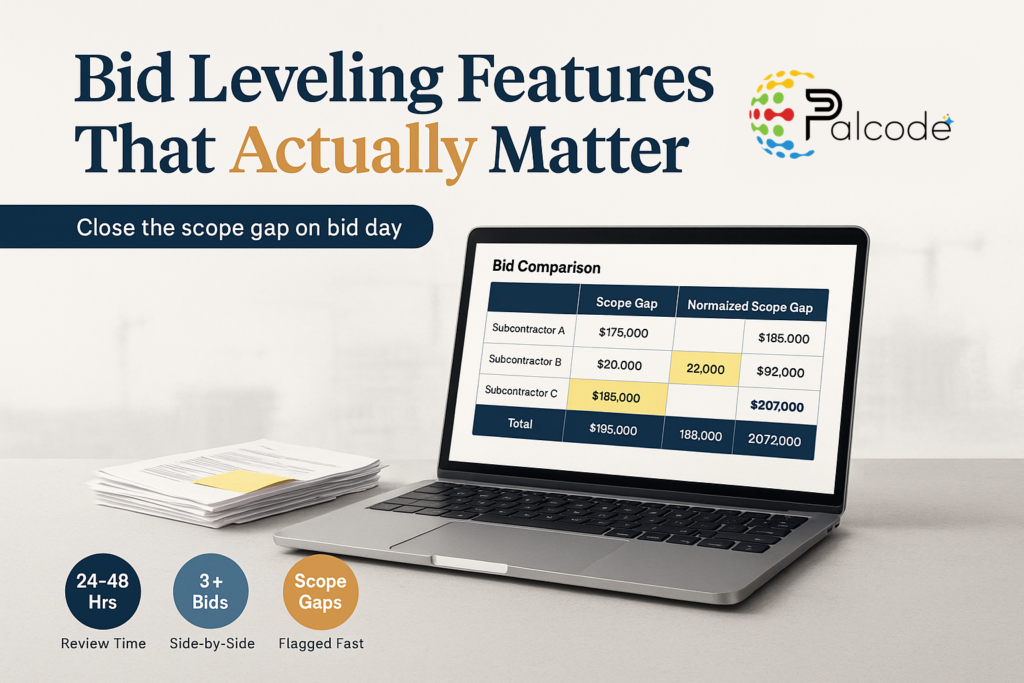
A normalized side-by-side matrix is the core deliverable of any bid leveling tool. The goal is to present bids at the same level of detail so that apparent price differences reflect actual scope differences, not just different ways of organizing a proposal.
Normalization matters because raw bid totals often can’t be fairly compared until the team accounts for alternates, allowances, and qualification language. Good platforms let estimators enter plug numbers or cost overrides to adjust bids to a common baseline. That step is essential, and it’s the part most teams underestimate when they’re evaluating software on a demo.
A strong side-by-side view also makes it easy to spot where one bidder has included an item another has omitted entirely, which is usually where the budget exposure hides. The scope gap detection capability built into most serious platforms is really just an extension of this same comparison logic, applied systematically across every line.
Scope Gap and Exclusion Detection
This is the feature with the clearest ROI case. The lowest bid isn’t always the cheapest once you account for omitted work and assumed allowances. Software that flags missing scope and conflicting assumptions before award gives estimators a chance to address those gaps through clarification or plug numbers rather than discovering them mid-construction.
Exclusion detection is closely related. Qualification language in sub proposals is often dense and easy to overlook when you’re reviewing six bids in an afternoon. Automated flagging won’t replace a careful read, but it surfaces the items most likely to create problems so estimators can prioritize their review time.
Document Compliance and Addenda Tracking
A bid package isn’t just a price. It’s a response to a specific set of documents, and whether each bidder acknowledged the correct addenda matters for a fair evaluation.
Platforms that track required versus submitted documents reduce the chance of comparing a bid that responded to an outdated package against one that caught the latest revision. It’s not a glamorous feature, but compliance misses at the bid stage tend to create expensive conversations later. For teams managing large bid packages across multiple trades, this tracking capability is usually worth more than it looks in a feature list.
Audit Trail and Traceability
This one matters more than most teams realize until they need it. When an owner asks why a particular sub was selected, or when a number in the estimate gets questioned internally, being able to trace each leveled figure back to the source proposal line is the difference between a defensible recommendation and an awkward conversation about hidden spreadsheet formulas.
A clear audit trail also supports internal review processes. The bid leveling process involves judgment calls at every step, and documenting those calls in the tool itself keeps institutional knowledge from living only in someone’s head.
Risk Scoring and Bid Quality Insight
Some platforms assign risk scores based on completeness, extent of exclusions, and deviation from market rate. That’s genuinely useful, though it works best as a triage signal rather than a decision engine. A bid that scores high on risk deserves closer scrutiny, but the estimator still needs to read the qualification language and decide whether the exposure is real.
What risk scoring does well is help teams prioritize their review time across a large bid set. On a busy bid day with eight electrical proposals, knowing which two need the most attention before you open anything is a practical advantage.
Award Memo Generation and Workflow Integration
Award memo generation turns the comparison work into a documented recommendation without requiring a separate write-up effort. For preconstruction teams under time pressure, this matters because the rationale for an award decision often needs to be reconstructed after the fact if it wasn’t captured during the leveling process.
Integration with estimating and procurement workflows extends the value further. When selected sub pricing can move into budgeting or the broader project system without manual reentry, the leveling process stops being an island and becomes part of a connected preconstruction workflow. Not every team needs deep integration on day one, but it’s worth understanding a platform’s integration approach before you commit.
How AI Is Changing the Bid Leveling Workflow
AI-enabled extraction and gap detection are now standard in the more capable platforms, not differentiators. The practical effect is that estimators spend less time on data cleanup and more time on the judgment calls that actually affect risk and cost. That shift is real, though adoption is uneven. Teams that have integrated these tools into their standard bid process report shorter leveling cycles and more consistent documentation. Teams still evaluating them often underestimate the setup and workflow change involved.
The more interesting near-term development is traceability at the document level: tools that can link a normalized line item back to the specific page and paragraph of the original proposal, not just the bid total. That capability is becoming more common and it meaningfully reduces the time spent validating outputs manually.
What to Prioritize When Evaluating Platforms
The features above don’t all carry equal weight for every team. For most commercial GC estimating teams, the short list of non-negotiables looks something like this:
- PDF and Excel ingestion without manual rekey
- Automatic extraction of line items and qualification language
- Side-by-side normalization with plug number support
- Scope gap and exclusion flagging
- Audit trail linked to source documents
Export format matters too. If the leveled output can’t be shared in a format the rest of the team can use, whether that’s Excel or a shareable PDF report, the tool creates friction instead of removing it. That’s a basic requirement worth confirming before a platform makes your shortlist.
| Feature | Why It Matters | What to Look For |
|---|---|---|
| Multi-format ingestion | Subcontractors send PDFs, Excel, and Word files; rekey adds error risk | Accepts all common formats without manual conversion |
| Automatic line-item extraction | Eliminates manual bid rebuild; surfaces inclusions and exclusions | Extracts qualification language, not just totals |
| Side-by-side normalization | Raw totals aren’t comparable without a common scope baseline | Supports plug numbers and cost overrides per line |
| Scope gap and exclusion flagging | Lowest bid often hides missing scope; flagging enables pre-award clarification | Systematic detection across all bids, not just outliers |
| Audit trail and traceability | Supports internal review and owner questions after award | Links leveled figures back to source document lines |
| Addenda and compliance tracking | Ensures all bids respond to the same package version | Tracks required vs. submitted documents per bidder |
| Award memo generation | Documents recommendation without a separate write-up effort | Exportable format the broader team can use |
Frequently Asked Questions
How long does it take to implement bid leveling software?
Most cloud-based platforms can be configured and usable within a few days to a couple of weeks, depending on how much the team wants to customize templates and integrate with existing systems. The bigger time investment is usually workflow adoption, getting estimators to consistently use the tool rather than defaulting to their Excel habits on a tight bid day. Starting with one trade or one project type tends to smooth that transition.
What’s the difference between bid leveling software and a bid management platform?
Bid management platforms typically cover the full solicitation cycle: sending invitations, tracking responses, and managing subcontractor communication. Bid leveling software focuses specifically on the comparison and normalization work that happens once proposals are in hand. Some platforms do both, but the leveling features are where the accuracy and scope gap detection value actually lives.
Can bid leveling software handle bids that aren’t line-itemized?
This varies by platform, and it’s worth testing directly during evaluation. Tools with strong document extraction can usually parse lump-sum proposals and identify qualification language even when the sub hasn’t broken out individual line items. The output is less granular in those cases, but it still reduces manual work and captures key exclusions.
How much does bid leveling software typically cost?
Pricing generally runs from a few hundred dollars per month for lighter tools up to several thousand per month for enterprise platforms with deep integration and AI-powered extraction. Per-project pricing models also exist. The more relevant question is usually total cost relative to how many bids the team levels per month and what an undetected scope gap costs on a single project.
Does bid leveling software replace the estimator’s judgment?
No, and the better vendors don’t position it that way. Automation handles extraction, comparison layout, and gap flagging, but the estimator still decides which exclusions are acceptable, how to plug missing scope, and which bid to recommend. The software shifts where estimators spend their time, away from data entry and toward the decisions that actually require their expertise.
See How Automated Bid Leveling Works in Practice
If your team is still rebuilding proposals line by line and hunting for scope gaps manually, there’s a faster path. Palcode.ai’s Bid Leveling tool extracts line items, inclusions, and exclusions directly from subcontractor proposals and presents them in a normalized side-by-side matrix, so estimators spend their time on award decisions instead of data cleanup. Book a demo to walk through a real leveling workflow with your own bid types.