
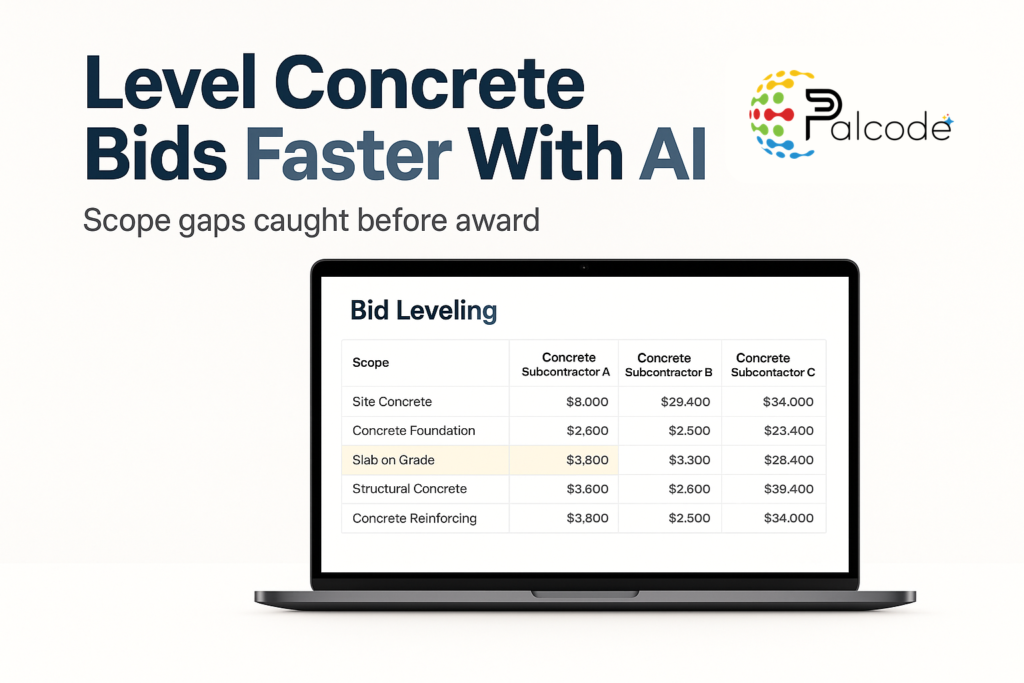
You’ve probably run into this already: two concrete bids arrive, one is noticeably lower, and your instinct is that something’s missing. Nine times out of ten, that instinct is right. The cheaper number reflects different assumptions about mix design, pour sequencing, or finishing scope — and if you miss that in leveling, you’re chasing the delta in the field instead of the bid room.
That’s the core difficulty with concrete. It doesn’t behave like a simple price-per-unit trade. The cost is sensitive to technical variables that shift constantly across project types — a commercial slab, a foundation package, and a structural pour all require different approaches, even if they look identical on a cover sheet.
Why Concrete Bids Are So Hard to Make Comparable
Concrete pricing depends on details that materially change the job: concrete strength, slump, cure time, reinforcement, additives, weather exposure, formwork, finishing, and sequencing. Two subs can price the exact same drawing set very differently based on what they assume about cold-weather protection, pour phasing, or site access.
Weather exposure is an underrated risk factor. Temperature, rain, and wind affect labor productivity and scheduling assumptions, which means schedule risk is often baked silently into a concrete bid without being labeled as such.
The scope itself breaks into components that each need alignment before a bid is trustworthy: excavation, formwork, reinforcement, placement, finishing, and curing. A subcontractor who excludes just one of those can show an artificially low headline number. That’s the part most teams underestimate — a missing scope item doesn’t announce itself, it just makes the bid look competitive.
Add to that the format problem. Subs send PDFs, spreadsheets, emails, and annotated scopes, each using different terminology and packaging the work differently. Without a structured leveling process, you’re comparing documents that weren’t designed to be compared.
What Estimating Software for Concrete Construction Actually Changes
Modern estimating software creates a consistent workflow for bid intake, normalization, and comparison. That structure matters because it forces every submission through the same review criteria, regardless of how each sub chose to format their proposal.
The practical impact shows up in a few specific areas:
- Centralized bid intake so proposals don’t scatter across email threads and shared drives.
- Standardized scope templates that require each sub to respond against the same categories, not their own preferred structure.
- Bid leveling sheets that normalize exclusions and inclusions into a side-by-side format.
- Faster gap detection so a missing curing or vapor barrier line item gets flagged before award, not during execution.
- Historical bid tracking so teams build a feedback loop on pricing behavior, win/loss patterns, and scope trends over time.
That last point compounds in value. When every submission is logged consistently, including project type, scope, bid value, and outcome, future estimates become more defensible and more accurate. That’s a structural advantage most manual processes can’t replicate.
For teams evaluating bid leveling software features, the concrete trade is a good stress test: if a platform handles the complexity of concrete scope alignment, it’ll handle most other trades cleanly too.
Where AI Workers Fit Into the Concrete Leveling Workflow
AI workers aren’t a replacement for estimator judgment. They’re a compression tool for the mechanical parts of bid review that consume time without requiring expertise.
For concrete specifically, the most valuable applications are document parsing and scope comparison. Many of the critical differences between concrete bids are buried in proposal language — mix design specifications, reinforcement details, phasing commitments, and site constraints. An AI worker can surface those differences in minutes; a human estimator then decides whether they’re acceptable, risky, or commercially significant.
The repetitive tasks where AI actually helps:
- Extracting scope items, exclusions, and alternates from subcontractor PDFs.
- Converting inconsistent bid formats into a common structure for comparison.
- Highlighting items present in one bid but absent in another.
- Drafting clarification requests when a bid is ambiguous on a key technical assumption.
This is where AI-assisted bid leveling changes the economics of preconstruction. A team that previously spent two days manually translating three concrete proposals into a comparable format can compress that to hours, with better consistency and fewer missed gaps.
A Practical Bid Leveling Workflow for Concrete Scopes
Best-practice bid management follows a sequence that most experienced GC teams already know but rarely execute consistently under bid-cycle pressure.
Start by issuing identical bid packages to all qualified subs. Drawings, specs, schedule, and any addenda should go to every bidder at the same time — inconsistency here is one of the most common sources of apples-to-oranges bids. Require proposals to follow a defined structure with clear inclusions and exclusions called out explicitly, not buried in scope narrative.
Use estimating software to collect and organize all proposals in one place, then let AI tools handle initial extraction and flag scope mismatches for human review. From there, level each bid against a defined scope matrix so the comparison is based on equivalent coverage, not raw price alone.
Award decisions should weigh the leveled price alongside reliability, qualifications, schedule fit, and risk profile. Some teams formalize this with weighted evaluation criteria that balance price against safety record, experience on similar project types, and reputation for delivering on schedule. That approach tends to produce better outcomes than chasing the lowest number before leveling is complete.
How AI Is Changing This Part of Preconstruction
Adoption is moving faster than most GC teams expected, but it’s still uneven. Larger firms have invested in platforms that automate bid intake and scope extraction as part of a broader preconstruction workflow. Smaller teams are often still running bid leveling in spreadsheets, which works but doesn’t scale well across multiple simultaneous bids.
The practical shift isn’t that AI replaces estimators — it’s that it raises the floor on consistency. Manual leveling quality depends heavily on who runs it and how much time they have. AI-assisted leveling tends to catch the same scope gaps regardless of bandwidth, which matters on hard-bid concrete work where estimators are often juggling several projects at once.
The teams getting the most value from these tools are the ones using AI for ingestion and normalization, then keeping humans in the loop for risk assessment and award strategy. That division of labor holds up well in practice and doesn’t require changing how estimators fundamentally think about bid review.
Why the Margin Impact Is Real
Hard-bid concrete work runs on tight margins. A scope gap that gets missed at bid leveling tends to surface as a cost overrun during execution, often at the worst possible time in the project schedule.
The efficiency case for estimating software is straightforward: faster leveling means more bids reviewed with the same team. The accuracy case is just as strong. In concrete, where a single assumption about mix design or pour sequencing can produce a meaningful cost difference, catching that at the bid stage is far cheaper than resolving it in the field.
| Approach | Bid Normalization Speed | Scope Gap Detection | Scalability Across Multiple Bids | Best Fit |
|---|---|---|---|---|
| Manual spreadsheet leveling | Slow; hours to days per bid set | Inconsistent; depends on estimator bandwidth | Poor; degrades under concurrent bid pressure | Small teams with low bid volume |
| Estimating software (no AI) | Faster intake and organization; leveling still manual | Structured templates reduce missed scope | Moderate; centralized data helps but human review bottleneck remains | Mid-size GCs with established scope templates |
| Estimating software with AI workers | Fast; automated extraction and normalization | Consistent flagging of mismatches across bids | High; scales across multiple simultaneous bid sets | GCs managing complex or high-volume concrete scopes |
Frequently Asked Questions
How long does it take to level a concrete subcontractor bid using AI-assisted software?
Teams using AI-assisted estimating platforms typically compress initial bid extraction and normalization from a full day of manual work down to a few hours. The AI handles document parsing and scope comparison; estimators then review flagged discrepancies rather than building the comparison from scratch. Actual time savings vary based on bid volume and how consistently subs follow the required proposal format.
What scope items do GCs most often miss when leveling concrete bids?
Vapor barrier, curing compound, cold-weather protection, and rebar tie-ins are among the most commonly omitted items in concrete proposals. Formwork and finishing scope can also differ significantly between bids without being obvious at the headline price level. A structured leveling checklist or AI-assisted gap detection catches these before they become field cost issues.
How much does estimating software for concrete bid leveling cost?
Entry-level estimating platforms start in the low hundreds per month, while enterprise solutions with AI bid leveling can run several thousand monthly depending on team size and feature set. Most platforms are priced per seat or per project volume, so the cost scales with usage. For teams running multiple concurrent concrete bids, the ROI tends to show up quickly in time saved and scope errors avoided.
Does AI bid leveling work if subcontractors send bids in different formats?
Yes, and that’s one of the clearest practical advantages. AI document parsing is designed to handle PDFs, spreadsheets, and unstructured proposal text—pulling line items and exclusions into a normalized format regardless of how each sub chose to structure their submission. Some inconsistency in source documents will still require human review, but the volume of manual cleanup drops substantially.
Should GCs use weighted scoring criteria when awarding concrete subcontractor bids?
Most experienced GC preconstruction teams do, especially on complex pours where schedule reliability matters as much as price. Weighted criteria typically factor in experience on similar project types, safety record, and schedule approach alongside the leveled bid number. That approach reduces the risk of awarding to the lowest bidder before scope alignment confirms the number is actually complete.
See How Faster Concrete Bid Leveling Actually Works
If your team is still spending days manually translating inconsistent concrete proposals into a comparable format, there’s a faster path. Palcode.ai’s Bid Leveling capability automatically parses subcontractor proposals, extracts scope items and exclusions, and flags mismatches across bids so your estimators spend time on judgment calls instead of document cleanup. Book a demo to see how it handles a real concrete bid set.