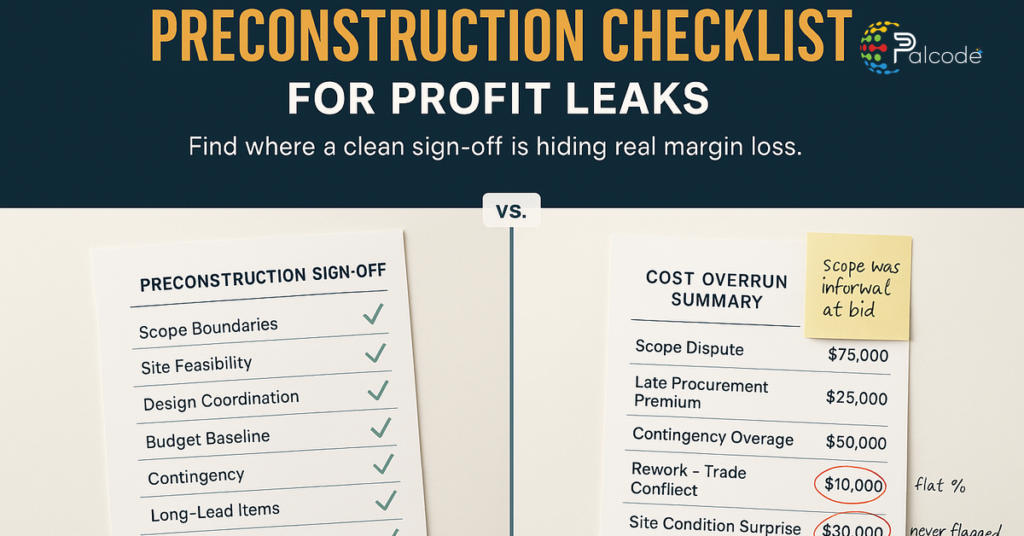
You’ve probably run into this already: the project looked fine through bidding, the estimate felt solid, and then somewhere between award and close-out the margin quietly disappeared. Rework. A long-lead item nobody flagged. A scope assumption that turned into a dispute. The problem usually traces back to preconstruction, not execution.
A preconstruction checklist, done right, isn’t a readiness ceremony. It’s a profit leak audit. The question isn’t whether your team has one. It’s whether your process actually forces early clarity on the things that cost money when they stay unclear.
The Real Preconstruction Checklist: A Profit-Leak Test
Before running through checkpoints, do a fast diagnostic. If several of the following are true for a typical project, your process is absorbing preventable cost somewhere:
- Scope boundaries are informal or assumed rather than written down
- Drawings are still changing when subcontractor pricing starts
- Site constraints surface after estimate assumptions are locked—sometimes days before bids are due, which by then means the estimate is already wrong
- Long-lead items get identified only when procurement is already late (and someone’s paying expediting premiums to compensate)
- Contingency is a flat percentage carried forward from the last job, not connected to anything specific about this one
If three or more of those land, your preconstruction process is collecting signatures without controlling cost. The audit below shows exactly where the leaks tend to be.
Ten Preconstruction Checkpoints That Protect Margin
Score each area honestly. A score of 1 means mostly informal. A 3 means documented but not reliably followed. A 5 means consistently executed and reviewed on every project.
Scope Clarity
Scope boundaries, exclusions, and allowances should be written before pricing starts, not reconstructed from memory after bids come in. When scope is vague, teams underprice exclusions and over-assume owner responsibility—and that gap shows up as disputes, not savings. This is the one checkpoint that, if skipped, tends to contaminate every other area downstream.
Site Feasibility
Soil conditions, drainage, utility conflicts, and access constraints need to be verified early. Surprise site costs are one of the more painful categories because they compound: a sequencing change forced by a drainage issue doesn’t just cost the fix, it costs the delay, and sometimes the recovery schedule on top of that.
Design Coordination and Budget Baseline
These two tend to fail together, which is why it’s worth treating them as connected. Constructability review is meant to happen before materials are ordered and crews are mobilized—trade conflicts caught in a coordination model cost a few hours; the same conflict caught in the field costs multiples of that. We’ve seen this show up especially hard on school and healthcare projects, where phasing constraints mean a coordination miss in the field is far more disruptive than it would be on a straightforward shell build. But the review only protects you if the estimate it’s tied to reflects current design maturity. Budget baselines that don’t track design development create false confidence, and underbidding driven by optimism about scope that hasn’t been resolved yet is one of the most consistent ways preconstruction teams lose margin before the project actually starts. Weekly design and cost validation meetings, with formal gate reviews, are what separates teams that catch these issues early from those that absorb them in the field.
Contingency Method
A generic contingency percentage can overstate cost and lose bids, or understate cost and destroy margin. Contingency should reflect identified risks with specific dollar exposure, not a flat allowance copied from the last job. That’s the part most teams underestimate—and it’s also the part that’s hardest to defend to an owner when the project closes with a swing.
Trade Prequalification and Procurement Planning
Subs should be vetted for insurance, safety record, financial stability, and relevant project experience before buyout decisions are made. Performance risk discovered after award tends to be far more expensive than the cost of a rigorous subcontractor prequalification workflow up front—the replacement cost of a failing sub, including delay and re-procurement, can dwarf any bid savings. Procurement planning runs into the same logic: long-lead items need to be identified and released with schedule intent, not flagged reactively when the schedule already shows a problem. By the time that gap is visible, the cost of fixing it through expediting or substitution usually exceeds what a proper procurement plan would have cost at the outset.
Permitting
Permit review timelines and inspection sequencing need to be built into the schedule and cost plan. Idle labor waiting on an inspection is a real, specific cost, and it’s almost always avoidable when permitting is treated as a cost driver rather than an administrative task.
Schedule Realism
CPM logic should reflect procurement lead times, inspection hold points, and site access constraints, not just a sequenced task list. Schedules that ignore those realities tend to produce overtime, stacked trades, and accelerated contract claims.
Risk Management
Risks should be tracked with owners, mitigations, and escalation paths, not just listed in a register that nobody revisits. Hidden exposure that isn’t actively managed has a way of becoming lost margin at project close.
Five Places Teams Lose the Most Money in Preconstruction
Across the checkpoints above, a few categories generate disproportionate cost when they’re weak.
Unclear scope is consistently the largest single source of bid gaps and post-award disputes. When scope boundaries aren’t explicit, both sides tend to assume the other is covering things nobody actually priced—on a $10M commercial project, that ambiguity can surface as $200K–$400K in disputed work before close-out.
Late constructability review converts digital coordination problems into field problems—a significant cost multiplier that is entirely preventable when review happens before release rather than after mobilization. Weak procurement timing tends to travel with it: by the time a long-lead gap becomes visible on the schedule, the cost of fixing it—whether through expediting, substitution, or delay recovery—usually exceeds what a proper procurement plan would have cost at the outset. These two failures compound each other in ways that aren’t always obvious until close-out, which is part of why they’re worth treating as a pair rather than separate line items.
Poor design-estimating coordination means the estimate is pricing the project as it was, not as it is. When design development, estimating, and scheduling aren’t aligned through regular reviews, teams lose the chance to correct assumptions before the GMP or final bid is set. On complex phased projects this can mean the gap between the estimate and reality is baked in months before anyone realizes it.
Generic contingency is underappreciated as a risk. It sounds like a buffer but functions as a guess—and a contingency not connected to actual risk analysis either loses bids or loses margin, depending on which direction the guess was wrong.
Questions That Reveal Whether Your Process Is Working
Bring these into your next preconstruction review. If the team can’t answer them quickly, the process lacks the discipline to protect profit.
- What are our top five scope assumptions, and are they documented anywhere?
- Which drawing items are still unresolved, and what do they cost if they change?
- Which long-lead materials could affect the critical path?
- Is our contingency tied to actual identified risk, or to what we used last time?
- Which permitting steps could affect release dates or mobilization?
How AI Is Changing the Preconstruction Checklist in Practice
The audit above is manual work when it’s done well, and that’s part of the problem. Most preconstruction teams don’t have extra capacity to run disciplined scope validation, risk tracking, and procurement planning across every project in parallel. An estimator spending four hours normalizing bids gets that time back for the scope review that actually changes the number—which is exactly where AI Workers are starting to matter, not as a replacement for the estimator’s judgment, but as a way to compress the document-processing work that happens before that judgment can even be applied.
Scope gap detection and finding missing scope in construction bids are two areas where AI document intelligence is already being applied to pull structured data from blueprints and bid documents, flagging coverage gaps across trades before the estimate is locked. Bid leveling tools that automatically parse subcontractor proposals are reducing the time estimators spend normalizing bids, which in turn creates more time for the risk and scope review that actually protects margin. The adoption curve is still early for most mid-market GCs, but the teams moving fastest are using these tools to handle document processing so estimators can focus on decisions rather than data extraction.
Read more
- Subcontractor Prequalification: Is Your Workflow Costing You?
- Scope Gap Construction Bids: Find Missing Scope Fast
| Preconstruction Area | What Strong Looks Like | Specific Cost If Weak |
|---|---|---|
| Scope Clarity | Scope, exclusions, and assumptions are written and reviewed before pricing starts | Bid gaps, scope creep, post-award disputes |
| Site Feasibility | Soil, drainage, utilities, and access verified early in design | Surprise site costs, sequencing changes, productivity loss |
| Design Coordination | Constructability review and trade conflict detection before release | Rework, RFI volume, coordination delay costs |
| Budget Baseline | Estimate tied to current design maturity with explicit assumptions | Underbidding, false confidence, margin erosion at GMP |
| Contingency Method | Contingency reflects identified risks with specific dollar exposure | Margin loss when unknowns hit; or lost bids from overpricing |
| Trade Prequalification | Subs vetted for insurance, safety, financial stability, and capability | Performance failure, replacement costs, schedule slippage |
| Procurement Planning | Long-lead items identified and released with schedule intent | Expediting costs, substitution premiums, delay recovery |
| Permitting | Permit timelines and inspection sequences built into cost plan | Idle labor, mobilization delays, acceleration claims |
| Schedule Realism | CPM logic reflects procurement lead times and inspection hold points | Overtime, stacked trades, acceleration exposure |
| Risk Management | Risks tracked with owners, mitigations, and escalation paths | Hidden exposure converts to lost margin at close-out |
Frequently Asked Questions
How detailed does a preconstruction checklist actually need to be?
It depends on whether scope is written down before pricing starts—which most teams skip, and which is usually where the answer becomes obvious. For any commercial project over a few million dollars, you need documented scope assumptions, an explicit risk review, and a written procurement plan at minimum. A checklist that only confirms tasks were completed without capturing the underlying decisions tends to miss the categories where margin actually leaks. Below that threshold, a lighter version focused on scope documentation and long-lead identification still pays off.
What’s the most common preconstruction mistake that costs GCs money?
Scope ambiguity at the start of pricing is typically the most expensive single failure. When scope boundaries aren’t written down and agreed on before bids go out, teams underprice exclusions, over-assume owner responsibilities, and set up post-award disputes that erode margin for the rest of the project. Late constructability review is a close second—field problems cost significantly more than digital coordination problems caught before mobilization, and the compounding effect on phased or occupied-space projects makes it worse.
How long does a proper preconstruction process take, and can it be shortened?
For most commercial projects, preconstruction spans several weeks to a few months depending on design maturity and project complexity. The activities that take the longest—scope validation, design coordination, procurement planning—can’t simply be cut. What can be compressed is the document processing that precedes those reviews: AI Workers are already reducing the time spent on bid normalization and scope extraction from blueprints, which frees estimators for the judgment-intensive work rather than shortening the process by skipping the review itself.
At what project size does a formal preconstruction checklist make sense?
Most estimators would say any commercial project above roughly $2–3 million warrants a formal, written preconstruction process, though the honest answer is that informal processes fail at every size—they just fail more visibly on larger jobs. Below that threshold, a lighter version focused on scope documentation and long-lead identification still pays off. The teams that get burned are usually those who never formalized the process because it hadn’t caused a visible problem yet, right up until it did.
What software tools support preconstruction checklist workflows?
Tools vary considerably by function. Estimating platforms handle budget baseline and takeoff. Prequalification software manages sub vetting and compliance tracking. Bid leveling tools parse and normalize subcontractor proposals to expose scope gaps before buyout. The gap most teams feel is in connecting those document-heavy steps—especially scope extraction from blueprints and bid comparison across trades—where AI Workers are beginning to replace manual spreadsheet work and give estimators a structured starting point rather than a blank page.
See How AI Closes the Scope Gap Before It Costs You
The preconstruction audit above only works if your team has time to run it properly. For most estimating teams, the bottleneck isn’t judgment: it’s the hours spent extracting scope from blueprints and normalizing bids before you can even start comparing them. Palcode.ai’s Scope Sheet Generation pulls structured scope items per trade directly from blueprint PDFs, giving your team a clean, reviewable scope baseline in a fraction of the manual time. Book a demo to see exactly how it fits into your preconstruction workflow.