You’ve probably run into this already: a subcontractor submits a bid, the numbers look right, and their company profile looks strong on paper. Then you dig a little deeper and realize the project experience they’re citing belongs to a parent company, a sister entity, or a corporate affiliate that won’t actually touch this job. That’s qualification borrowing, and it’s one of the more quietly damaging risks in the subcontract award process.
What Qualification Borrowing Actually Means in Construction Bidding
Qualification borrowing is the practice of relying on another entity’s experience, financial strength, or technical credentials to make a bidder appear qualified. It shows up in a few distinct forms. A subcontractor might lean on a parent company’s prior project history, or a JV arrangement where one partner’s bonding capacity does all the heavy lifting for a weaker partner. Sometimes it’s subtler: a bidder cites equipment or management staff that are technically employed by an affiliate, not by the named sub itself.
The problem is structural. Most formal prequalification frameworks, including World Bank standard bidding documents and USDA/RUS guidance, require that qualification criteria attach to the legal entity submitting the bid, not its corporate family. The Bihar tender document cited in procurement literature is explicit on this: it is the legal entity or entities comprising the bidder that must satisfy stated qualification requirements, not parent companies or subsidiaries.
That standard exists for a reason. The entity evaluated during prequalification is supposed to be the entity that signs the subcontract and delivers the work.
Read more: How to Prequalify Subcontractors: GC Process Explained
Why Qualification Borrowing Creates Real Downstream Risk
Performance risk is usually the first thing that surfaces, but it often hits at the worst possible moment ; two or three months into a project when the parent company’s resume has already shaped everyone’s expectations. If the subcontractor lacks its own experienced supervision structure or enough equipment to run the scope independently, no amount of corporate backing changes what shows up on site every morning. That gap between what the qualification file implied and what actually walks through the gate is where the schedule starts slipping.
What tends to get underestimated is how quickly the cash flow piece compounds the performance problem. A subcontractor with thin working capital of its own, one that’s counting on a related entity’s financial backing to fund payroll and material orders through a 30- or 45-day payment cycle, doesn’t have much margin when something goes sideways. One missed owner pay app, one disputed change order, and the sub is suddenly rationing crew hours or slowing material deliveries to manage its exposure. The GC absorbs most of that schedule risk directly.
On federally funded or publicly regulated work, there’s a third layer of exposure that goes beyond project performance. Both World Bank guidance and USDA/RUS rules treat an affirmative qualification determination as a formal prerequisite to award. If the qualification file doesn’t survive scrutiny — because the credentials it relied on belonged to an affiliate rather than the named entity — the award itself can be challenged. That’s not a hypothetical: bid protests on public work can freeze a project for months, and the GC is the one holding that exposure while the schedule clock keeps running.
Red Flags That Signal a Qualification Problem
Most of these signals are visible if you know what to look for before you make the award decision.
- The subcontractor’s project resume is primarily the resume of another company under a different legal name, sometimes this is obvious from the letterhead, sometimes it only becomes clear when you ask who actually held the prime subcontract on those jobs.
- The proposed crew, supervision, or project management staff aren’t employed by the named entity (worth asking directly: are these people on your payroll, or are they being loaned from an affiliate for this project?).
- Financial capacity comes from a related firm, but the actual subcontractor has thin capitalization on its own balance sheet , a quick look at the sub’s standalone financials versus the parent’s is usually enough to surface this.
- Prior project references were completed under a different corporate structure, with no documentation connecting them to today’s entity.
- The estimator on the other end of the phone can’t clearly identify which legal entity will hold the subcontract and self-perform the scope, vague answers here are usually a sign the question hasn’t come up internally either.
Any one of these should prompt a specific follow-up question before the bid moves forward. They don’t disqualify a sub outright, but they do mean the burden of clarification shifts to them.
Read more: EMR Subcontractor: What It Is Before You Award
What to Verify Before You Award a Subcontract
The evaluation framework that World Bank and USDA/RUS guidance both point toward is straightforward: confirm relevant experience, past performance, financial position, and operational capability, all tied to the entity that will actually perform the work. That means your review needs to answer a few specific questions before the award goes out.
First, who is the actual contracting party, and is it the same entity that will self-perform the scope? Second, does that entity have similar project experience in its own name? Third, does it carry adequate labor, supervision, and financial capacity without relying on a related company to fill those gaps?
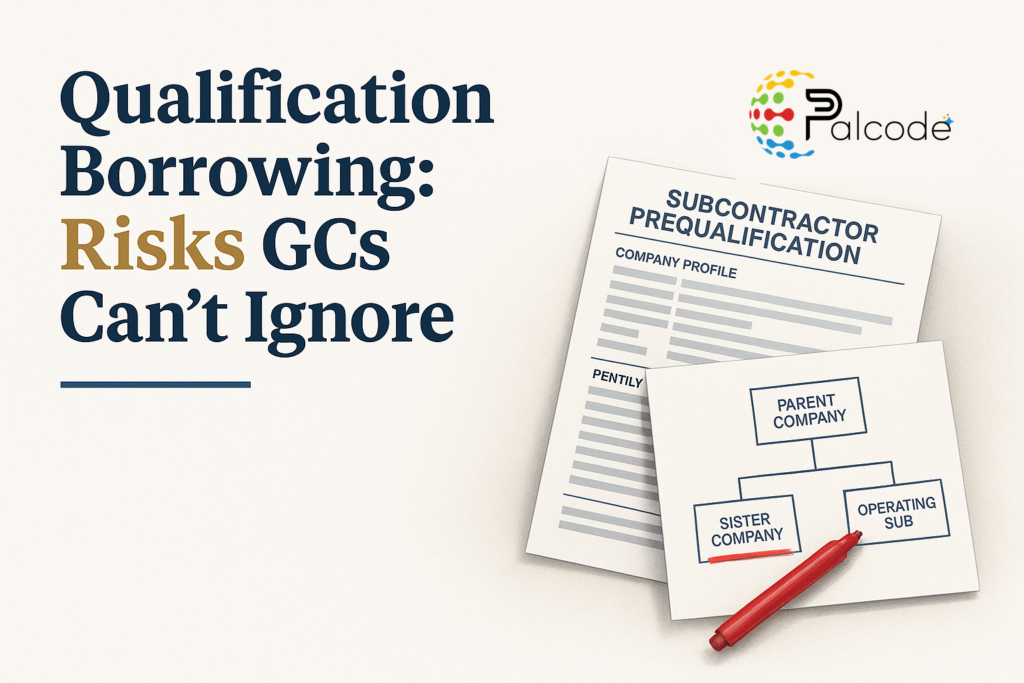
If a subcontractor is presenting combined resources, asking for documentation that makes the relationship explicit is reasonable and, on public work, often necessary. That documentation typically includes corporate structure charts, JV or teaming agreements, and written commitments to provide personnel or equipment. Project references should be tied to the exact legal entity, not the corporate family broadly.
When Qualification Borrowing Can Be Legitimate
There are situations where relying on an affiliate’s credentials is explicitly permitted. Some solicitations allow JV structures or teaming arrangements as long as the supporting documentation is clear and the roles are defined. The key distinction is whether the bid documents and applicable procurement rules specifically allow it, and whether the support is properly documented in the qualification file.
The default assumption, especially on private commercial work where the rules may be silent on this, is that the named subcontractor must independently demonstrate the experience and capacity needed for the scope. If the solicitation doesn’t address combined resources, don’t assume they’re allowed.
How Estimators Should Factor Qualification Into Bid Review
Estimators spend most of their review time on price, scope gaps, and production rates. That’s appropriate. But qualification risk is just as consequential as a missing allowance or an understated scope line.
A low number from a subcontractor that can’t actually perform is a liability, full stop. Think about what it costs when a sub goes sideways mid-project: emergency re-procurement typically runs 15–25% above the original contract value once you factor in the gap period, overtime to recover schedule, and whatever the owner charges in liquidated damages while you sort it out. That’s real money, and it doesn’t show up in the bid tab when you’re making the award call. The award process is increasingly treated as a formal risk-control step, not an administrative formality — and that framing only makes sense if qualification review is happening before the low number has already shaped the conversation.
The practical approach: before a bid enters serious consideration, confirm the legal entity, verify its own project history, and check that its safety and performance record is consistent with the project’s risk profile. If those checks take more than a few minutes per sub, the qualification process probably needs more structure.
Read more: Subcontractor Prequalification Checklist: What to Collect
How AI Is Changing Qualification Review in Preconstruction
Prequalification has traditionally been a manual, relationship-driven process, which is exactly why qualification borrowing tends to slip through. When a sub has a strong track record with a GC’s business development team, the document review sometimes gets less scrutiny than it deserves.
AI-assisted document parsing is starting to change that dynamic. AI Workers that can extract entity names, project histories, and financial data directly from submitted qualification packages make it easier to flag mismatches between the named bidding entity and the experience being presented. The underlying judgment still belongs to the estimator or preconstruction manager, but the surface area for missed red flags gets smaller when the review isn’t entirely manual.
That’s a practical adoption benefit, not a speculative one. The teams seeing results from it tend to use automated review as a first-pass filter, then apply human judgment to the flagged items rather than trying to manually read every document in the package.
Frequently Asked Questions
Is qualification borrowing always against the rules in construction bidding?
Not always. Some solicitations explicitly allow JV structures or teaming arrangements where one partner’s credentials support another, provided the documentation is clear and roles are defined. On most commercial projects where the solicitation is silent on this, the named subcontractor needs to satisfy qualification criteria independently.
What documentation should a GC require when a subcontractor is presenting combined resources?
At minimum, ask for a corporate structure chart showing the relationship between entities, any JV or teaming agreement that formalizes the arrangement, and written commitments from the supporting entity to provide specific personnel or equipment. Project references and safety records should be tied to the exact legal entity holding the subcontract, not just the broader corporate family.
How much does it cost to deal with a misqualified subcontract award?
The costs compound quickly and hit from multiple directions. A bid protest on a public project can freeze an award for weeks or months while procurement officials review the file — during which your schedule is running and your owner relationship is under strain. If the problem surfaces post-award during construction, emergency re-procurement typically costs 15–25% above the original contract value before you account for delay damages, overtime to recover float, and any liquidated damages the owner assesses in the interim. The USDA/RUS framework treats qualification as a prerequisite to award precisely because remedying a bad award after the fact is so expensive. Catching the problem in the bid leveling phase, before the subcontract is executed, is almost always the lower-cost path — even when it means reopening a price conversation you thought was settled.
Can a subcontractor’s parent company guarantee performance if the sub itself is underqualified?
A parent guarantee may provide some financial backstop if performance collapses entirely, but it doesn’t put qualified supervision on the job site or fix the operational gaps that cause schedule problems in the first place. Qualification and guarantee are separate questions — don’t let one substitute for the other during bid review.
How should estimators build qualification review into the bid leveling process?
Run qualification checks in parallel with scope and price review, not afterward. Before a bid enters serious comparison, confirm the legal entity, verify its own project history, and flag any mismatches between the named sub and the experience presented. A simple checklist tied to your prequalification criteria keeps this from being ad hoc and makes the review defensible if an award decision is later questioned.
Catching Qualification Gaps Before the Award Goes Out
If your bid review process is still catching qualification problems after the low number has already shaped the conversation, the review is happening too late. Palcode’s Bid Leveling product parses and compares subcontractor submissions automatically, flagging scope and documentation gaps across bids so your team can spot credential mismatches and missing information before the award decision gets made. If you’re evaluating how to tighten up your subcontract qualification process, a demo call is a practical next step.