Ask five estimators which software they use and you’ll get five different answers. That’s not because the market is fragmented by accident; it’s because no single platform wins across every company size, workflow type, and project complexity. The brands surfacing consistently in 2025 reviews and market roundups reflect three distinct buying paths, and understanding which path matches your operation saves a lot of time during evaluation.
How the Best Construction Estimating Software Brands in 2025 Break Down by Segment
The clearest signal from current market data is that the category has split into camps: enterprise GC platforms, mid-market builders, dedicated takeoff tools, and niche systems for specialty or heavy-civil work. You’ve probably run into this already when comparing options, where one tool looks great in a demo but clearly wasn’t designed for how your team actually operates.
Enterprise GCs and complex commercial preconstruction teams keep gravitating toward Procore and Autodesk Construction Cloud / Autodesk Forma. Procore holds a 4.6/5 rating with more than 4,000 reviews on G2, while Autodesk Forma sits at the top of G2’s construction estimating category with a 4.4/5 rating and over 5,000 reviews. Neither of these is purely an estimating tool, and that’s exactly the point. Teams choose them because they want preconstruction estimating connected to bidding, financial workflows, and project controls inside one environment.
Mid-market builders and residential production teams are a different story. Buildertrend and CoConstruct appear repeatedly in best-of lists aimed at that segment, typically where the team needs estimating combined with customer management and project scheduling rather than enterprise-level financial controls. Houzz Pro shows up in remodeling and designer-led residential work specifically.
Dedicated Takeoff and Cost-Estimating Tools Still Have a Strong Place
A meaningful portion of commercial estimating teams in 2025 still run a two-tool stack: a dedicated takeoff or markup tool paired with a separate estimating or project-control system. That’s not a legacy habit; it reflects the fact that some tools genuinely do one thing better than any platform tries to do everything.
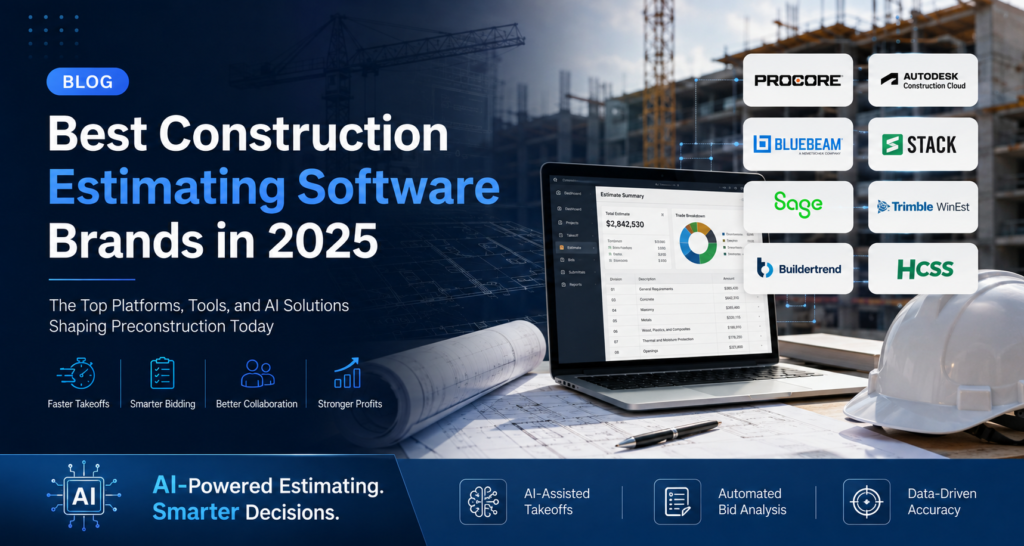
Bluebeam Revu is the clearest example. It holds a 4.7/5 rating from more than 900 verified users on Capterra’s 2025 report, making it the highest-rated solution in that report. Teams use it for PDF-based quantity takeoff and document markup, often feeding results into a separate estimating engine. STACK and PlanSwift serve a similar role for collaborative digital takeoff, with STACK in particular gaining traction among teams that want cloud-based quantity workflows without a full platform commitment.
On the cost-estimating side, Sage Estimating and Trimble WinEst remain persistent choices for teams that need deeper formula controls and estimating logic than a platform-level tool typically provides. HCSS occupies a narrower lane, showing up specifically in heavy and civil contractor workflows where the estimating requirements differ substantially from vertical construction.
What Preconstruction Teams Actually Prioritize When Choosing
The buying criteria that show up most consistently in review roundups and category rankings are speed of takeoff, bid package management, and integration with accounting or ERP systems. Accuracy across revisions and alternates matters just as much, and that’s the part most teams underestimate during a demo. A tool can handle a clean set of drawings well but struggle when addenda start rolling in mid-bid.
Collaboration features have moved up the priority list as well. Comparing multi-trade bids across subcontractors isn’t something most estimating tools were designed to streamline, and that gap becomes obvious during a busy bid cycle when the estimator is manually reconciling scope between five different sub proposals.
Review sites consistently show demand for software that combines estimating with project controls rather than treating estimating as an isolated function. That’s why platform-level tools like Procore and Autodesk remain dominant in the enterprise segment even though their pure estimating capabilities aren’t always rated higher than dedicated tools.
A Brand-by-Brand Look at the Major Players
Here’s how the most frequently cited brands in current roundups actually position in practice:
- Procore: strongest fit for enterprise GCs who want unified project financials and bidding in one environment, not just a standalone estimating module.
- Autodesk / Autodesk Construction Cloud / Forma: the clear choice where BIM-connected estimating and a broader construction cloud stack matter to the preconstruction workflow.
- Bluebeam Revu: the most review-validated option for PDF markup and quantity takeoff speed, frequently paired with a separate estimating system.
- STACK: popular for collaborative, cloud-based takeoff, especially where multiple estimators are working a bid simultaneously.
- PlanSwift: still notable for detailed takeoffs and established workflows, though it tends to show up more in established teams than in new deployments.
- Sage Estimating and Trimble WinEst: persistent in commercial estimating teams that need formula-driven cost control and integration with accounting systems.
- Buildertrend and CoConstruct: well-suited to mid-size residential and custom home builders where estimating, customer management, and project tracking need to live together.
- HCSS: a specialized fit for heavy and civil contractors, rarely the right choice outside that segment.
Where AI Fits Into the 2025 Estimating Software Market
The honest picture of AI in construction estimating right now is that adoption is real but uneven. Most of the major platforms have added some form of AI-assisted functionality, whether that’s automated quantity detection, document parsing, or bid comparison support. The practical value depends heavily on how the tool is implemented and whether the underlying data is clean enough to act on.
Dedicated AI estimating tools are emerging as a separate category alongside the established platforms, particularly for tasks like AI-assisted cost estimating and automated bid analysis. The teams getting the most out of these tools tend to be the ones that have already standardized their data formats and workflow steps. Dropping an AI layer onto a disorganized estimating process usually surfaces the disorganization faster than it solves it.
The practical adoption reality is that most commercial estimating teams in 2025 are using AI as an enhancement to an existing stack, not as a replacement for established platforms. That’s likely to shift over the next few years as AI-native tools mature, but for now the brands listed above still define most active buying decisions.
Which Path Actually Fits Your Team
The market in 2025 doesn’t point to a single winner. Enterprise GCs tend to consolidate around Procore or Autodesk for the integration value. Mid-market builders find more fit in Buildertrend or CoConstruct. Estimators and preconstruction specialists often pair a dedicated takeoff tool with a separate estimating or project-control system, accepting the complexity in exchange for best-in-class performance at each layer.
The decision usually comes down to one question: is your biggest pain point the estimating calculation itself, or everything that happens around it, bid management, scope comparison, sub coordination, and financial reporting? The answer tends to predict which category of tool actually solves your problem.
| Brand | Best Fit | Core Strength | Typical Deployment |
|---|---|---|---|
| Procore | Enterprise GCs | Unified project financials and bidding workflow | Standalone platform |
| Autodesk Construction Cloud / Forma | Enterprise GCs and design-build teams | BIM-connected preconstruction and estimating | Standalone platform |
| Bluebeam Revu | Commercial estimating teams | PDF markup and quantity takeoff speed | Paired with a cost-estimating system |
| STACK | Estimators and preconstruction specialists | Cloud-based collaborative takeoff | Paired with a project-control system |
| PlanSwift | Established estimating teams | Detailed digital takeoff workflows | Paired with estimating or ERP |
| Sage Estimating | Commercial estimators needing cost-formula depth | Formula-driven estimating and accounting integration | Paired with project controls |
| Trimble WinEst | Teams needing deep estimating controls | Detailed cost modeling and formula logic | Paired with ERP or project management |
| Buildertrend | Mid-size residential and light commercial | Estimating plus customer and project management | Standalone platform |
| CoConstruct | Custom home builders | Residential estimating and client collaboration | Standalone platform |
| HCSS | Heavy and civil contractors | Civil-specific estimating and field operations | Standalone platform |
Frequently Asked Questions
What’s the difference between Procore and Autodesk for construction estimating?
Both are enterprise-grade platforms, but the distinction comes down to where the rest of your workflow lives. Procore is typically favored for unified project financials and bid management across the GC organization. Autodesk Construction Cloud and Forma tend to be chosen where BIM-connected preconstruction and design-phase estimating are central to the team’s workflow. In practice, the choice often follows whichever platform the firm’s project management team is already using.
Is Bluebeam Revu actually an estimating tool or just a markup tool?
It’s primarily a PDF markup and document review tool, but many commercial estimating teams use it as the front end of their takeoff process, measuring quantities directly from PDF drawings before feeding results into a separate cost-estimating system. Its 4.7/5 Capterra rating from over 900 verified users reflects real adoption in estimating workflows, even though it doesn’t generate a cost estimate on its own.
How much does construction estimating software typically cost in 2025?
Enterprise platforms like Procore and Autodesk are generally priced on annual contracts that scale with company size, often running into the tens of thousands of dollars per year for a full commercial GC deployment. Dedicated takeoff tools like STACK and PlanSwift tend to run at lower per-seat or subscription rates, which is part of why teams pair them with other systems rather than going all-in on an enterprise platform. Residential-focused tools like Buildertrend are usually priced closer to the mid-market SaaS range.
Do mid-size GCs really need an enterprise platform, or is something like STACK enough?
It depends on where the friction actually is. If your estimating bottleneck is takeoff speed and quantity accuracy, a dedicated tool like STACK or Bluebeam may solve the real problem without the overhead of a full platform. If bid management, sub coordination, and financial reporting are equally painful, a platform-level tool starts to make more sense. Most mid-size teams that outgrow a takeoff-only stack do so because bid comparison and scope management become the bigger time drain.
Are AI features in current estimating software mature enough to rely on?
For specific tasks, yes. Automated quantity detection, document parsing, and bid analysis are areas where AI features are delivering measurable time savings for some teams in 2025. That said, the results tend to be much stronger for teams with standardized data and clean drawing sets. Teams expecting AI to compensate for disorganized processes usually find it surfaces the underlying problems faster than it resolves them.
See How AI Handles the Estimating Work Your Platform Doesn’t
If you’ve mapped out the major platforms and still feel like bid leveling, scope comparison, and coverage gap detection are falling through the cracks, that’s exactly the problem, Palcode.ai was built to address. Book a demo to see how preconstruction teams are using Palcode.ai to automate the manual estimating steps that even the best platforms leave on the table.