A mechanical sub you’ve never used just sent a number well under everyone else’s. Do you carry it, or do you start asking who they are? That question is cheaper to answer before the bid lands.
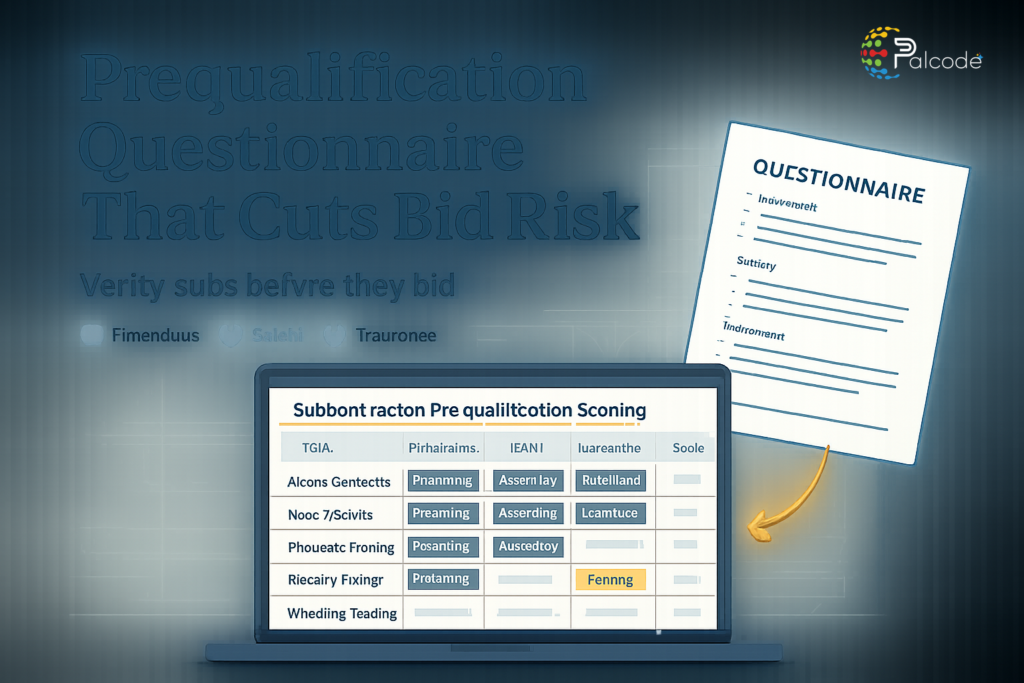
A pre qualification questionnaire for subcontractors screens the company, not the proposal. It covers finances, safety record, experience and capacity. It isn’t a bid form, and it doesn’t compare scope or price.
Done badly, it’s a long form nobody reads. Done well, it keeps weak firms off your bid list and spares estimators a nasty surprise in buyout.
What a Pre Qualification Questionnaire for Subcontractors Should Ask
Start from what public owners already screen. The TxDOT prequalification program looks at financial strength and backlog. It also covers experience and safety.
Quality and claims history are in scope too. So are references and capacity. Insurance and licensing finish the set.
Don’t copy all of that into one form. Pick the questions that change your decision. If an answer wouldn’t move a sub from “yes” to “no”, cut the question.
Experience questions deserve the most care. One public template applies a recent-experience standard, asking for project examples completed within the past 5 years, according to the Tennessee prequalification questionnaire. The same source describes a model that wants at least 2 comparable projects for a trade.
Comparable means the same trade, similar contract size and a similar delivery setup. A drywall sub with a great record on a small tenant fit-out hasn’t proved anything on a hospital.
Keep the form short enough to finish. A Saudi Aramco-style template limits responses to 4 A4 pages, as shown in this sample questionnaire. Subs with thin admin staff will quit on a 30-page packet, and those are often the firms you want.
Ask for names, not adjectives. Reference contacts, project values and the superintendent who ran each job tell you more than a paragraph of marketing copy.
Who owns it? Procurement teams usually send and track the form. Estimators should have a say in the experience section, since they know which trades have burned the company before.
What about subs? They answer faster when they know why a question exists. A one-line explanation beside each section pays for itself.
Public owners often set the questions by rule. A private GC has more room to tailor.
Competitive angle: a tight questionnaire is a selling point. Good subs bid where the process is clear.
Format tip: use yes/no fields where you can and short narrative boxes where you can’t.
Common mistake: asking for everything on every trade. A roofer and an electrician don’t need identical forms.
Starter set: company basics, three recent comparable projects, backlog, safety contact and insurance carrier.
Review rule: assign one reviewer per questionnaire so nobody assumes someone else checked it.
Template note: revisit the form each year and drop anything you never used.
Read More – Subcontractor Bid Software: What GCs Actually Need in 2026
How to Evaluate a Subcontractor’s Financial Stability
Financial questions are where most questionnaires get vague. A sub can answer “yes, we’re financially sound” and mean nothing by it. Ask for documents instead.
Public programs set the pattern. The South Carolina prequalification handbook treats financial capacity as a core part of the review, and the TxDOT program does the same through its financial strength and backlog review.
What are you actually trying to learn? Whether this firm can carry payroll and materials while you pay on a normal cycle. A sub that can’t will lean on your cash flow, and that’s a schedule problem before it’s a legal one.
Look at the trend, not one number. A single strong year can hide two weak ones. Compare the current statement against the prior period and ask the sub to explain any swing.
Backlog matters as much as the balance sheet. A well-funded firm with every crew committed elsewhere will staff your job thin. Ask what’s under contract, what’s pending and who the project manager would be on yours.
Bonding capacity belongs here too. A surety’s willingness to back a sub is an outside opinion you don’t have to produce yourself. If the sub can’t get a bond for your contract size, find out why before you rely on them.
Estimators and procurement teams should read this section together. Procurement spots missing documents. Estimators spot when a sub is stretching well beyond the size of work it has done before.
Documents Subcontractors Should Provide for Prequalification
Answers without paper are opinions. The documents you request should back up the specific claims on the form. Keep the list short so small firms can actually deliver it.
Reasonable requests include:
- Current financial statements, ideally reviewed or audited
- A certificate of insurance showing limits and carrier
- Proof of the trade license for the state where the work sits
- Safety documents, including the experience modification rate and incident logs
- A reference list with contact names and project values
Public templates ask for similar material. The CSU subcontractor prequalification form is a useful model for how a university system structures its request to subs, and a published subcontractor template shows a different owner’s take on the same screen.
Don’t ask for what you won’t read. Every extra attachment is another reason for a busy sub to skip your bid. If nobody has opened a document type in a year, drop it.
Insurance Limits and What to Check Before You Approve a Sub
Insurance is the easiest section to fill in and the easiest to get wrong. A certificate shows a policy existed on the day it was issued. It doesn’t prove the limits fit your contract.
Limits vary by owner and project. One California questionnaire sets liability at $1 million per occurrence and $2 million aggregate, but your own contract language and your carrier’s advice should drive the number you require.
Read the certificate against the contract, line by line. Check the coverage types, the policy dates and whether your company is named as an additional insured. A mismatch found at award is a nuisance, and one found after a loss can mean uninsured exposure.
A short verification checklist keeps the review consistent:
- License active and matched to the trade being bid
- Insurance limits meet the contract, with current policy dates
- Safety record reviewed against your own threshold
- References called, not just listed
- Backlog and key staff confirmed for your schedule
References are the step teams skip. A five-minute call to a prior GC will tell you whether the sub finished, staffed the job and handled change orders without a fight. It’s the cheapest check on the list.
Read More – Qualification Borrowing in Subcontractor Bids: Key Risks
Keeping Prequalification Current Without Burning Out Your Team
A questionnaire approved two years ago says little about today. Financials move, crews turn over and insurers change. Set an expiry, and treat it as a hard stop.
Some owners already work this way. Tennessee’s bidding information page ties prequalification to an annual cycle, which is a sensible starting point for private teams too. Refresh sooner if a sub’s size, ownership or safety record changes.
Should every sub be prequalified on every project? Usually not.
Small, simple scopes rarely justify the review time. Larger or higher-risk packages do, and a sub qualified for one owner’s job doesn’t automatically carry that approval to yours.
Tier the process instead. Run a light check for routine trades and a full review for structure, envelope and major systems. That keeps estimator hours on the packages where a failed sub would hurt most.
Watch for firms that borrow someone else’s credentials to pass the screen. Ask who will actually perform the work and who will supervise it. Your questionnaire should make that answer a matter of record.
Automation is starting to help here, mostly with the drudgery. Software can read submitted forms, flag missing fields and track expiring documents. It still can’t judge whether a sub’s story about a failed project is believable, so a person has to make the final call.
The teams that get this right treat the questionnaire as a living tool. They review which questions predicted real problems and cut the ones that never did. Over a few cycles, the form gets shorter and sharper.
Frequently Asked Questions
What should a subcontractor prequalification questionnaire include?
Cover financials, backlog, comparable projects, safety, insurance, licensing and references. Keep it tight enough that a small sub can finish it in one sitting.
How long should subcontractor prequalification stay valid?
Twelve months is a sensible default. Tennessee requires the questionnaire annually, and financials go stale fast.
What insurance limits should subcontractors carry?
One California school-district questionnaire sets liability at $1 million per occurrence and $2 million aggregate. Check your own contract and your carrier’s advice before copying that.
Should I prequalify subs on every project?
No. Skip it on small, simple work where review time outweighs the risk. For larger jobs, redo it, since project-specific qualification may not transfer.
How much time does a questionnaire program take to set up?
The template itself takes a few days. Verification is the real cost, so plan reviewer hours before you roll it out to every trade.
How Palcode.ai Can Solve It
Once a prequalified sub bids, the next risk is scope, not credentials. Palcode.ai offers a bid leveling AI Worker that parses subcontractor bids and lines them up item by item, so inclusions, exclusions and gaps show up before award.
Qualified Subs Still Need Leveled Bids
Prequalification narrows who gets to bid. Palcode.ai can show you how bid leveling picks up where the questionnaire stops.