You’ve probably run into this already: your team has a solid process for sending invitation-to-bid packages, tracking who opened the drawings, pushing addenda out. The invite side works. Then bids come in and everything slows down. Proposals arrive in different formats, scope inclusions don’t line up, and someone ends up rebuilding the whole thing in a spreadsheet just to figure out which number’s actually comparable.
That’s the software gap most preconstruction teams don’t name directly. It’s not that GCs lack tools. It’s that the tools they have stop at the wrong point in the workflow.
Why Bid Management Software Usually Means Invite Management
Most platforms marketed as bid management software are built around the upstream side: organizing subs by trade, distributing packages, tracking engagement, sending reminders, logging responses. Genuinely useful work, especially once invite volume grows and email-based distribution starts breaking down.
But invite management and bid leveling are different workflows. A sub can open the package, respond within 24 hours, and still leave out a critical scope item. The platform that tracked their engagement won’t catch that. The estimator will, eventually, manually reviewing PDFs side by side at 9pm before bid day.
That gap sticks around because construction teams have historically bought tools that solve the easiest part first. Distribution and tracking are easy to digitize. Leveling’s harder, so it stays in Excel.
What Bid Leveling Actually Involves
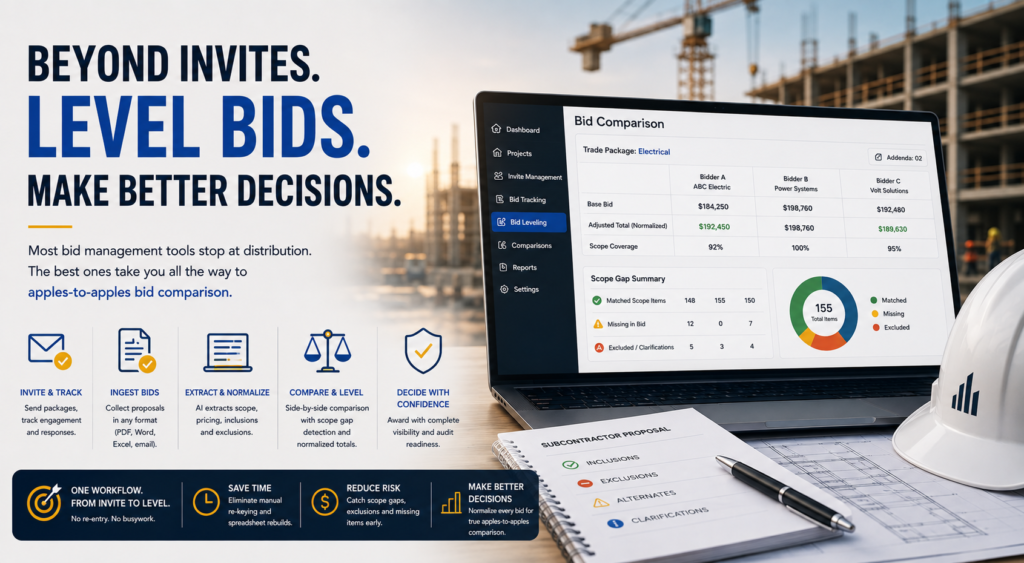
Bid leveling means comparing subcontractor proposals on equal footing, so nobody accidentally picks the cheapest incomplete number. In practice that means identifying what each bid includes and excludes, reconciling alternates, accounting for any addenda that touched scope, and adjusting totals so the comparison is actually apples-to-apples.
The core difficulty is format. Proposals show up as PDFs, Word docs, email attachments, informal quotes. Before any comparison can happen, someone has to pull the relevant terms out of each one and organize them into something you can actually review side by side. That extraction step is where most of the manual labor lives. It’s also where mistakes pile up.
Scope gaps are easy to miss when you’re moving fast. A sub’s proposal might just stay silent on a line item the project actually requires. If the leveling process doesn’t explicitly check each bid against project requirements, that silence reads as inclusion until it doesn’t.
The Real Cost of the Workflow Break
When bid distribution and bid leveling live in separate platforms, the handoff between them bleeds time. The GC gets bids through one tool, then rebuilds them by hand in another format just to compare them. That re-keying isn’t just slow. It introduces transcription errors, and the leveled comparison ends up only as good as whoever did the rebuild.
For a team running several bid packages at once, that cost adds up fast. This is the part most teams underestimate when evaluating software. Invite tools look great in a demo. The leveling bottleneck only shows up mid-cycle, when estimator time is already stretched thin.
A platform that handles bid comparison across multiple trades without forcing manual re-entry can cut real cycle time. The question is whether the platform a GC’s actually evaluating does that or whether it just manages the inbox.
What Better Bid-Leveling Software Should Actually Do
A practical leveling system needs to do more than store incoming PDFs. It should ingest proposals, pull scope and pricing details out of varied formats, organize those details into a comparison matrix, and flag anywhere coverage is missing or inconsistent. The output should be something an estimator can actually use to make an award decision. Not a starting point for more manual cleanup.
That means handling real proposal messiness: non-standard layouts, informal language, scope buried in narrative paragraphs instead of clean line items. Tools that only work on tidy, well-structured proposals aren’t solving the actual problem.
Workflow continuity matters too. If the leveling tool sits completely separate from the invite platform, the GC still has to manually move data between them. Best case is a system where invite tracking flows into bid normalization without anyone re-entering anything.
How AI Is Changing This Workflow
The more useful AI applications here focus on document ingestion and extraction. Instead of an estimator reading each proposal and manually filling in a comparison matrix, an AI-assisted system reads the incoming documents, pulls out inclusions and exclusions, and pre-populates the leveling sheet. The estimator reviews and adjusts instead of building from scratch.
That’s not a minor shift. Extraction and initial organization usually eats up a big chunk of the time spent leveling bids. Automating it doesn’t remove estimator judgment. It just redirects that judgment toward actual comparison and decision-making instead of data entry.
Adoption’s still uneven. Some GC teams have folded AI-assisted leveling into their standard workflow. Plenty of others are still running platforms built before document AI was viable, and those haven’t caught up. What’s technically possible and what most teams are actually running is a wider gap than the software marketing lets on.
What to Ask When Evaluating Platforms
The most useful question when evaluating bid management software is direct: does this platform only manage invites, or does it also help compare subcontractor bids on a normalized basis? Most vendors will say both. The follow-up is asking for a live demo of the leveling workflow, specifically with a messy, real proposal, not a clean demo file.
Other criteria worth pressing on:
- Does the system ingest proposals from PDF and common document formats without manual reformatting?
- Does it extract scope inclusions and exclusions, or just capture the total number?
- Does it flag coverage gaps against project requirements, or does that comparison still happen manually?
- Is there a direct handoff from invite tracking to the leveling workflow, or does data need to be re-entered?
- How does the system handle addenda that changed scope after the original package was sent?
A platform that handles all of that well is genuinely different from one that just handles invites well. Worth being explicit about that distinction before signing anything, because the leveling gap is exactly where the most expensive mistakes tend to happen.