If your prequalification process still depends on scattered email threads, outdated spreadsheets, and tribal knowledge, you’re not just losing efficiency you’re exposing your projects to hidden risk. A single subcontractor default can cost 1.5–3× the original contract value, while one expired COI on an active jobsite can leave your business financially vulnerable at the worst possible time.
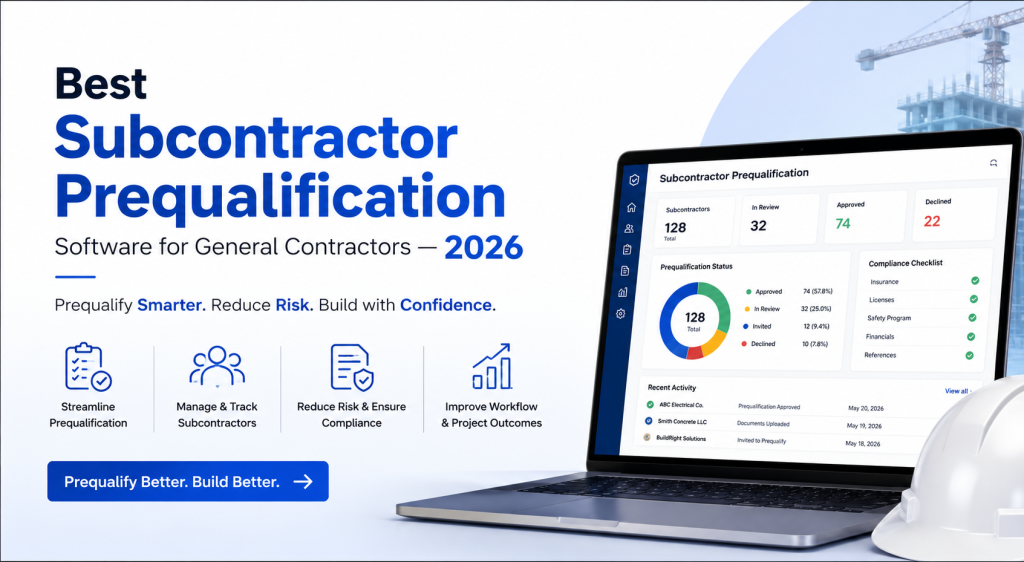
That’s why more general contractors are investing in the best prequalification software to streamline subcontractor evaluation, automate compliance tracking, and centralize project documentation. Modern subcontractor management software now helps teams reduce qualification timelines from weeks to days, improve visibility across workflows, and eliminate manual tracking errors.
In this guide, we’ll break down the best prequalification software for general contractors in 2026, what features actually matter, and how to choose the right platform for your construction workflow, subcontractor bid management process, and long-term operational growth.
Why Manual Subcontractor Management Is Costing You More Than You Think
The Hidden Cost of Spreadsheet-Based Bid Tracking
Most GCs underestimate how much manual subcontractor bid management actually costs. It’s not just the hours — it’s the compounding risk. When bid invites go out via email, responses come back in different formats, and follow-ups happen in separate threads, your team spends more time organizing information than evaluating it. Subcontractor bid management that depends on manual tracking creates version control problems, missed deadlines, and bidder pools that shrink every cycle because subs find the process too burdensome to bother.
Qualification Delays That Push Your Award Dates
Chasing financial statements, safety records, bonding letters, and insurance certificates one sub at a time is a full-time job. For GCs running multiple bids simultaneously, qualification delays don’t stay in preconstruction — they ripple into mobilization schedules, award dates, and project starts. Subcontractor tracking software that automates document requests, sends renewal reminders, and flags missing items removes the coordinator bottleneck entirely.
Scattered Documents and Compliance Exposure
When prequalification data, COIs, and license records live across emails, shared drives, and individual desktops, compliance gaps are inevitable. One expired certificate on the wrong project — discovered during an audit, not before — is an exposure you didn’t price and can’t easily fix. Centralized construction workflow management turns a recurring liability into a solved problem.
What AI-Powered Subcontractor Management Software Actually Does
The generation of construction software built around AI isn’t replacing the judgment calls it’s eliminating the manual work that was consuming the people paid to make them.
The best AI software for contractors now handles:
- Automated contractor research and discovery — identifying qualified subs across trade divisions without manual database searches
- Real-time license and insurance verification — cross-checking credentials automatically instead of waiting for documents to arrive
- Risk scoring — flagging financial red flags, poor safety records, or capacity issues before award
- Document collection and renewal tracking — automated requests, reminders, and expiration alerts with no coordinator required
- Bid communication and tracking — centralizing RFIs, scope clarifications, and responses in one place instead of scattered email threads
The result isn’t just faster prequalification. It’s a more defensible process one where every decision has a documented data trail.
Top Subcontractor Prequalification Software Platforms in 2026
Procore Prequalification
Best for GCs already running Procore across their project stack. Prequalification data flows directly into bid invites, contract awards, and project execution without manual hand-offs. Limited to one questionnaire template per company, and financial analysis depth is lighter than dedicated platforms but the workflow integration is hard to match if your team already lives in Procore.
PreQual by Vertikal RMS
The strongest option when financial default risk is your primary concern. Every financial submission goes to human analysts who review balance sheets, income statements, and credit data with actual judgment — not just automated scoring. Self-service starts at around $6/sub/year; full analyst review runs $30–$165 per submission. Paired with CertFocus for COI tracking, it covers the full compliance cycle.
Palcode AI
Built for speed and scale. Palcode’s AI engine automatically identifies qualified subcontractors, verifies licenses, and checks coverage areas across CSI divisions — cutting new-market database development from two weeks to around 48 hours. Native Procore integration means qualification data doesn’t live in a silo. Strong fit for GCs expanding into new geographies or managing broad trade partner pipelines.
Highwire
Purpose-built for safety compliance and contractor risk management. Dynamic assessments tailor prequalification questions based on trade, scope, and project location, so subs only answer what’s relevant. AI-driven safety risk analytics and a documented ROI in incident reduction make it the go-to for owners and GCs where safety metrics matter most.
COMPASS by Bespoke Metrics
The sub-friendly option. The standardized 1Form is completed once and reused across any GC using the platform, which dramatically reduces the administrative burden on trade partners. If subcontractor friction and bidder pool size are your biggest problems, this addresses the root cause rather than patching around it.
How to Choose the Right Platform for Your Operation
Not every platform solves the same problem. Match your choice to your biggest actual exposure:
- You’re on Procore: Start with Procore Prequalification. The integration value alone is worth evaluating before adding another tool.
- Financial default is your top risk: PreQual by Vertikal RMS. Automated scoring misses nuance in financials; human analysts don’t.
- Expanding into new markets: Palcode AI’s automated research and license verification cuts weeks off your pipeline development.
- Safety metrics and incident reduction: Highwire’s dynamic assessments and AI safety analytics are built specifically for this.
- Sub friction is shrinking your bidder pool: COMPASS’s 1Form model is the most sub-friendly approach on the market.
Before committing to any platform, pressure-test three things: Does it integrate with your existing ERP and project management tools? Does it create friction for your subs, or reduce it? And what does total cost of ownership look like including implementation, training, and any fees passed to subcontractors?
Ready to Stop Managing Subcontractors in Spreadsheets?
If your current process depends on a coordinator who could walk out the door tomorrow, that’s not a process it’s a single point of failure. Modern subcontractor management software gives your team a defensible, scalable system that doesn’t break when someone takes PTO.
Book a demo to see how AI-powered subcontractor management fits your workflow
Frequently Asked Questions
What is subcontractor management software?
Subcontractor management software helps general contractors qualify, track, and manage trade partners across the entire project lifecycle from prequalification and bid management through compliance monitoring and performance tracking. Platforms like Procore, Vertikal RMS, and Palcode AI automate document collection, risk scoring, and communication so your team isn’t chasing paperwork manually. The goal is replacing a fragile, person-dependent process with a repeatable, auditable system.
What is the best subcontractor tracking software for general contractors?
It depends on your primary pain point. Palcode AI leads on automated research and compliance tracking at scale. PreQual by Vertikal RMS is the strongest choice when financial vetting depth matters most. Procore Prequalification wins on workflow integration if you’re already in that ecosystem. Map your biggest exposure first financial default, compliance gaps, or bidder pool efficiency and the right platform becomes clear.
How does AI improve subcontractor bid management?
AI-powered subcontractor bid management automates the manual tasks that slow down preconstruction: contractor discovery, license verification, document requests, follow-up reminders, and risk scoring. Instead of a coordinator manually cross-referencing databases and chasing responses, the system handles the legwork and surfaces the information your team needs to make decisions. The practical result is faster award cycles, fewer compliance gaps, and a more defensible paper trail.
How long does it take to implement subcontractor prequalification software?
Simple cloud-based deployments with minimal customization can be operational within a few weeks. Complex implementations requiring ERP integrations and data migration typically take one to three months. Most platforms offer onboarding support — the bigger variable is how much historical subcontractor data you need to migrate and how many systems need to connect.
What’s the ROI on subcontractor management software?
ROI comes from three directions: efficiency gains from automating manual qualification work, risk reduction from catching bad-fit subs before they’re on your job site, and compliance cost avoidance from keeping insurance and license records current. One documented example: a pharmaceutical manufacturer using Highwire saved $7 million annually through incident reduction and eliminated platform fees paid to a prior vendor. For most GCs, the math starts with the cost of a single subcontractor default typically 1.5–3× the original contract value.
About the Author
Mohit Mohan is the founder of Palcode.ai and a builder of AI-first systems for commercial construction workflows. He works closely with preconstruction leaders to translate real field constraints coverage gaps, bid volatility, scope ambiguity, compliance friction, and estimator capacity limits into repeatable, governed operating workflows that scale across projects and teams.