A sub you’ve never worked with sends the low number on the mechanical package. Nobody on your team knows if they can bond the job or staff it. That’s the moment subcontractor prequalification was supposed to have already happened.
It’s the vetting of a trade contractor’s financials, safety record, insurance and capacity before bidding or award. It isn’t bid leveling, which compares scope and price once bids land. It also isn’t an owner prequalifying you as the GC.
Done well, it shrinks the bid list to firms you’d actually sign. Done badly, it’s a folder of expired certificates.
What Subcontractor Prequalification Actually Covers
Prequalification evaluates a trade contractor’s financial, safety, insurance, bonding, licensing, experience and operational capacity before bidding or award. In practice that sorts into seven review categories.
Bonding and insurance sit on one side. Safety and financial stability sit on another. References and operational capacity fill in the picture, and compliance checks tie it together.
Each category answers a different question. Can this firm finish the work if steel prices jump?
Will its crew get hurt, stall the site and drag your EMR along? Can it staff your job while it’s busy on three others?
Estimators feel this first, because a bid from an unvetted sub is a number you can’t trust. Procurement teams feel it in paperwork. Subcontractors feel it as one more form, which is why a clean, repeatable process gets better response rates than a fresh questionnaire every time.
One point gets missed constantly. Qualification isn’t blanket approval. GCs may cap awards based on bonding capacity, backlog, working capital, project size and trade complexity, so a sub can be approved for a $400,000 package and not a $4 million one.
Why GCs Prequalify Before Bids Come In
The cost of skipping it shows up late. A sub that runs out of working capital mid-job leaves you covering payroll or finding a replacement at premium pricing. That’s schedule failure, and sometimes a default claim.
Safety is the second exposure. A weak program means incidents, stop-work orders and a worse EMR for the firm that hired them.
Insurance gaps are the third. If a certificate lapses and a claim lands, the liability can roll uphill to you.
Why do it before bidding instead of after? Because a low bid from a firm that fails review forces you to rebid, and that burns estimator time you don’t have. Screening first keeps the bid list clean from the start.
Public owners and surety partners also look at how you select trade partners. A documented process gives you an answer when someone asks why a sub was chosen. A phone call and a hunch doesn’t.
Not every role benefits equally. Estimators gain a trustworthy bid pool. Project managers get fewer surprises in the field.
Risk and procurement staff get a paper trail. Subcontractors with strong numbers gain from it too, since it separates them from low-bid chasers.
Worth asking: if your last three bad sub experiences all passed your intake, what exactly was the intake checking?
Read More – What Is Subcontractor Prequalification? A Practical Guide for General Contractors
How GCs Structure the Subcontractor Prequalification Process
Most GCs split the work in two. They onboard a subcontractor once, refresh the file annually, and run project-specific checks for larger or higher-risk work. That keeps the baseline light and saves deep review for jobs that warrant it.
A workable flow looks like this:
- Send a standard questionnaire and collect documents.
- Score each submission against written thresholds.
- Assign an approval tier and an award limit.
- Set a renewal date, usually twelve months out.
Notice the order. Thresholds get written before anyone scores, which prevents the favorite sub from getting a pass. Consistent scoring is the whole point.
Who owns it? Usually preconstruction or procurement runs intake, with safety and risk staff reviewing their own sections. Estimators shouldn’t be verifying insurance certificates between takeoffs.
Project-specific checks matter when the trade is complex or the sub is stretched. That’s where you confirm current backlog and whether they can staff your schedule, not just whether they passed last spring. A firm approved in March can be a different company by October.
Renewal is the step that rots first. Teams build a good onboarding flow, then nobody chases the expiring files. Assign it to a person with a calendar, not a shared inbox.
Thresholds, Documents and the Subcontractor Prequalification Checklist
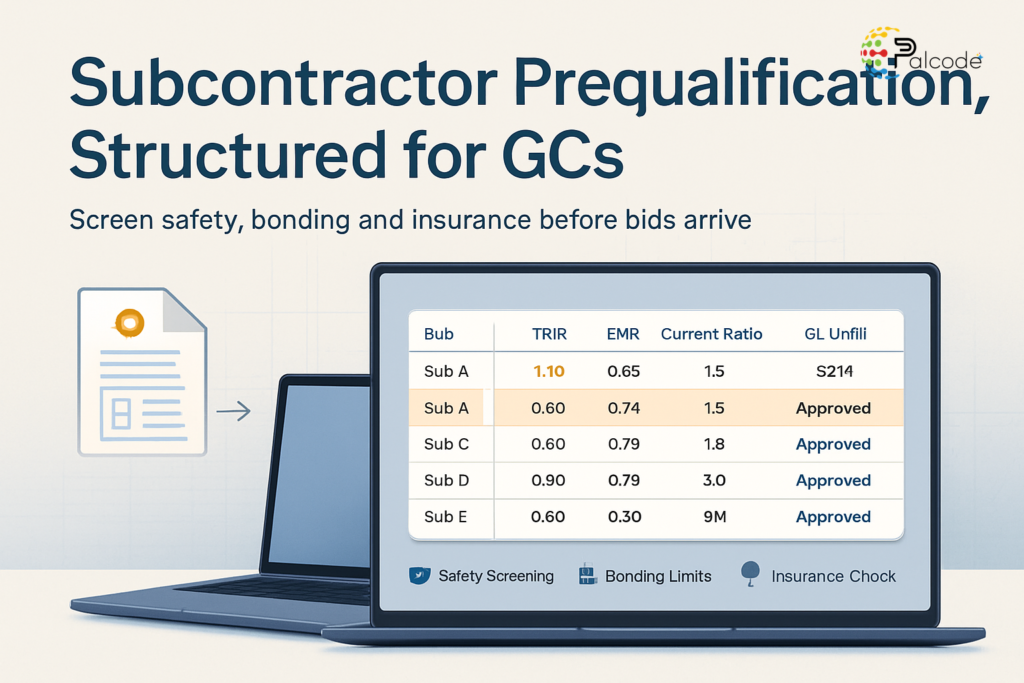
Numbers make the scoring defensible. On safety, a TRIR of 1.0 or below is a common threshold for automatic approval. The same source gives the formula: recordable incidents times 200,000, divided by total hours worked.
On the financial side, common checks include a current ratio of at least 1.2, no bankruptcy within 5 years, and no unresolved mechanics lien above your threshold. The same source cites general liability limits of $1 million per occurrence and $2 million aggregate.
It also notes that GCs commonly ask for 2 to 3 years of financial statements and EMR data for the prior 3 years.
Experience needs a yardstick too. Reviews often require 5 to 10 similar completed projects, though some forms ask for 3 to 5 projects finished within the past 3 years. Match the number to your trade and project size.
A short verification list keeps reviewers honest:
- Active license for the work location
- Insurance certificates that match your limits
- Bonding letter showing single and aggregate capacity
- EMR history and written safety program
- Three references from comparable jobs
A clean TRIR doesn’t close the file. A low EMR doesn’t replace review of DART rates, OSHA citations or a written safety program, and none of it proves they can staff your job.
Read More – Subcontractor Prequalification Checklist: What to Collect
A Worked Example: Scoring One Electrical Sub
Say an electrical sub submits a file for a mid-size package. Their crew logged 3 recordable incidents over 400,000 hours. Run the math and recordable incidents times 200,000, divided by total hours worked gives a TRIR of 1.5.
That’s above the common 1.0 line, so it doesn’t auto-approve. It doesn’t mean rejection either. A reviewer would pull the written safety program and ask what changed after each incident.
Now the financials. If their current ratio comes back at 1.1, they sit under the common 1.2 minimum. Two soft flags on one file is a conversation, and many GCs would approve with a lower award limit or a bond requirement.
That’s the point of tiers. A binary pass or fail would throw out a decent firm, while tiers let you price the risk instead of ignoring it.
Costs, Catches and Who Should Skip It
The process isn’t free. Financial screening can pull sensitive material, and that can include CPA-prepared statements, bank information, bonding letters and litigation history.
Some forms also reach back 10 years for bankruptcy records. Smaller subs push back on that, so explain what you do with the data.
Software adds another bill. Platforms may run $3,000 to $50,000 annually, plus $2,000 to $15,000 for implementation and $1,000 to $5,000 for training. The same guide flags internal administration of often $5,000 to $20,000 a year, and integrations at $2,000 to $10,000.
That second set of costs is what most buyers underestimate. The license is the visible part. The person who chases documents is the real expense.
It’s also a poor fit for very small GCs. If you don’t have someone to verify documents, run annual renewals and score consistently, the process stalls. A simple form and a few phone calls may serve you better until headcount grows.
What about AI? Adoption here is practical rather than dramatic.
Document intake and expiry tracking are the easy wins, since software can read a certificate faster than a coordinator. Judgment calls on a borderline TRIR or a stretched backlog still belong to people.
Read More – Prequalification Tool for GCs: Key Buying Criteria
Frequently Asked Questions
What TRIR is acceptable for subcontractor prequalification?
A TRIR of 1.0 or below is a common line for automatic approval. Anything higher usually triggers a closer look at the safety program rather than an instant rejection.
How often should subcontractors be requalified?
Once a year is the usual cycle. Add a project-specific check when the job is large, complex or higher risk.
What documents do I need for subcontractor prequalification?
Start with 2 to 3 years of financial statements and EMR data for the prior 3 years. Add insurance certificates and a bonding letter. References and a written safety program round out the file.
How much does prequalification software cost?
Plan on $3,000 to $50,000 a year for the license. Implementation runs $2,000 to $15,000, and training adds $1,000 to $5,000, plus internal admin time.
Is subcontractor prequalification worth it for a small GC?
Often not in a formal sense. If nobody can verify documents, chase renewals and score consistently, a heavy process just produces stale files. A short form and real reference calls work better.
How Palcode.ai Can Solve It
Once your prequalified list feeds the bid, the next bottleneck is comparing what each sub actually priced. The Bid Leveling AI Worker from Palcode.ai parses subcontractor bids and lines up inclusions, exclusions and scope gaps side by side, so estimators spend time on decisions instead of spreadsheets.
Narrow the Bid List, Then Level It Faster
Once your subs are vetted, the bids still need to be compared line by line. Talk with Palcode.ai about how bid leveling fits the workflow your estimators already run.