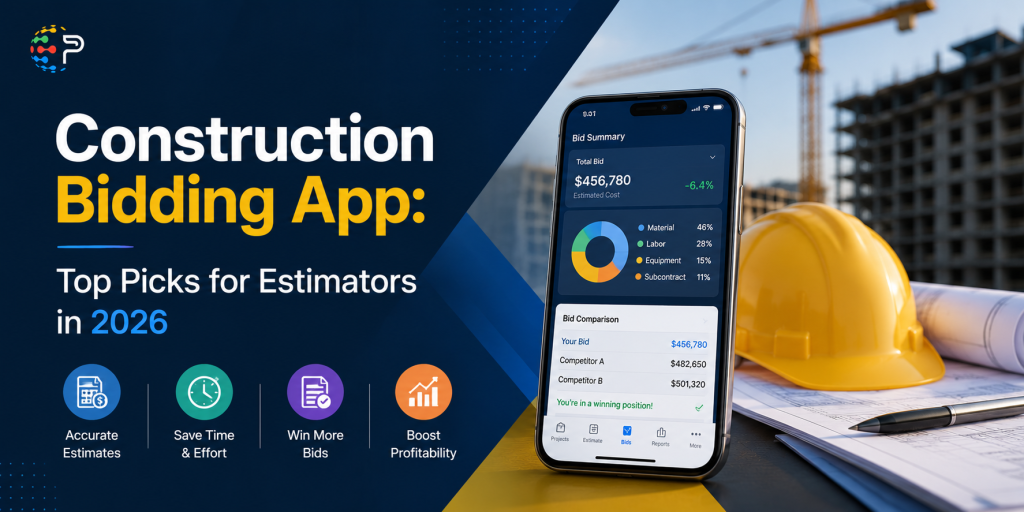
Every vendor in this space will tell you their platform is “AI-powered.” Every demo looks clean. Every sales rep has a case study ready. Then you sign up, go to invite MEP subs in your market, and half the contact records are either wrong or three years old. If you’re close to making a decision on a construction bidding app not just poking around, but actually evaluating this is the guide that tells you what these platforms actually do, where they fall short, and which type of operation each one is genuinely built for. No vendor spin. No feature-list padding.
What You’re Actually Buying
A lot of buyers waste weeks evaluating the wrong category of software. Here’s the distinction that matters:
Estimating software: Bluebeam, STACK, On-Screen Takeoff is what you use to build your own numbers. Quantities off the drawings, unit costs, labor burden, markup. That’s a different problem.
A construction bidding app: It manages the subcontractor side of preconstruction. Sending ITBs, tracking who responded, collecting quotes when they come in, leveling them before you write your GC number. Some platforms do both. Most do one or the other. And the ones that claim to do both usually do one of them badly.
The core workflow you’re trying to fix looks like this:
- Upload or reference project plans
- Identify scope packages by trade
- Build an ITB list for each trade
- Send invitations and track responses
- Collect quotes and level them side by side
- Assemble your GC bid package
The difference between platforms is how much of steps 2 through 5 they actually handle and whether their sub network has real, current contact data in your market.
Read More : Electrical Contractor Bidding Software: Top Options Compared
What to Actually Pressure-Test Before You Buy
Sub Coverage in Your Specific Market
Ignore the headline network numbers. “1.5 million subs” means nothing if half of them are stale records from 2021. During the demo, ask the vendor to pull a live list count for a specific trade within 50 miles of your main market. If they can’t do that on the spot, you have your answer about the data quality.
What Their “Bid Leveling” Actually Means
There’s a wide gap between a side-by-side price comparison and real bid leveling. Real leveling means the platform flags when a mechanical sub left out test and balance, or when a concrete sub didn’t include forming before your estimator finds it at 4pm on bid day. If you’re running 20 bids a year and your estimator spends four hours manually normalizing sub proposals into a comparable format, that’s two full work weeks a year spent on formatting. That’s the problem worth solving.
Whether the AI Actually Reads Plans
Every product page says “AI-powered” in 2026. What that actually means ranges from “we sort subs alphabetically based on a keyword filter” to “upload your plans, and it identifies scope packages by trade and builds your ITB list in under 30 minutes.” Those are not the same thing. Ask the vendor to demonstrate the plan-to-ITB workflow on a real drawing set during your demo not their curated demo project. That one question tells you more than an hour of slides.
How Pricing Actually Works at Renewal
Half these platforms won’t quote you a number until you’re two demos deep and talking to an enterprise sales rep. That’s a deliberate choice. Watch for contracts tied to your annual construction volume that’s the mechanism that lets vendors reprice you 10–15% every renewal year with a straight face, because your revenue went up even if your software usage didn’t.
Read More : AI in Construction Estimating: Which Tools Are Worth the Investment
The Top Construction Bidding Apps in 2026
Procore — Right Choice If You’re Already a Customer
Procore includes a bidding module as part of its broader construction management suite. Bid packages, sub invitations, document sharing, awarded bids converting directly to subcontracts or purchase orders it’s all there. The Planroom feature centralizes drawings and specs inside each bid package so nothing gets lost across email threads.
The real argument for Procore’s bidding isn’t the features it’s the integration. Your preconstruction data flows directly into project execution without re-keying anything at contract award. If your team lives in Procore for project delivery, that’s a genuine operational advantage.
Here’s the honest caveat: Procore prices on annual construction volume, not on features used. A mid-size GC doing $50M–$250M a year is looking at $50,000–$150,000 annually. Annual renewals have been running 10–14% increases consistently. The bidding module alone does not justify that price. If you’re already a Procore customer, use it. If you’re shopping specifically for better bid management, there are purpose-built options that deliver a comparable feature set for a fraction of the cost.
Best for: Large GCs who need project lifecycle integration and are already on Procore.
Watch out for: Volume-based pricing, renewal increases, no AI plan analysis.
BuildingConnected (Autodesk) — Strong Network, Slowing Development
BuildingConnected has the largest name recognition in preconstruction software, and the sub network is genuinely large major trade packages in most major metros have real coverage. If your firm runs Autodesk Build, Docs, or Forma for project delivery, having preconstruction in the same ecosystem has a logical appeal.
The part that doesn’t make it into the sales deck: you’re not buying one product. To get the full capability they’ll show you in a demo bid management, prequalification, estimating — you’re stacking BuildingConnected Pro, TradeTapp, and likely ProEst. That’s three separate line items. GCs who went through the full procurement process report total costs in the $15,000–$22,000+ per year range. And since the Autodesk acquisition, development pace has visibly slowed while pricing has roughly doubled over the same period.
TradeTapp’s prequalification using ConsensusDocs® 721 is legitimately good for large commercial work where sub financial risk is a real concern. That’s not a throwaway feature. But there’s no AI that reads your plans and identifies scope your estimator is still building ITB lists manually, just with a cleaner interface to track responses.
Best for: Enterprise GCs already embedded in the Autodesk ecosystem with compliance requirements.
Watch out for: Stacking costs across multiple products, limited AI features, reported price escalation post-acquisition.
STACK — The Right Tool for Takeoff, Not the Full Bidding Workflow
STACK is a precision instrument for the takeoff side of preconstruction. Upload digital plan sets, run quantity measurements, build cost estimates it does that combination faster and more accurately than most alternatives, and the cloud-based setup means your team is looking at the same version of everything in real time.
What it isn’t: a full bidding workflow platform. STACK doesn’t send ITBs, manage sub outreach, or level incoming quotes. If your pain point is takeoff accuracy and the time your estimators spend on quantity measurement, it’s worth a serious look. If your pain point is the ITB-to-leveled-bid process, STACK solves a different problem.
Best for: Estimators and subcontractors who need fast, accurate quantity takeoff.
Watch out for: Not a sub outreach or bid leveling platform narrow scope by design.
PlanHub — A Reasonable Starting Point, Not a Long-Term Answer
PlanHub’s entry point is genuinely accessible: GCs can post projects for free, invite subs from a network of 400,000+, and track who’s viewed or downloaded documents. For a smaller GC currently running the entire bidding process through a shared inbox and a color-coded spreadsheet, that’s a real improvement.
The ceiling is also real. There’s no AI reading your plans and building your ITB list you’re doing that manually. Bid leveling is basic; you’re not getting automated scope gap flagging. PlanHub 2.0 added a takeoff and estimation tool as a $699 add-on, which reduces some of the tool-switching. But for a GC running complex commercial work with 20+ trade packages per bid, the manual process bottleneck comes back fast.
It’s a reasonable place to start if you’re coming from no software at all. It’s not where you stay if you’re growing.
Best for: Smaller GCs and subcontractors who need low-cost sub outreach and document distribution.
Watch out for: Manual ITB process, basic leveling, better suited to subs than GCs managing complex scope coverage.
Buildxact — The Most Credible AI Play for Smaller Commercial Builders
Buildxact is doing something the larger platforms haven’t: actually integrating AI into the bid comparison workflow in a way that saves real time. The Blu AI tool extracts quantities from uploaded plan sets automatically reducing manual takeoff time and when sub quotes come in, it highlights pricing differences, missing line items, and anomalies across bids in the leveling view.
The audit trail is also worth noting: bid history, pricing estimates, and awarded contracts are tracked over time, which gives you real data on sub performance and pricing trends across projects not just a snapshot on bid day.
Pricing starts around $169/month, with the full AI toolset unlocked at the Master plan tier around $509/month. For smaller commercial builders who want AI in construction estimating without enterprise pricing, it’s currently the most complete option at that price point.
Best for: Small to mid-size commercial builders who want AI-assisted takeoff and leveling without enterprise overhead.
Watch out for: Complex initial setup, limited invoice customization, may be cost-prohibitive at the AI-tier for very small firms.
SmartBid by ConstructConnect — Enterprise Compliance Done Right
SmartBid is a serious tool for serious compliance requirements. Standardized prequalification using ConsensusDocs® 721, side-by-side bid comparison, bid-day management, integration with ConstructConnect’s project intelligence data — if you’re bidding public work or large institutional projects where sub financial vetting is a real risk management issue, this is the platform that treats it as such.
What it’s not: fast to implement, transparent on pricing, or right-sized for a mid-size GC with a lean estimating team. Onboarding is a real investment. The UI reflects its age. And there’s no AI plan analysis your precon team is still building ITB lists manually. If you have a large preconstruction department with dedicated bid coordinators and compliance staff, it fits. If you don’t, the operational overhead doesn’t make sense.
Best for: Large enterprise GCs with heavy compliance requirements on public or institutional work.
Watch out for: Steep onboarding curve, opaque pricing, overkill for most mid-size GCs.
Read More : AI Bid Management: How It Works and Which Platforms Lead in 2026
Simple Platform Comparison
| Platform | Best Fit | AI Plan Takeoff | Bid Leveling | Subcontractor Network | Starting Price |
|---|---|---|---|---|---|
| Palcode.ai | GCs & Chief Estimators | Yes | Yes (Full) | Integrated | Book a Demo |
| Procore | Large GCs, full project lifecycle | No | Limited | Procore Network | ~$10K–$80K+/year |
| BuildingConnected | Enterprise / Autodesk users | No | Yes | 1.5M+ subs | ~$3.6K–$15K+/year |
| STACK | Estimators / takeoff focus | Yes (Takeoff only) | No | N/A | $2,999/user/year |
| PlanHub | Low-cost subcontractor outreach | No | Basic | 400,000+ subs | Free for GCs |
| Buildxact | Small–mid contractors | Yes (Blu AI) | Yes | Integrated | ~$169–$509/month |
| SmartBid | Compliance-heavy enterprises | No | Yes | ConstructConnect network | ~$5K–$25K+/year |
| Contractor Foreman | Small GCs | No | Yes | Internal | $49/month |
How AI Is Changing the Bidding Workflow
The platforms doing this right aren’t using AI as a marketing line. They’re using it to eliminate the manual steps that quietly drain estimating hours: identifying trade scope from plan sets, building ITB lists, personalizing outreach, normalizing sub quote formats before leveling.
What the industry is still waiting for: a single platform that handles plan intake through leveled, awarded bids without requiring your estimator to bridge the gaps with spreadsheets. A few platforms get close. Most are still strong on one end of that workflow and weak on the other.
That gap is where the real evaluation question sits: which bottleneck is actually costing your team the most time right now the front end (plan-to-ITB), the back end (quote collection and leveling), or both?
Where Palcode.ai Fits
Palcode.ai is built for GCs and chief estimators who need the preconstruction workflow ITB management, subcontractor prequalification, bid leveling, and AI-powered bid management without the overhead of an enterprise suite or volume-based pricing.
The bid leveling module handles scope normalization and exclusion flagging natively. Prequalification tracks COI, EMR, bonding capacity, and DBE/MBE status in a single workflow. ITB tools send trade-specific, personalized invitations not blast emails. And none of it requires stitching together multiple products to get the capability that should come standard.
If your estimating team is currently burning time on manual ITB list-building, chasing sub responses across email threads, and reformatting proposals into comparable formats before bid day that’s the specific problem Palcode is built to compress.
If your current process has your estimators manually building ITB lists, chasing subs through email, and spending hours reformatting quotes before bid day that’s a solvable problem. Book a demo and bring a real project scope. We’ll show you exactly how the bid leveling, prequalification, and ITB workflow maps to what you’re doing today — no canned demo data.
Frequently Asked Questions
What’s the difference between a construction bidding app and estimating software?
Estimating software is for building your own numbers from plan takeoffs quantities, unit costs, labor, markup. A construction bidding app manages the subcontractor procurement side: sending ITBs, tracking responses, collecting quotes, and leveling them for comparison. Some platforms combine both, but most are built around one workflow or the other. Know which problem is costing your team the most time before you start demoing anything.
Which construction bidding app has the best AI features in 2026?
Buildxact’s Blu AI tool is the most credible AI implementation at the mid-market price point it extracts quantities from plans and flags scope gaps in the leveling view. For the ITB creation side, Downtobid uses AI plan analysis to compress scope identification from a full day to under an hour. The honest evaluation question is: does the platform actually read plans and identify trade scope, or does it just filter a sub database and call it AI?
Is Procore worth it just for the bidding module?
No. Procore’s bidding module doesn’t have AI plan analysis or automated outreach, and the pricing is based on annual construction volume not features used. You’d be paying enterprise suite rates for a feature set that purpose-built platforms deliver for a fraction of the cost. If you’re already a Procore customer, use it. If bidding is your specific pain point, there are better-fit options.
What should mid-size GCs expect to pay?
Purpose-built platforms targeting mid-market GCs typically fall in the $200–$600/month range and deliver better ROI than enterprise suites. Once you move into BuildingConnected, SmartBid, and Procore territory, you’re in quote-required pricing and GCs who’ve been through that process report $5,000–$25,000+ per year for the mid-tier tools, and $50,000–$150,000+ annually for Procore at mid-market volume.
Can I use a bidding app if I already have preferred subs?
Yes every credible platform lets you maintain your own private sub list alongside the platform network. Your existing relationships stay intact. The platform fills in coverage gaps for trades where you need to go broader. You’re not starting from scratch.
About the Author
Shikha is a Senior Product Growth Marketer at Palcode.ai, where she focuses on driving product adoption and improving user engagement through strategic, data-driven marketing. She also contributes to website content creation, translating complex product ideas into clear, structured, and SEO-optimized content that enhances user understanding and visibility.