Ask any experienced GC what quietly kills project schedules and you’ll hear the same things: change orders, weather, slow design teams. But submittals rarely make the list even though a poorly managed submittal process causes most of those downstream headaches in the first place.
That’s not an exaggeration. A 35% first-pass rejection rate is the industry average. On a 500-submittal project, that means 175 packages bouncing back each one carrying a 2–4 week delay and roughly $805 in direct administrative costs. The math gets ugly fast.
This guide is for the GC or preconstruction manager who wants to actually run the submittal process well not just survive it. We’ll walk through every step, who owns what, where things go sideways, and what separates teams that finish clean from the ones still chasing approvals when the schedule is already bleeding.
What Is a Construction Submittal?
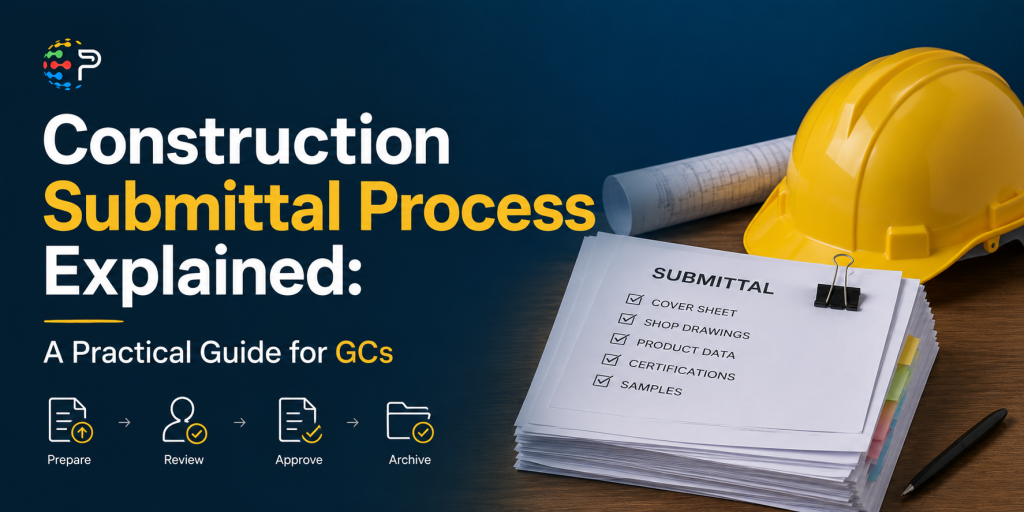
Here’s the plain version: a submittal is proof that what you’re about to install is what was designed. Before materials get ordered, fabricated, or delivered to the site, the contractor or sub sends documentation to the design team showing exactly what they plan to use. The architect or engineer reviews it against the drawings and specifications. If it checks out, work moves forward. If it doesn’t, it comes back and the clock starts over. It’s not a formality. It’s the checkpoint between “we think this is right” and “we know this is right.” A complete submittal package typically includes:
- Product data sheets or cut sheets with model numbers and specifications
- Shop drawings when fabrication dimensions or coordination matter
- Finish, color, and hardware selections
- Required certifications (UL, AHRI, ASME, and whatever the spec section calls for)
- A spec section reference, submittal number, and revision tracking
- A transmittal form that tells the reviewer what’s in the package and what action you need from them
Here’s a quick field example: your MEP sub is ordering rooftop HVAC units. Before the purchase order goes anywhere, they submit cut sheets, efficiency ratings, dimensional data, and refrigerant type. The mechanical engineer checks it against the spec. If it passes, procurement proceeds. If the refrigerant type is wrong R-410A submitted when the spec calls for R-454B you’ve got a problem that just ate three weeks of schedule float.
Why Most GCs Don’t Take Submittals Seriously Enough
The submittal process gets treated like a paperwork obligation. It shouldn’t be. When 35% of submittals come back rejected on first pass, that’s not just a nuisance it’s a structural schedule risk. At $805 per rejection in direct administrative burden alone, a 500-submittal project running at that rate generates over $140,000 in preventable costs before a single piece of equipment hits the site. And that figure doesn’t include the downstream effects: compressed trade schedules, potential liquidated damages exposure, procurement delays on long-lead items, and the accumulated relationship strain with your design team when the same packages keep bouncing back. The submittal process is your cheapest and earliest opportunity to catch non-compliance. Finding the problem on paper is an afternoon. Finding it after installation is a crisis.
Read More: Best RFI and Submittal Tracking Software for Construction
The Construction Submittal Process: Step by Step
Step 1: Build the Submittal Schedule Before Anyone Starts Compiling
The GC owns the submittal schedule. Not a shared responsibility the GC owns it. And it needs to exist before subcontractors start pulling cut sheets. A good submittal schedule maps every required item to a responsible party, a target submission date, an expected review window, and a procurement “need-by” date. The trick is building it backward from installation dates, not forward from contract award.
This matters most for long-lead equipment. Chillers run 20–26 weeks from order to delivery. Generators, 24–32 weeks. Custom switchgear, 26–40 weeks. Elevators, 20–26 weeks. If you haven’t approved those submittals well before most teams even think to push for them, you’ve already got a schedule problem you just don’t know it yet. The submittal schedule should be a living document tied to the CPM schedule. Items on the critical path get priority. Long procurement windows get submitted first. And it gets updated when the project changes, not once at kickoff and never again.
Step 2: Subs Prepare the Submittal Package
Once the schedule is set, subcontractors start compiling. This means pulling the spec sections that cover their scope, identifying every required submittal within those sections, and sourcing documentation from vendors and fabricators. This is also where most of the problems that show up later actually start.
Unmarked cut sheets. Generic manufacturer catalogs instead of project-specific documentation. Missing certifications. Wrong model numbers. No spec section reference. These feel like small oversights, but each one is a reason for rejection downstream and by the time the design team sends it back, you’ve lost weeks you didn’t have to spare.
Subs who consistently mark their cut sheets, reference CSI spec sections, include lead times, and label revisions cleanly move through the review cycle faster. That sounds obvious, but it’s rare enough to be a competitive advantage.
Step 3: GC Preliminary Review The Most Important Step
Here’s the honest truth about the GC preliminary review: it’s the single highest-leverage step in the entire submittal process, and most teams treat it like a rubber stamp. Before anything reaches the design team, the GC’s project engineer reviews the package for completeness and basic spec compliance. That means cross-referencing cut sheets against the relevant spec sections, verifying product tags match the drawing schedules, checking that required certifications are actually included, and making sure proposed products aren’t undocumented substitutions in disguise.
During months 2–7 of a commercial project — when submittal volume peaks this step is where things fall apart. Project engineers are working through dozens of packages simultaneously, cross-referencing 70-page manufacturer cut sheets against 30–50-page specifications under schedule pressure. When teams are stretched, rejection rates spike to 40–50%. Catching a refrigerant type mismatch or a missing AHRI certification before the submittal reaches the engineer costs an hour. Catching it after equipment is installed costs months. If there’s one place to invest more time in your submittal process, this is it.
Step 4: Formal Submission to the Design Team
Once the GC review is done and the submittal is stamped with review notes, it goes to the architect or engineer usually through project management software. The transmittal documents what’s in the package, which spec sections are covered, any substitutions being proposed, and any specific decisions the design team needs to make. This is the gate. From here, the submittal either gets approved and moves to procurement, or it comes back and the whole cycle starts over.
Step 5: Design Team Technical Review
Architects and engineers review submittals against the contract documents drawings, specifications, applicable codes, and design intent. It’s not a single reviewer. Different submittals route to different people: structural steel shop drawings go to the structural engineer, mechanical and electrical equipment goes to the MEP engineers, finishes and envelope assemblies go to the architect.
Standard review windows run 5–10 business days per contract, but backlogged design teams on large projects can push to 4–6 weeks. On most large commercial projects, design teams are managing review queues across 10 or more active jobs simultaneously. Your submittal isn’t their only priority. The cleaner and more complete your package is when it arrives, the faster it moves.
What they’re actually checking:
- Full compliance with every applicable specification requirement
- Building codes — IBC, ASHRAE, NFPA, NEC, and local jurisdictional requirements
- Physical dimensions, clearances, and coordination with adjacent systems
- Performance ratings and required third-party certifications
- Equivalency documentation for any “or equal” substitutions
- Warranty terms and the adequacy of O&M documentation
Step 6: Response and What Happens When It Comes Back “Revise and Resubmit”
The design team sends back one of the following:
| Response | What It Means | Schedule Impact |
|---|---|---|
| Approved | Meets specs — proceed with procurement | None |
| Approved as Noted / Approved with Exceptions | Minor issues; proceed with documented modifications | Minimal |
| Revise and Resubmit | Non-compliance identified; correct and resubmit | 2–4 week delay — full cycle restarts |
| Rejected | Wrong product or major non-compliance | 2–4+ weeks — full resubmission required |
When “Revise and Resubmit” lands in your inbox, the whole loop restarts: the sub coordinates with the manufacturer, revises the package, resubmits to the GC, the GC reviews again, resubmits to the design team, the design team reviews again. That cycle burns float. And when it happens on a long-lead item, you’re not just burning float you’re pushing out your procurement date, which pushes out fabrication, which pushes out delivery, which eventually pushes out your installation window.
Step 7: Final Approval and Procurement Release
Once the design team stamps the submittal approved, the GC gets the approval to the sub so the purchase order can go to the manufacturer. From that point, the approved submittal becomes the permanent project record the basis for as-builts, warranty claims, and O&M manual compilation at closeout.
The chain runs: approved submittal → purchase order → fabrication → shipping → delivery → installation. Every week of delay at the beginning of that chain extends the end. Treat the procurement release as schedule-critical, because it is.
Submittal Types at a Glance
| Type | What It Includes | Who Prepares | Typical Timing | % of Total |
|---|---|---|---|---|
| Product Data | Cut sheets, certifications, performance data | Supplier/Vendor | Early procurement | ~70% |
| Shop Drawings | Fabrication and installation details, dimensions | Sub or fabricator | Pre-fabrication | ~20% |
| Samples | Physical material pieces, finish chips | Sub or supplier | Before ordering | ~10% |
| Mockups | Test assembly verifying look, fit, and performance | Sub | Pre-construction or early construction | Varies |
| Engineering Calculations | Load calcs, voltage drop, hydraulic calcs | Sub’s engineer | Per spec requirements | Varies |
| Closeout Submittals | As-builts, warranties, O&M manuals | Sub / GC | Project closeout | Ongoing |
Learn More: What Is Subcontractor Prequalification? A Practical Guide for General Contractors
Deferred Submittals: What GCs Often Get Wrong
Deferred submittals aren’t just late submittals. They’re a specific category: design work that was intentionally excluded from the permit set and delegated to a specialty contractor whose engineer will actually design it.
Common examples include structural steel connections designed by the fabricator’s engineer, post-installed anchors, fire protection system layouts, and certain mechanical system details. The specialty contractor’s licensed engineer of record stamps the work; it’s contractor-specific design, not just product selection.
The critical difference from a standard submittal is that deferred submittal packages must be reviewed and approved by the engineer of record and, in most jurisdictions, the authority having jurisdiction (AHJ), before that scope can proceed. They don’t route through the normal GC-to-design-team channel. Treating them like standard product data submittals is one of the faster ways to land an inspection hold on work you thought was cleared.
How AI Is Changing the GC Preliminary Review
The GC preliminary review is where the most rejection risk lives and where manual processes break down first under volume pressure. A PE reviewing dozens of MEP equipment submittals during peak project months is hunting through 70-page cut sheets for specific technical parameters: refrigerant type, MERV ratings, efficiency ratings, coil coating specs. One missed line item means a 3-week rejection cycle.
AI-powered submittal review tools now handle that cross-referencing automatically extracting technical characteristics from manufacturer cut sheets and comparing them against project specifications before the package reaches the design team. Teams using these tools have pushed first-pass rejection rates under 5% while recovering most of the PE time that was going into manual data extraction.
The model isn’t “trust the AI and move on.” The AI does the extraction and comparison; the PE reviews the findings and makes the calls. The difference in practice is between a PE spending six hours digging through a cut sheet and spending 45 minutes reviewing a structured compliance analysis. Same expertise, much better use of time.
Know More: How Voice AI Improves Bid-Day Response for Busy Preconstruction Teams
5 Things High-Performing GC Teams Do Differently
1. They start long-lead submittals before anyone asks them to.
Chillers, generators, custom switchgear, elevators — these need approvals before most teams are even thinking about it. Build the submittal schedule backward from procurement deadlines, not from NTP convenience.
2. They run a dedicated submittal kickoff with subs before the first package is submitted.
What documentation does each spec section require? What does acceptable “or equal” documentation actually look like? What are your review timeline expectations? Subs who get that conversation upfront submit cleaner work.
3. They actually invest in the GC preliminary review.
This isn’t a checkbox step. It’s the difference between a 35% rejection rate and a 5% rejection rate. The time you spend here gets returned to you many times over.
4. They track who has the ball at all times.
GC, sub, architect, engineer everyone should be able to see at any given moment who holds a submittal and when the response is due. No “I thought you had it” conversations.
5. They tie due dates to real procurement and installation dates.
Review windows that aren’t connected to actual schedule needs are just theater. Work backward from installation dates. Build in a buffer for at least one revision cycle on anything complex.
Managing submittals in isolation is exactly how they become a bottleneck. The strongest preconstruction teams connect their submittal schedule, subcontractor coordination, and approval tracking inside one platform — so when a submittal stalls, everyone sees it immediately and knows what it means for procurement. If you’re rethinking how your team manages this process, take a look at how Palcode approaches preconstruction workflow automation. Book a demo to see how it works on projects like yours.
Frequently Asked Questions
What is a submittal schedule and why does the GC own it?
The submittal schedule is a master tracking document covering every required submittal on the project responsible parties, submission dates, review windows, and procurement deadlines. The GC owns it because the GC is responsible for the overall construction schedule, and submittal approval timing directly drives when subs can place purchase orders. An unmanaged submittal schedule is one of the most common root causes of long-lead material delays.
What’s the difference between a submittal and a deferred submittal?
A standard submittal confirms that a proposed product or material meets the project specifications. A deferred submittal covers specialty design work that was excluded from the original permit set work delegated to a trade contractor’s licensed engineer to actually design. Deferred submittals require review and approval from the engineer of record and usually the local AHJ before that scope can proceed. They need separate tracking and different routing than standard submittals.
What’s a submittal package versus a single submittal?
A single submittal covers one spec section or item. A submittal package groups related submittals together for example, a full lighting package covering all fixture types on the project, submitted together so the design team reviews them as a coordinated set. Packages are generally more efficient for the design team but require more thorough upfront organization from the GC and sub.
What are the most common reasons submittals get rejected on first review?
The biggest culprits: unmarked or generic cut sheets with no clear product identification, missing required certifications (AHRI, UL, ASME, DLC, etc.), products that don’t actually meet spec requirements (wrong refrigerant type, insufficient efficiency ratings, incorrect mounting options), incomplete documentation that forces an RFI, and “or equal” substitutions without adequate equivalency backup.
How do you manage submittals on a fast-track project?
Aggressively front-load. Long-lead submittals go out before the complete submittal log is even finished. Review windows should be locked in contractually and tied to NTP-relative dates, not floating deadlines. Package submittals by critical path dependency so the design team knows what to prioritize. And invest in tools that compress GC review time when the schedule is compressed, there’s no margin for a multi-day manual cross-reference exercise on every package.
About the Author
Shikha is a Senior Product Growth Marketer at Palcode.ai, where she focuses on driving product adoption and improving user engagement through strategic, data-driven marketing. She also contributes to website content creation, translating complex product ideas into clear, structured, and SEO-optimized content that enhances user understanding and visibility.