
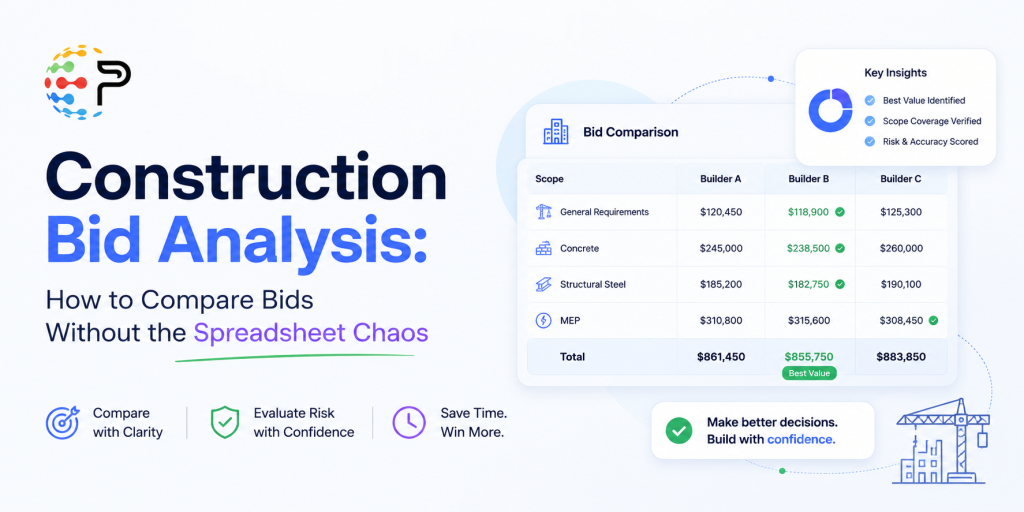
Every GC has lived this scenario. Bid day closes, six sub proposals land in your inbox within the same two-hour window, and now someone on your estimating team is manually transferring numbers into a comparison spreadsheet — tab by tab, line by line, hoping nothing gets transposed.
That spreadsheet has been the industry standard for decades. It also quietly costs firms thousands of dollars in estimator hours, introduces scope gaps that don’t surface until mid-project, and produces bid decisions that are only as good as whoever built the formula logic.
If you’re evaluating contractor bidding software or looking to tighten your preconstruction workflow, this guide breaks down what construction bid analysis actually involves, where the manual process breaks down, and what to look for in a platform built to handle it properly.
What Construction Bid Analysis Actually Involves
Bid analysis isn’t just price comparison. Done correctly, it’s a multi-stage evaluation process that runs from the moment ITBs go out to the moment a contract gets awarded.
The full process covers four distinct phases:
Preliminary screening: It confirms that submissions are complete, legally compliant, and properly formatted before any real evaluation begins. Bids with missing documents, unsigned forms, or absent bid security don’t advance. This isn’t bureaucratic it’s a signal. A sub that can’t follow ITB requirements usually can’t follow scope requirements either.
Technical evaluation: It assesses whether the bidder can actually do the work: relevant experience, schedule compliance, material specs, warranties, and execution capability. This phase is where qualification-based decisions happen and where the lowest number can and often should get set aside.
Price evaluation and bid leveling: It is where most firms spend the majority of their time and where most errors occur. Leveling means organizing bids so you’re comparing equivalent scope across all submissions. One concrete sub includes rebar; another doesn’t. One mechanical bid covers commissioning; another stops at rough-in. Without explicit scope alignment, you’re not comparing bids you’re comparing assumptions.
Post-qualification and award:It closes the loop, verifying that the selected contractor’s representations were accurate before the contract executes.
Most spreadsheet-based processes handle phase three reasonably well on simple scopes. They struggle badly on everything else.
Read More : Construction Task Automation: What to Automate and Which Tools Do It Best
Where Manual Bid Comparison Breaks Down
Scope Gaps Don’t Surface Until It’s Too Late
The core problem with spreadsheet-based construction bid analysis is that it’s reactive. You compare what was submitted, not what was required. When a sub excludes a line item intentionally or because they read the scope differently that omission only becomes visible if your estimator catches it during review.
On a $4M fit-out with 12 sub packages, that’s a lot of line items to catch manually. Firms that have moved to AI bid management tools flag these gaps automatically by comparing submission content against the original scope document. The estimator still makes the call but the system surfaces the discrepancy rather than requiring them to find it.
Bias Contaminates Decisions
Choosing the same sub you’ve always used, even when a competitor submitted a sharper number with equivalent qualifications, is a margin problem. So is awarding based on relationship rather than a scored evaluation framework.
Strong contractor bidding software builds in weighted scoring price, safety record, schedule history, DBE/MBE status, COI compliance so the decision reflects the criteria that actually matter for the project, not just familiarity or recency.
Bid Tracking Falls Apart Under Volume
A firm running 10–15 active bid solicitations simultaneously cannot track ITB status, submission deadlines, follow-up communications, and leveling progress across all of them in a shared spreadsheet without something slipping. Bid invitation software that centralizes all active solicitations, automates deadline reminders, and logs every sub interaction eliminates the tracking overhead that eats estimating capacity.
Read More : Contractor Bidding Software: What to Look For Before You Buy
The Bid Leveling Problem: Apples to Apples Doesn’t Happen Automatically
Bid leveling deserves its own section because it’s the most labor-intensive and error-prone part of the entire construction bid analysis process.
The goal is to normalize all received bids against a common scope baseline typically organized by CSI division so the evaluation team is making genuine comparisons. In practice, this means identifying what each sub included, what they excluded, and what needs a plug number to complete the picture.
The classic example: three sub bids on the same concrete scope come in at $300K, $345K, and $225K. The $225K number looks compelling until you notice it doesn’t meet the safety requirements in the ITB. The $300K bid doesn’t include rebar. Once you insert a market-rate plug number for the missing rebar, that bid moves to $330K and suddenly the $345K fully-compliant submission looks like the cleaner choice.
That logic is straightforward on one package. Multiply it across eight or ten CSI divisions with multiple bids per package, and the cognitive load on your estimating team becomes the actual bottleneck.
AI bid management platforms handle this by automatically flagging missing line items, suggesting plug values based on historical project data, and generating leveled comparison views without requiring manual spreadsheet work. The estimator reviews and approves but they’re not building the leveling matrix from scratch.
Bid Analysis Methods: Choosing the Right Evaluation Framework
Not all projects use the same selection criteria, and your bid analysis process should reflect that.
| Selection Method | Primary Criteria | Best Fit | Risk |
|---|---|---|---|
| Price-based | Lowest responsive bid | Public / government work | Excludes qualitative factors |
| Best-value | Price + experience + safety + schedule | Mixed commercial | Requires clear scoring rubric |
| Qualification-based | Capability and track record, price secondary | Specialized / high-risk scopes | Higher cost tolerance required |
| AI-assisted scoring | Weighted multi-factor with automated flagging | High-volume preconstruction | Requires clean historical data |
For most commercial GCs, best-value selection is the practical standard. The challenge is applying it consistently which requires a defined scoring framework applied the same way to every sub, every project. That consistency is hard to maintain in a spreadsheet environment and much easier to enforce in a purpose-built contractor bidding software platform.
What to Look for in Construction Bid Tracking and Analysis Software
If you’re actively evaluating platforms, these are the capabilities that separate useful tools from ones that add process overhead without removing it.
Centralized bid invitation management: Every active solicitation, every submission deadline, every sub communication in one place. Bid invitation software that still requires you to manage follow-ups via email is half a solution.
Automated scope gap detection: The platform should compare submitted bid content against your scope document and flag missing items not wait for your estimator to catch them.
Leveling built into the workflow: Side-by-side normalized comparisons, plug number suggestions, and scope deviation logging should be native features, not something you export to Excel to build manually.
Subcontractor prequalification integration: Bid analysis and sub qualification are part of the same decision. A platform that handles both EMR tracking, COI compliance, financial vetting eliminates the handoff friction between estimating and risk management.
Audit trail and decision documentation: When a bid dispute arises, you need documentation of how the award decision was made. Platforms that log evaluation criteria, scoring, and selection rationale protect you legally and operationally.
Historical data utilization: The best AI bid management tools use your past project data actual costs by CSI division, sub performance history, regional labor rates to inform plug numbers and flag anomalies in incoming bids. This compounds in value over time as the system learns your project mix.
Read More : Construction AI Workflow Software: How Leading Teams Are Using It in 2026
Frequently Asked Questions
What is construction bid analysis?
Construction bid analysis is the structured process of evaluating contractor and subcontractor proposals after the ITB submission deadline. It covers preliminary compliance screening, technical qualification review, price evaluation and scope leveling, and post-qualification verification. The goal is to identify the most suitable bid not simply the lowest number based on criteria specific to the project.
What is bid leveling in construction?
Bid leveling is the process of normalizing all received bids against a common scope baseline so they can be compared accurately. Because different subs interpret scope differently, bids often include or exclude different line items. Leveling identifies those gaps, inserts plug numbers for missing items, and produces an apples-to-apples comparison across all submissions. It’s the most labor-intensive part of bid analysis and the phase most improved by AI bid management software.
Why is the lowest bid not always the best choice?
The lowest bid may exclude required scope items, rely on labor rates that aren’t sustainable, or come from a subcontractor whose safety record or financial stability introduces project risk. Best-value bid analysis incorporates price alongside qualifications, experience, safety record, and schedule capability. A bid that looks cheap at award can become expensive by substantial completion.
What’s the difference between bid analysis and bid evaluation?
These terms are often used interchangeably, but there’s a useful distinction. Bid evaluation typically refers to the broader process ITB issuance through contract award. Bid analysis refers specifically to the analytical work of comparing and scoring received proposals. Analysis is a phase within evaluation.
How does AI improve construction bid analysis?
AI bid management tools improve bid analysis primarily by automating the most time-intensive manual tasks: scope gap detection, line-item normalization, plug number suggestion, and multi-factor scoring. They also apply historical project data to flag anomalies a bid significantly below market average on a specific scope, for example that a manual review might miss under deadline pressure. The estimator still owns the decision; AI handles the data work that makes that decision faster and more defensible.
See What Structured Bid Analysis Looks Like in Practice
If your preconstruction team is still managing bid comparison in spreadsheets or evaluating platforms that don’t fully address scope leveling, sub prequalification, and bid tracking in one workflow Palcode.ai is worth a closer look.
We’ll show you the platform against your actual project types and bid volume so you can evaluate it against the specific bottlenecks in your current process. Book a demo
About the Author
Mohit Mohan is the founder of Palcode.ai and a builder of AI-first systems for commercial construction workflows. He works closely with preconstruction leaders to translate real field constraints coverage gaps, bid volatility, scope ambiguity, compliance friction, and estimator capacity limits into repeatable, governed operating workflows that scale across projects and teams.