Most teams understand what an RFI is. The friction shows up in the handoffs: who’s responsible at each step, what happens when the chain breaks down, and why a question that should take a day somehow consumes two weeks of schedule. If you’ve watched a straightforward clarification stall out while a crew sits idle, you already know the stakes.
Who Submits an RFI in the Construction RFI Process
Subcontractors initiate the vast majority of RFIs. They’re the ones working closest to the drawings, and they’re the first to hit a spec section that contradicts a detail sheet or a dimension that simply doesn’t resolve. The GC’s site team also submits RFIs directly when they encounter unclear drawings or conflicting standards — though less frequently than sub-driven submissions.
The trigger is always the same: something in the contract documents is unclear, missing, or internally inconsistent. A well-formed RFI references the specific drawing sheet or spec section at issue, proposes a suggested resolution where possible, and gets routed to the GC first — not straight to the design team.
That last point matters more than people give it credit for. Subcontractors who send RFIs directly to the architect, bypassing the GC, create a coordination problem even when the question itself is legitimate.
The RFI Workflow: How It Moves Through the Chain
Once the subcontractor submits to the GC, the GC reviews it. If the answer exists in documentation the GC already holds, it gets resolved there. That’s the ideal case — and it’s faster than most teams assume it could be.
If the GC can’t resolve it, the RFI escalates to the design team: typically the architect, but sometimes a structural or MEP engineer, a specialty consultant, or the owner directly, depending on where the gap lives. The architect coordinates with other consultants as needed before drafting a response. That coordination step — reviewing original design intent and sometimes validating technical feasibility with outside parties — is where most of the elapsed time accumulates.
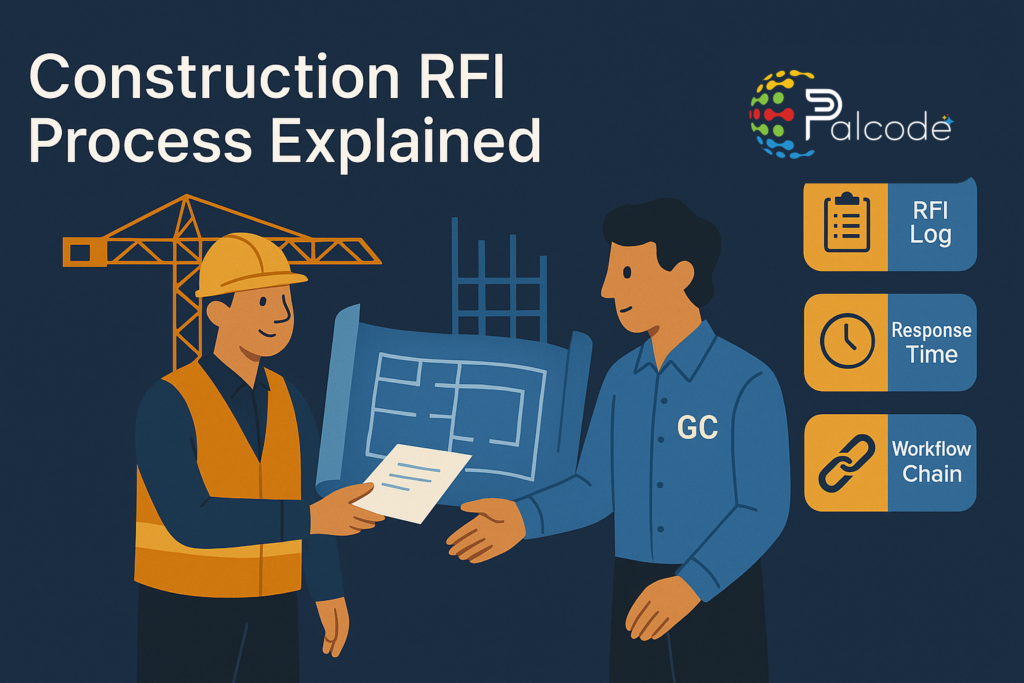
The written response then travels back down: from the design team to the GC, and from the GC to the sub. If the answer resolves the issue, the RFI is marked closed and work resumes. If it doesn’t, the sub may need to resubmit with additional context — which restarts the clock.
Understanding the full RFI project management process from a GC’s perspective helps teams anticipate where handoffs tend to break and set realistic expectations with subs before the first RFI even arrives.
Who Actually Responds to an RFI
The architect handles the largest share of RFI responses on most commercial projects. Their role is to review the request for completeness, coordinate with discipline engineers when the issue touches structural, mechanical, or electrical systems, and draft a response that reflects original design intent — not improvise in the field.
Complex RFIs sometimes loop in the owner or a specialist consultant, particularly when the question involves something outside the architect’s direct scope. The responding party also has to decide whether the clarification is a true interpretation of existing documents or a scope change that needs a formal contract modification. That distinction has real cost implications and tends to slow things down when the line isn’t obvious.
How Long the Construction RFI Process Actually Takes
The honest answer is 7 to 10 days for a standard RFI, based on industry data. Contract language usually specifies a response window somewhere between 5 and 14 days, and research from Navigant puts the real-world range at roughly 6.4 to 10 days, varying by project size and region.
Urgent RFIs — flagged because work literally can’t proceed otherwise — are typically resolved in 24 to 48 hours. That timeline is achievable, but depends entirely on the design team being reachable and the question being genuinely answerable without extensive coordination.
What often gets underestimated is the total effort behind a single RFI cycle. A Navigant study puts the average processing effort at about 8 hours per RFI when you add up administrative logging, technical review, response drafting, and distribution. The cost side is starker: the average RFI cycle from issuance to response runs approximately $1,080. Multiply that across a 200-RFI project and the overhead becomes a meaningful budget line on its own.
That’s the part most teams underestimate. It’s not just the calendar days — it’s the cumulative labor going into questions that, in a cleaner documentation set, might never have needed to be asked.
What Drives RFI Delays
Response times stretch for a handful of predictable reasons. Design documents that weren’t fully coordinated before construction started generate more RFIs — and more complex ones. Architect availability matters; a single-person design firm responding between site visits doesn’t move at the same pace as a full project team.
RFIs that lack specificity also take longer. A vague question forces the responding party to guess at scope, coordinate more broadly, and hedge the answer. A well-formed RFI with a specific drawing reference and a proposed solution gets answered faster — almost universally.
Tracking is another friction point. Manual RFI logs built in spreadsheets frequently miss aging items until they’ve already delayed a crew. RFI software for construction addresses exactly this problem by automating status tracking and surfacing overdue items before they compound.
RFI Roles and Responsibilities: A Quick Reference
- Subcontractor: Identifies the gap, drafts the RFI, references specific documents, submits to GC
- General contractor: Reviews for completeness, resolves if possible, escalates to design team with appropriate context
- Architect: Primary responder on most RFIs, coordinates with consultants, responds in writing
- Engineers and consultants: Provide technical input on discipline-specific questions that fall outside the architect’s direct scope
- Owner: Occasionally involved when the question touches contract obligations or scope decisions that require their authorization
How Automation Is Changing the RFI Workflow
The structural roles in the construction RFI process aren’t changing. Subcontractors will still submit, architects will still respond, and GCs will still coordinate the handoffs. What’s shifting is how fast those handoffs happen and how much admin labor they consume.
AI workers are getting better at parsing project documentation to flag likely RFI triggers before they become formal requests. Automated logging and routing reduce the gap between submission and delivery to the right party. Some platforms now track response aging in real time and escalate automatically when a deadline is approaching — which historically required a project engineer to babysit a spreadsheet.
Adoption is still uneven across the industry. Larger GCs with dedicated preconstruction teams are integrating these tools faster than smaller firms, partly because the ROI is easier to quantify when you’re processing dozens of RFIs per project. But the underlying math — roughly $1,080 per RFI cycle and 8 hours of effort — makes the case for almost any project size.
Frequently Asked Questions
Can a subcontractor send an RFI directly to the architect?
Technically possible, but it usually creates problems. Standard RFI workflow routes submissions through the general contractor first, who reviews, filters, and escalates as needed. Bypassing the GC can cause coordination gaps and may violate the project’s contract terms.
What happens if the design team doesn’t respond within the contract’s RFI window?
A missed response deadline can create a basis for a time extension claim or a cost claim if the delay caused schedule impacts. Most contracts set a 5 to 14 day response window — documenting when the RFI was submitted and when a response arrived matters for any dispute that follows.
How much does an RFI typically cost the project?
Around $1,080 per RFI cycle on average, based on Navigant research, once you account for administrative logging and technical review. At roughly 8 hours of total effort per RFI, the cost adds up quickly on projects with high RFI volumes — and that’s before factoring in any crew downtime waiting on answers.
What’s the difference between an RFI and a submittal?
An RFI is a question asking for clarification on existing design intent or contract documents. A submittal is the contractor’s formal submission of product data, shop drawings, or samples for the design team’s review and approval. They serve different functions, though both flow through the GC and get logged as project documentation.
How do you reduce the number of RFIs on a project?
Better pre-construction coordination is the most direct lever. Projects that run thorough document reviews before mobilization — and flag ambiguities in drawings during the bid phase — tend to generate fewer field RFIs. Clearer scope documents and well-coordinated drawing sets reduce the gaps that trigger most requests.
See How Palcode.ai Handles the Coordination Work Behind Every RFI
If your team is spending meaningful time logging, routing, and chasing RFI responses across projects, Palcode.ai was built for exactly that workflow. Our AI workers help GCs and preconstruction teams manage document coordination with less manual overhead and fewer things falling through the cracks. Book a demo to see how it works on a project like yours.