If you’re evaluating bidding and estimating software right now, you’ve probably already felt the pain that’s driving the search: takeoffs that take too long, bids assembled across too many spreadsheets, and a growing sense that your competitors are moving faster than you.
The market has a lot of options. Most of them solve part of the problem. Very few solve all of it and some create new inefficiencies while fixing old ones.
This guide cuts through the noise. It covers what separates capable software from genuinely useful software, what different platforms are built for, and the questions you need to answer before you sign anything.
Why Spreadsheet-Based Estimating Has a Hard Ceiling
Manual estimating isn’t just slow it’s a liability. A study by QuickBooks and TSheets found that one in four firms would go out of business after just two or three inaccurate estimates. That’s the real stakes behind a missed line item or an outdated unit price.
The core problem with spreadsheet-based workflows isn’t effort estimators put enormous effort into them. It’s the absence of a system: no version control, no integration with live material pricing, no audit trail when a bid gets questioned.
Construction estimating software doesn’t replace good estimating judgment. It removes the structural vulnerabilities that make inaccurate estimates more likely.
Read More : Best Construction Bid Software in 2026: An Honest Comparison
What Contractor Bidding Software Actually Does
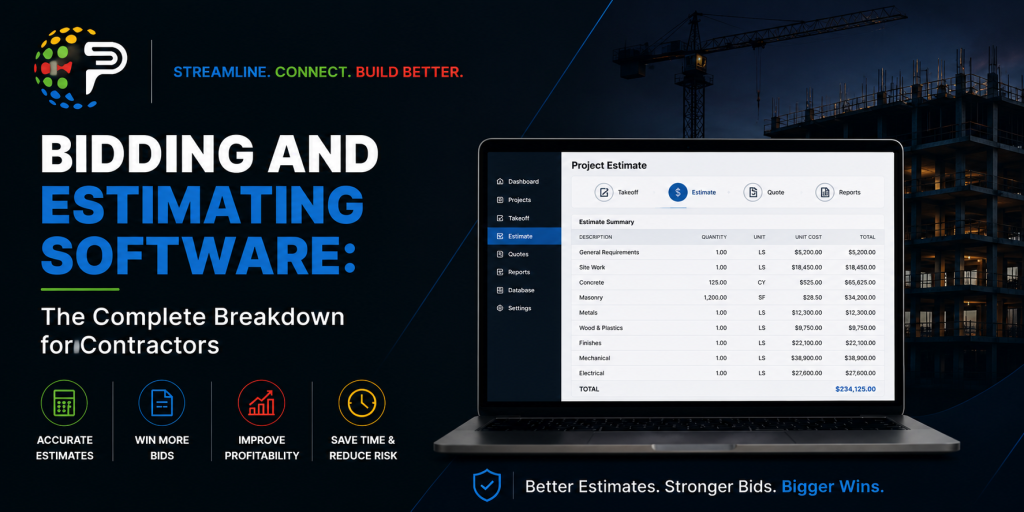
Before comparing platforms, it’s worth being precise about what the category covers. Construction estimating software refers to a digital tool or a suite of tools that empowers estimating teams to accurately and efficiently estimate their project bid price, with features that typically include quantity takeoffs and project scope determination.
In practice, “estimating software” spans a wide range from standalone takeoff tools to full preconstruction suites that handle everything from ITB management to bid leveling. Here’s what a capable platform should handle:
Digital Takeoff — Measuring directly from digital plans, eliminating manual scale-ruler calculations. When design changes occur during preconstruction or construction phases, software keeps those revisions accounted for so they don’t create cost exposure.
Assemblies and Cost Libraries — Reusable cost assemblies tied to CSI divisions, updated with regional labor and material data so estimates don’t require starting from scratch every time.
Bid Management — Tracking which jobs you’ve bid, your win rate by project type, and the status of active solicitations. For firms handling volume, this alone justifies the investment.
Subcontractor Solicitation — Issuing invitations to bid, collecting sub quotes, and leveling them against scope — all within a single workflow rather than bouncing between email threads.
Integration with Job Costing — Closing the feedback loop between what you estimated and what you actually spent, so historical data improves future bids.
How Different Platforms Approach the Problem
Not all contractor bidding software is built for the same contractor. Understanding target market and architecture matters more than feature checklists.
| Platform | Best Fit | Core Strength | Key Limitation |
|---|---|---|---|
| Buildxact | Small to mid-size residential builders and remodelers | End-to-end workflow from lead to invoice in one platform | Less suited for large commercial or heavy civil work |
| HCSS HeavyBid | Heavy civil and infrastructure contractors | Industry-standard bid management with 50,000+ estimator user base | Enterprise pricing; steeper implementation curve |
| Autodesk Construction Cloud | Mid-to-large commercial GCs with existing Autodesk workflows | Deep integration with design tools; 3D plan review in preconstruction | Can be over-engineered for contractors who don’t need the full stack |
| Palcode.ai | General contractors focused on bid lifecycle and subcontractor management | AI-powered ITB automation, prequalification, and bid leveling in a unified workflow | Purpose-built for GC preconstruction — not a standalone takeoff tool |
Buildxact positions itself as an all-in-one solution covering lead management, takeoff, estimating, quoting, scheduling, cost tracking, and accounting integration which makes it practical for smaller firms that want a single platform rather than a patchwork of integrations. The tradeoff is that the depth of any individual module is narrower than a purpose-built tool.
HCSS HeavyBid describes itself as the industry standard for construction estimating and bid management, trusted by more than 50,000 estimators a meaningful signal in a market full of new entrants. For heavy civil contractors, the combination of historical cost data, crew productivity defaults, and bid-day tools is difficult to replicate. But it’s genuinely enterprise software: the onboarding investment is real, and it’s not built for residential remodelers or small commercial GCs.
Autodesk’s approach centers on the ability to view project plans in 3D, giving estimating teams an enhanced understanding of design intent before performing takeoffs which matters most for complex commercial projects where design ambiguity is a cost risk. For firms already embedded in the Autodesk ecosystem, that integration is a genuine advantage. For firms that aren’t, it may be more platform than they need.
How to Evaluate Contractor Estimating Software: The Right Questions
Feature lists don’t make buying decisions easier they make them harder. These questions will.
What’s Your Primary Bottleneck?
Takeoff speed, bid accuracy, sub quote management, and bid-day coordination are all different problems. Identify the one that’s costing you the most before evaluating platforms. A tool built for faster takeoff won’t fix a broken sub solicitation process.
How Does It Handle Subcontractor Scope Management?
Most platforms handle sub quote collection. Fewer handle scope leveling the process of comparing bids that don’t cover identical scope. If you’re managing complex scopes across multiple CSI divisions, verify whether the platform has structured bid leveling or whether you’re back in a spreadsheet anyway.
What Does the Integration Architecture Look Like?
The estimate doesn’t live in a vacuum. It needs to connect to your accounting system, your job cost tracking, and ideally your CRM or prequalification database. Confirm native integrations versus API-dependent connections and ask what happens to that data when a design revision comes in mid-estimate.
What’s the Real Implementation Timeline?
Vendors will give you a go-live number. Ask for case studies from firms your size doing your project types. Implementation timelines vary significantly based on how much historical cost data you’re migrating and how much your current workflow needs to change.
How Is the Pricing Structured?
Per-seat, per-project, and platform-fee models each create different incentives. Per-seat pricing can disincentivize getting your whole estimating team on the platform. Per-project pricing can create hesitation on small jobs. Understand the model and model it against your actual bid volume.
What the Best Construction Bid Software Has in Common
Regardless of platform, the tools that generate real ROI tend to share a few characteristics:
They reduce re-work not by preventing change orders, but by tracking them systematically so cost exposure doesn’t accumulate invisibly.
They create institutional memory cost history from past projects feeds into future estimates rather than sitting in a retired estimator’s head or a dead spreadsheet.
They tighten the feedback loop connecting what was bid to what was built, so your unit costs improve with every project rather than resetting.
And they handle bid day without breaking the final hours before a deadline are where estimating workflows get stress-tested. Platforms that require manual assembly at bid time are creating a reliability problem at the worst possible moment.
Frequently Asked Question
What’s the difference between bidding software and estimating software?
They’re often used interchangeably, but there’s a useful distinction. Estimating software is focused on calculating project costs takeoff, assemblies, pricing. Bidding software is focused on the process of submitting and managing bids tracking ITBs, managing sub quotes, handling bid-day assembly. Many platforms now combine both functions, but understanding which problem you’re solving first helps narrow the evaluation.
Can small contractors use enterprise estimating software?
Most enterprise platforms are not cost-effective for firms doing fewer than 20–30 bids per year. Smaller contractors typically get better ROI from tools like Buildxact, which are built for the residential and light commercial market with simpler onboarding and pricing structures that fit smaller bid volumes.
How important is integration with accounting software?
Critical, especially once you’re past the early-growth stage. Without a connection between your estimate and your job cost actuals, you’re making future bids with incomplete information. QuickBooks, Sage, and Viewpoint integrations are the most common confirm whether the integration is native or requires a third-party connector.
What should I look for in a construction bid software demo?
Push the vendor on your actual workflow, not their showcase workflow. Ask them to walk through a subcontractor solicitation for a project similar to yours, show you what bid leveling looks like across three competing quotes with different scope coverage, and demonstrate what happens when a plan revision comes in after takeoff is complete.
How long does it typically take to see ROI from estimating software?
For most firms, meaningful productivity gains show up within two to three bid cycles as estimators build familiarity and cost libraries are populated with project-specific data. The larger ROI improved win rates through better-calibrated bids typically takes one to two project cycles to measure accurately.
See What AI-Powered Bid Management Looks Like in Practice
Most estimating platforms were built to make individual estimates faster. Palcode.ai was built to manage the entire bid lifecycle from ITB to subcontractor prequalification to bid leveling without the manual handoffs that slow down preconstruction teams.
If you’re evaluating software and want to see how AI can reduce the administrative load on your estimating team without adding complexity, book a demo and we’ll walk through your specific workflow.
About the Author
Mohit Mohan is the founder of Palcode.ai and a builder of AI-first systems for commercial construction workflows. He works closely with preconstruction leaders to translate real field constraints coverage gaps, bid volatility, scope ambiguity, compliance friction, and estimator capacity limits into repeatable, governed operating workflows that scale across projects and teams.