You’ve probably run into this already: a sub wins the bid, gets on site, and then things start sliding. Maybe it’s cash flow. Maybe their crew is stretched across two other jobs. Maybe you find out their EMR was a red flag the whole time. A solid subcontractor prequalification process, written down and enforced consistently, is what keeps that scenario from repeating.
Most GCs have some version of vetting happening. The problem is that it’s informal. When the criteria live in someone’s head, they shift depending on who’s doing the reviewing, which trade is involved, or how tight the bid schedule feels that week. Putting the process in writing is what makes it defensible, repeatable, and actually protective.
What Subcontractor Prequalification Actually Covers
Prequalifying subcontractors means evaluating financial health, safety performance, and operational capacity. The Horton Group defines it specifically as assessing a subcontractor’s ability to borrow money and honor that debt. That framing is useful because it keeps the financial review grounded in practical terms rather than abstract creditworthiness.
Financial health means more than a credit score. You’re looking at cash flow projections, debt levels, and bonding capacity across both single-project and aggregate limits. A sub who can bond a $2M project but is already maxed on their aggregate won’t have room for yours, even if everything else checks out. That’s a concrete failure mode a written threshold catches early.
Safety metrics need their own section. OSHA 300 logs, incident rates, and the Experience Modification Rating (EMR) are the standard data points. An EMR above 1.0 signals that a company’s claims history is worse than the industry average. That’s a concrete threshold your written process can use rather than leaving it to judgment.
Operational capacity covers staffing levels, license validity, and whether a sub is geographically or workload-stretched at the time of bidding. Some GCs apply stricter approval limits for higher-risk trades like curtainwall, or for subs entering market geographies new to them. That kind of tiered review is much harder to apply consistently without something written down.
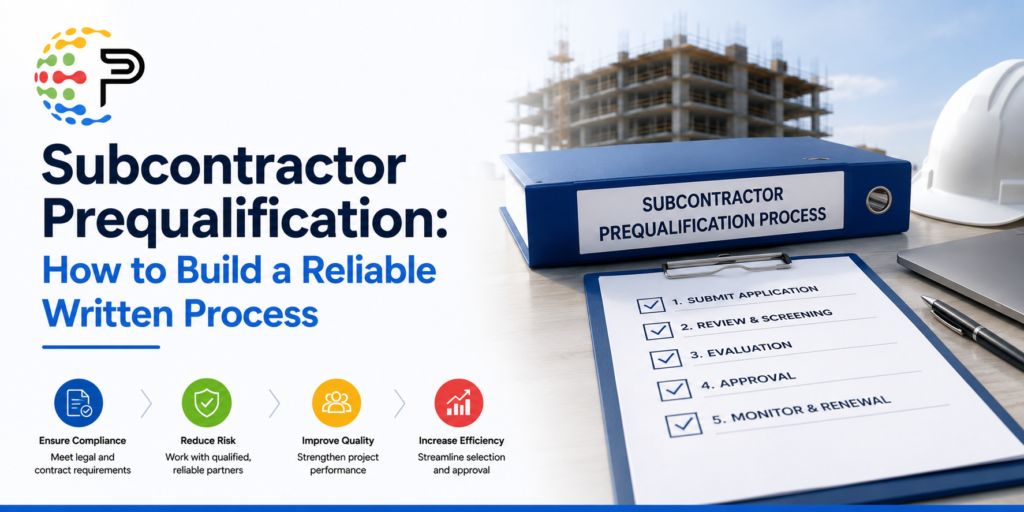
Building Your Written Subcontractor Prequalification Process
Step 1: Define Your Criteria Before You Review Anyone
The criteria need to exist before a specific sub is in front of you. Once there’s a relationship, a referral, or schedule pressure in the mix, it’s much harder to apply a threshold objectively. Write down your minimum acceptable EMR, your bonding capacity floors, your licensing requirements, and your position on prior bankruptcy or lien filings. Get it on paper before the first application comes in.
Ethics and compliance factors belong here too. A history of labor law violations, license suspensions, or contract defaults is disqualifying in most written frameworks, even when the trade relationship looks attractive. If your process doesn’t address them explicitly, they’ll get evaluated inconsistently, and that inconsistency is where your exposure lives.
Step 2: Create a Standardized Application
Every sub who wants to bid needs to complete the same application. That’s the whole point of standardization. The form should be accessible, ideally linked directly from your company website, so subs don’t have to ask for it.
Beyond the basics, the application should pull in specific data: Dun & Bradstreet numbers and surety provider details. A direct question about bankruptcy history matters too. Reference contacts, typically three to four of them, need enough specificity that you can actually verify quality and creditworthiness rather than just confirming the sub exists. Supporting documentation like financial statements, insurance certificates, and license copies should be required at submission, not chased down afterward.
Step 3: Verify, Don’t Just Review
Self-reported data is only as reliable as the person reporting it. Your process needs to specify third-party verification of financial claims and safety records, not just a review of what the sub submitted. Reference checks should be real conversations, not checkbox confirmations.
Background review should include OSHA citation history and any lien filings or bond claims on record. Skipping them is where GCs tend to get surprised later. That’s the part most teams underestimate: a sub with a clean application but a contested lien history creates legal exposure that doesn’t surface until the worst possible moment.
Step 4: Maintain a Living Database of Qualified Subs
A one-time review isn’t enough. Financial situations change. Safety records shift. A sub who was clean two years ago may have taken on too much volume or picked up a significant OSHA citation since their last review.
DPR Construction requires annual requalification for all subcontractors to remain eligible for bidding. That’s a reasonable baseline, and some GCs move to quarterly updates for high-volume or high-risk trade partners. Either way, the cadence needs to be written into the process, not triggered by something going wrong.
Your database should also define who is allowed to bid. Restricting bids to prequalified subs is standard practice in rigorous programs. If exceptions exist, the approval process needs to be written down too, including who has authority to sign off and what documentation is required. Open-ended exceptions undermine the whole system over time.
Where Technology Fits Into the Sub Prequalification Process
Manual prequalification is time-consuming. Collecting documents, chasing follow-ups, and tracking requalification dates across dozens of trade partners adds up fast. Prequalification software and subcontractor management software can automate the data collection workflow and flag subs whose certifications or financials are expiring. That matters when you’re managing a large qualified vendor pool and nobody has time to manually monitor renewal dates.
Technology doesn’t replace judgment on the close calls. It handles the administrative load and reduces the chance that something slips through because a requalification deadline got missed. Some platforms also integrate on-site performance feedback from project management teams, creating a loop between field experience and future bid eligibility. That’s harder to replicate in a spreadsheet-based system, and most GCs who try eventually give up on keeping it current.
AI-assisted review is starting to appear in this space. The practical value right now is mostly in document parsing and flagging missing fields or inconsistencies in submitted financials, not in making qualification decisions outright. Expect this layer to mature as more GCs move prequalification workflows into structured digital environments.
Read More : Compare AI Solutions for Construction Progress Tracking
What a Written Process Actually Protects You From
A rigorous sub prequalification process doesn’t guarantee a project runs smoothly. It does reduce the probability of the most predictable failure modes: a sub who runs out of cash mid-project, or a crew with a safety record that leads to a job site incident.
It also provides legal cover. When a dispute arises and your selection process gets challenged, a written and consistently applied framework is evidence that due diligence happened. An informal process, or no process at all, offers no such protection. Assessing subcontractor risk before it surfaces on your job site is significantly easier than managing it once it already has.
The consistency piece matters almost as much as the content itself. A prequalification process that gets applied selectively, based on who you know or how busy the bid schedule is, creates the same gaps as having no process. Writing it down is what makes enforcement possible.
Frequently Asked Questions
How often should we requalify subcontractors who are already in our database?
Annual requalification is the most common standard, and it’s what firms like DPR Construction use as their baseline requirement. For high-volume trade partners or trades with elevated risk profiles, quarterly updates make more sense. Whatever cadence you choose, it needs to be written into the process rather than triggered only when something goes wrong.
What financial documents should we require in a prequalification application?
At minimum, require financial statements, insurance certificates, and bonding capacity details covering both single-project and aggregate limits. Dun & Bradstreet numbers and surety provider information add another layer of verifiability. Self-reported financials should always be cross-checked against third-party sources rather than taken at face value, since that’s precisely where the gaps tend to hide.
What does subcontractor prequalification software typically cost, and is it worth it for mid-size GCs?
Entry-level prequalification platforms often start in the range of a few hundred dollars per month, with pricing scaling based on vendor volume and integration needs. For a GC managing 30 or more active trade partners, the time savings on document collection and requalification tracking alone usually justify the cost. The more useful question is whether your current process has blind spots that cost more to fix than software would cost to run.
Can we restrict bidding to prequalified subs only, or does that cut the pool too much?
Restricting bids to prequalified subs is standard practice in structured programs and it’s defensible. The trade-off is that your qualified pool needs to be large enough to generate real price competition per trade. Most GCs handle this by keeping the prequalification application accessible and processing new applicants on a rolling basis, so the pool grows over time rather than staying fixed at whatever size it started.
What’s the difference between a prequalification process and just checking references?
Reference checks are one input in a much larger review. A full prequalification also covers financial ratios, EMR and safety history, bonding capacity, and any record of lien filings or contract defaults. References tell you what past clients thought of the work. The other data points tell you whether the sub can actually complete your project without becoming a financial or legal liability midway through.
See How GCs Are Bringing Structure to Their Subcontractor Workflows
If your prequalification process still lives in email threads and spreadsheets, Palcode.ai can show you what a more structured approach looks like in practice. Book a demo to walk through how leading preconstruction teams are managing sub vetting, bid review, and scope coverage in one connected workflow. Book a Demo
About the Author
Shikha is a Senior Product Growth Marketer at palcode.ai, where she focuses on driving product adoption and improving user engagement through strategic, data-driven marketing. She contributes to product growth initiatives through market research, user behavior analysis, growth experimentation, and the development of best practices that help teams improve customer experience and product performance. Her work focuses on turning complex product concepts into actionable insights that support adoption, retention, and long-term growth. Explore More Blogs Here.