
Most ITB documents don’t fail because the project is unattractive. They fail because a qualified contractor opens the package, can’t figure out what’s actually being asked, and moves on. You’ve probably seen this yourself: a bid deadline passes, and the responses that do come in are wildly inconsistent or riddled with exclusions that make comparison nearly impossible. That’s usually an ITB problem.
An invitation to bid is a formal solicitation document issued by a project owner to collect competitive price proposals from contractors for a defined scope of work. Writing one that generates real, usable responses means treating it as a communication tool, not just a legal box to check.
What ITB Construction Documents Actually Need to Contain
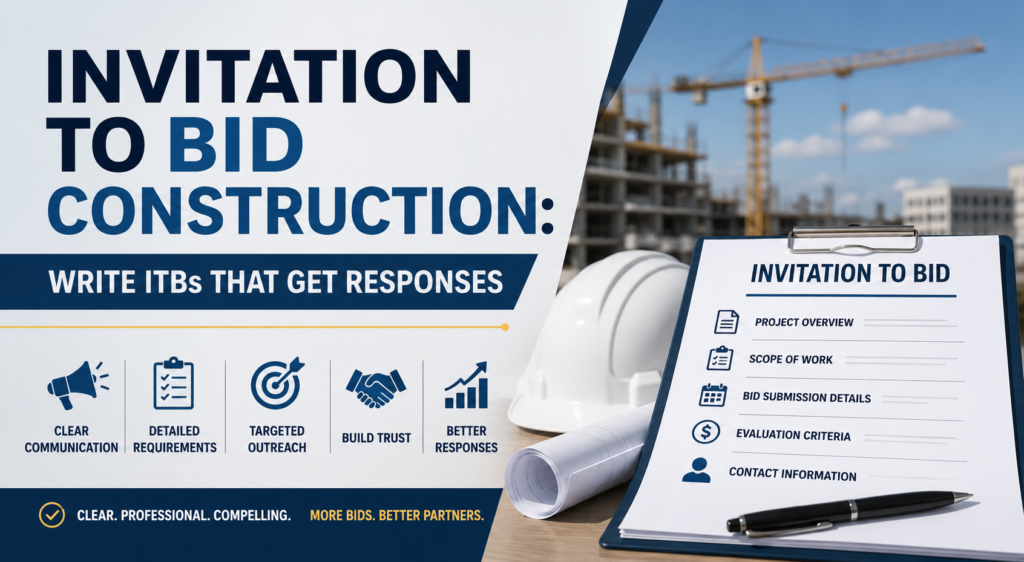
The components of a strong invitation to bid in construction are well understood. The gap is usually in how thoroughly each section is written, not whether it exists at all.
Every ITB should open with a clear project description: the nature of the work and the location, with enough context for a contractor to assess immediately whether it’s a fit. A paragraph or two is enough there. The real effort goes into the scope of work, which needs to enumerate specific tasks and deliverables in enough detail that bidders don’t have to guess what’s included. Scope gaps at this stage tend to surface later as change orders. Contractors pricing a vague scope will either pad heavily or miss items entirely, and neither outcome is useful.
Technical specifications belong in their own section, covering materials and design performance standards. These let contractors price based on actual project requirements rather than assumptions about what you’ll accept. Alongside those, the timeline section should spell out start and finish dates, key milestones, and the RFI submission deadline. That last detail matters more than most owners realize: a defined RFI window gives contractors a structured path to resolve ambiguities before they have to price around them.
Submission guidelines are often underspecified. State clearly whether bids should be submitted physically or electronically, in what format, and how many copies are required. Bids get rejected for non-compliance with submission rules, and every preventable rejection is a response you won’t be comparing.
Two more sections tend to determine whether your ITB generates competitive tension or a cautious, thin response pool. First, your evaluation criteria: state explicitly how bids will be judged, whether that’s lowest price, relevant experience, or a weighted combination. Contractors invest real hours in a bid package. If they can’t assess whether they have a fair shot at winning, many won’t bother. Second, the contractual terms and the form of contract the winner must sign. Transparency here builds enough trust that more contractors are willing to commit the effort.
How to Structure Your ITB for Maximum Response Rate
Getting qualified responses isn’t just about having the right sections. It’s about how you manage the process around the document.
Give bidders enough time. Rushed timelines produce incomplete responses and push away contractors with full project pipelines, which usually means the ones you actually want. A bid package that requires real takeoff work, supplier coordination, and site condition verification needs a realistic preparation window. Compressing it is almost always a false economy.
Prequalify before you issue. Sending an invitation to bid in construction to a list of unvetted contractors dilutes the response pool and increases the chance your lowest-priced bid comes from someone who can’t execute the work. Confirming financial capacity, relevant experience, and bonding capability before the ITB goes out keeps the process focused. If your team hasn’t formalized that step, a closer look at what subcontractor prequalification actually involves is worth your time before the next solicitation cycle.
Establish a responsive communication channel for the bid period. Contractors will have questions. How quickly you answer them signals whether this is a well-managed project worth bidding. Slow or unresponsive owners get priced with a risk premium, or don’t get bids at all.
Require a jobsite walk when the project conditions warrant it. Contractors who physically verify access and existing conditions price more accurately, which means fewer qualification-heavy responses that are difficult to evaluate later.
Common ITB Construction Mistakes That Kill Response Quality
Scope ambiguity is the leading cause of bid errors. Not contractor negligence. When the scope of work is vague, bidders either exclude anything uncertain or make assumptions that diverge across the response pool. Neither outcome is useful when you’re trying to run a real comparison.
Missing bid bond requirements in the ITB is another recurring issue. Contractors who discover mid-preparation that bonding is required may back out rather than scramble to arrange it, especially smaller subs with limited bonding capacity. State bond requirements in the original document, not in an addendum issued a week before bids are due.
Inconsistent drawings and specifications create a related problem. If the plans and specs conflict on a material or method, contractors will either flag it in an RFI or make their own call. Either way, you’re introducing pricing variability that a tighter ITB would have eliminated upstream.
Bid leveling after the fact can absorb some of this variability, but it’s a significant effort. Teams spending hours reconciling inconsistent scope interpretations across every bid cycle are dealing with a symptom. The source is usually a weak ITB. Resources built around structured bid leveling can help on the back end, but the cleaner the ITB, the less normalization work is required when responses come in.
What Contractors Are Actually Looking for When They Review Your ITB
From a contractor’s perspective, an ITB is a risk assessment document as much as it is a project opportunity. They’re asking: Is the scope clear enough to price accurately? Is the timeline realistic? Does the evaluation process seem fair? Does the contract form contain terms they can work with?
When any of those questions can’t be answered from the document itself, the contractor decides how much unknown risk to absorb. Some walk. Others bid defensively, loading responses with exclusions and allowances that make the package harder to evaluate.
The RFI window is the contractor’s primary tool for resolving ambiguity. But it only works if the ITB defines a clear submission deadline and the owner commits to responding before bids are due. Contractors who receive RFI answers after the bid deadline are essentially forced to price the unknown, and that’s never to the owner’s advantage.
How AI Is Changing the ITB Process
The parts of ITB preparation that have historically consumed the most estimator time are being handled more and more by AI-assisted document tools. Extracting scope items from drawings and detecting gaps between what plans show and what spec sections cover are two obvious examples. In practice, this means faster scope sheet generation from blueprint PDFs and automated coverage checks that a single estimator would have previously done manually, line by line.
Adoption is still uneven. Larger GCs with high bid volume are further along; smaller teams are earlier in the evaluation process. But the direction is clear enough. The ITB process itself isn’t fundamentally different, but the ability to produce a thorough, gap-free scope document in less time is improving. That matters because stronger source material produces better contractor responses.
The teams that’ll feel the impact most are those currently relying on one experienced estimator to catch everything by hand. That’s a real capacity constraint. Document intelligence tools address it not by replacing estimator judgment but by handling the extraction and organization work that doesn’t require it, which frees up the people who actually understand the project to focus on the decisions that need them.
Frequently Asked Questions
What does ITB mean in construction?
ITB stands for Invitation to Bid, a formal document issued by a project owner to solicit competitive price proposals from qualified contractors for a specific scope of work. It differs from a Request for Proposal in that the focus is on price rather than a broader evaluation of approach or qualifications. Most public construction projects and many private ones use the ITB format to create a structured, auditable procurement process.
How long should contractors have to respond to an invitation to bid?
Short deadlines consistently produce lower-quality responses. Projects with significant takeoff requirements or complex site conditions typically need at least two to four weeks from ITB issuance to bid due date. Compressing that window tends to push away contractors with full pipelines and produces bids padded with contingency to cover incomplete preparation time.
What should the evaluation criteria section of an ITB include?
State explicitly how bids will be ranked, whether by lowest price alone or a weighted method that factors in experience and bonding capacity. Contractors invest real hours preparing a response, and an opaque evaluation process is a deterrent. Bidders who understand what you’re actually evaluating tend to submit more targeted, useful responses rather than defensive ones loaded with exclusions.
How much does preparing a formal ITB package typically cost in staff time?
Internal preparation usually runs between 20 and 80 staff hours depending on project complexity and how much drawing coordination is required. That figure climbs when specifications are being written from scratch or when multiple trade packages each need a separate scope narrative. Owners who invest more heavily in ITB preparation typically spend less time resolving bid inconsistencies after responses come in.
Can a poorly written ITB result in bid rejection or legal issues?
Bid rejection is the more immediate risk. Non-compliant submissions, where responses miss requirements the ITB failed to communicate clearly, are often disqualified even when the contractor’s price would have been competitive. On public projects, an ambiguous ITB can also invite protests from contractors who believe the evaluation process was applied unevenly. Clear submission guidelines and explicit evaluation criteria are the simplest way to reduce both risks.
See How Palcode.ai Helps Estimators Build Tighter Bid Packages
If your team is spending too much time resolving scope gaps and normalizing inconsistent bids after the fact, the ITB document is usually where the problem starts. Palcode.ai is built to help preconstruction teams generate structured scope sheets directly from blueprint PDFs, identify coverage gaps before bids go out, and level responses faster when they come in. Book a demo call to see how it fits into your current bid process. Book a Demo
About the Author
Shikha is a Senior Product Growth Marketer at palcode.ai, where she focuses on driving product adoption and improving user engagement through strategic, data-driven marketing. She contributes to product growth initiatives through market research, user behavior analysis, growth experimentation, and the development of best practices that help teams improve customer experience and product performance. Her work focuses on turning complex product concepts into actionable insights that support adoption, retention, and long-term growth. Explore More Blogs Here.