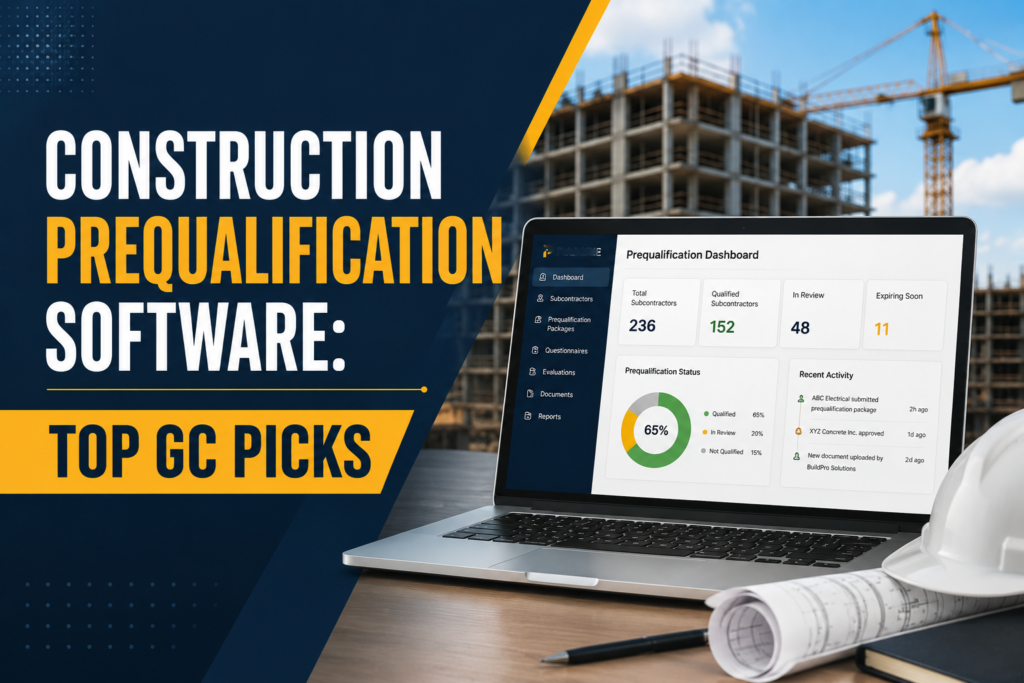
You’ve probably run into this already: a subcontractor clears the COI checklist, passes every standard screen, and then shows up on site undercapitalized or two months behind on another job. The old pass-or-fail model doesn’t catch that. It just collects documents.
What top GCs are doing differently in 2026 is using prequalification software as a risk intelligence layer, not a compliance gate. That shift determines who gets invited to bid in the first place. The platforms enabling it have gotten specific enough that picking the wrong one for your org has real operational consequences.
What Construction Prequalification Software Actually Does Now
The baseline expectation has moved significantly. Collecting certificates of insurance and safety logs was enough five years ago. Now, leading platforms automatically aggregate subcontractor financials, backlog data, surety information, and project history into a unified risk profile. GCs surface instability before it becomes a field problem rather than reacting after the fact.
There’s also upstream value most teams underestimate. Risk programs like SDI, OCIP, and CCIP depend on accurate subcontractor data. A well-structured prequalification workflow feeds those programs with consistent, auditable information rather than ad-hoc document pulls pulled at the last minute.
Prequalification software is a data infrastructure decision that touches your broader risk posture. That framing tends to get lost when teams treat it as a checkbox process.
The Leading Platforms and Where They Actually Differ
The market in 2026 has several dominant players, and they’ve differentiated enough that choosing based on feature lists alone will steer you wrong. The real distinctions come down to depth of analysis, ecosystem fit, and how much human judgment the platform assumes you want in the loop.
PreQual by Vertikal RMS
This platform leans on expert financial analyst review rather than pure automation. If your team needs deep financial analysis with human interpretation behind it, and you’re pairing it with CertFocus for COI verification, PreQual fits that workflow well. It’s designed for GCs who treat financial instability as the primary risk category. The tradeoff is real: the analyst-review model typically adds turnaround time compared to fully automated alternatives. For teams weighing their options, there’s a useful breakdown of what modern GCs are using instead of Vertikal RMS that’s worth reviewing before committing.
Highwire
Highwire’s edge is AI-powered safety risk analytics with dynamic assessments tailored to specific project requirements. That matters when you’re managing a portfolio with varying risk profiles across project types. Safety-focused GCs running hazardous trades or high-incident-rate environments tend to get the most from this platform. It’s less about financial depth and more about real-time safety scoring that adjusts to context.
COMPASS by Bespoke Metrics
The standardized one-form approach is COMPASS’s core value. It reduces administrative burden on subcontractors, which tends to improve both completion rates and data quality. Q Score analytics give GCs a normalized scoring framework across their sub base. For teams drowning in inconsistent data from fragmented questionnaires, that standardization has genuine operational value. COMPASS is often paired with Jones for automated COI collection.
Autodesk TradeTapp
If your team is already in Autodesk Construction Cloud, TradeTapp’s integration story is compelling. The network of over 250,000 registered subcontractors also means you can build bid lists from platform searches rather than starting from scratch every project. The honest caveat: teams outside the Autodesk ecosystem will find the onboarding investment hard to justify on integration benefit alone.
Procore Prequalification
Procore earned the Leader and Easiest to Use ratings in the prequalification category as of mid-2026, and that reflects real adoption patterns. For mid-to-large GCs already running Procore for project management, the native integration is a genuine efficiency driver. Prequalification data flows directly into the broader construction management workflow without manual re-entry. Teams comparing Procore against other options will find a direct feature-level look at Palcode vs. Procore Prequalification useful for framing the decision.
Oracle Textura
Enterprise-grade configurable financial analysis is Textura’s core strength. For GCs running Oracle across other parts of their construction management stack, the integration holds up. But the limitation is equally real: outside the Oracle ecosystem, interoperability tends to be constrained. The configuration overhead also may not pencil out at smaller organizational scales where that depth isn’t needed.
How Top GCs Are Integrating These Tools Into Preconstruction
The GCs extracting the most value from prequalification software aren’t using it as a standalone checkpoint. They’re weaving it into the full bid cycle from the start.
Automated insurance compliance is one area where the workflow shift is most visible. Tools like Jones, typically deployed alongside COMPASS, handle COI collection and endorsement verification without the manual back-and-forth that stalls bid invitations. That friction has historically been a real bottleneck, and it’s largely solvable now.
Unified risk profiling is where the more sophisticated teams are investing. Combining financial data, safety records, and surety information into a single sub profile gives preconstruction teams a defensible basis for bid list decisions. It also shortens the conversation when a project owner asks why a particular sub wasn’t invited.
The downstream benefit is data-driven bid list building. With a well-maintained prequalification database, you’re not assembling a sub list from memory or spreadsheets at the start of every project. The qualified pool is already there, scored and current. Building that written process is what separates teams that get consistent results from teams still relying on institutional knowledge that walks out the door when a senior estimator leaves.
Where AI Is Actually Changing This Workflow
The honest version of the AI story in prequalification isn’t that it eliminates judgment. It’s that it eliminates the manual labor that used to prevent judgment from happening at all.
Highwire uses AI to generate dynamic safety assessments tailored to specific project types rather than running every sub through the same static questionnaire. That’s a practical improvement over the traditional model. Automated COI verification means compliance checks happen continuously rather than as a one-time gate before bid day.
Financial analysis is where adoption is still uneven. AI-assisted financial review is available on several platforms, but many GCs still value human analyst interpretation for complex financials. This is why PreQual’s analyst-review model hasn’t been displaced by automation. Fully automated financial scoring tends to miss context that an experienced reviewer catches.
The firms moving fastest are treating prequalification software as a data foundation rather than a decision engine. They use the platforms to surface the right questions, not to answer them automatically.
| Platform | Core Differentiator | Best Fit | Key Limitation | Ecosystem Dependency |
|---|---|---|---|---|
| PreQual by Vertikal RMS | Expert financial analyst review with CertFocus COI integration | GCs prioritizing deep financial due diligence | Analyst-review model adds turnaround time vs. automated platforms | Low, works independently |
| Highwire | AI-powered safety risk analytics with dynamic project-specific assessments | Safety-focused GCs managing high-risk trade environments | Less depth on financial risk compared to dedicated financial platforms | Low, works independently |
| COMPASS by Bespoke Metrics | Standardized one-form model with Q Score analytics | GCs needing consistent, normalized sub data across a large pool | Less flexibility for highly customized qualification criteria | Often paired with Jones for COI automation |
| Autodesk TradeTapp | Network of 250,000+ registered subs with Autodesk Construction Cloud integration | GCs already embedded in the Autodesk ecosystem | Integration ROI drops sharply outside the Autodesk stack | High, best within Autodesk Construction Cloud |
| Procore Prequalification | Native integration within Procore project management, rated Leader in July 2026 | Mid-to-large GCs running Procore across their project lifecycle | Less compelling for teams not already on Procore | High, built for the Procore ecosystem |
| Oracle Textura | Enterprise-grade configurable financial analysis | Large GCs using Oracle across their construction management stack | Limited interoperability with non-Oracle platforms | High, designed for the Oracle ecosystem |
Frequently Asked Questions
What does construction prequalification software actually cost?
Most enterprise platforms start in the low five figures annually and scale with company size and sub volume. Some offer per-project or per-sub pricing structures as an alternative. The more important cost consideration is usually implementation time: plan for four to eight weeks of setup, data migration, and team onboarding before the platform runs at full capacity.
How hard is it to switch prequalification platforms if we’re already using one?
The main switching cost is historical sub data. Before committing to a new tool, audit what’s exportable from your current platform, particularly financial records, safety scores, and COI documentation. Teams that have built customized workflows in Oracle Textura or Procore typically face the steepest migration effort. TradeTapp’s large existing sub network reduces re-enrollment friction, but your internal risk scoring logic still needs to be rebuilt in whatever system you move to.
Can prequalification software replace manual COI tracking entirely?
For most GCs, the manual tracking piece can be fully automated. Tools like Jones handle ongoing COI collection and endorsement verification without requiring staff to chase documents. The software still surfaces exceptions for human review when a certificate doesn’t meet project-specific requirements, so someone still resolves those flags. It eliminates the routine work, not the judgment calls.
Is prequalification software only useful at the bidding stage?
Limiting it to bid invitations is one of the more common underuses of these platforms. Leading GCs treat the sub risk profile as a live document that updates through the project lifecycle, feeding risk programs like OCIP and CCIP with current data rather than a snapshot from bid day. Some platforms also support ongoing safety monitoring and financial re-evaluation at project milestones, which is where the deeper risk management value actually sits.
How do AI-powered prequalification tools differ from traditional questionnaire-based systems?
Traditional systems collect static responses and flag pass-or-fail conditions against fixed criteria. AI-powered platforms like Highwire generate dynamic risk assessments that adjust based on the specific project type rather than running every sub through the same generic criteria. The more significant difference shows up in financial analysis: some platforms now aggregate external financial data automatically rather than relying on self-reported sub submissions, which reduces the risk of outdated information influencing who gets invited to bid.
See How Palcode.ai Fits Into Your Prequalification and Bid Workflow
If you’re evaluating where prequalification data connects to your bid leveling and scope management process, that’s exactly where Palcode.ai operates. The platform is built for GCs and preconstruction teams who need to move from a qualified sub list to a structured bid comparison without the manual overhead in between. Book a demo with Palcode.ai to see how it handles that handoff in practice. Book a Demo
About the Author
Mohit is the Founder and CEO of Palcode.ai — an AI-powered platform helping general contractors automate preconstruction, sub outreach, and bid management. Before building Palcode, he spent years inside the problem, watching estimators lose weeks to manual follow-ups that software should have handled a long time ago. Explore More Blogs Here.