You’ve probably been there: three bids come in for the same mechanical scope, the spread is wider than you expected, and the instinct is to look hard at the lowest number. The problem is that a lower number often just means something got left out. That’s exactly what bid leveling is designed to catch before it turns into a change order six months into the job.
What Bid Leveling in Construction Actually Means
Bid leveling is the process of organizing and aligning subcontractor proposals so they all reflect the same scope before you compare pricing. The phrase you’ll hear most often is “apples to apples,” and that’s accurate. The goal isn’t to find the cheapest number. It’s to find the most complete bid, because those two things are rarely the same document.
Each sub interprets project requirements differently. One electrical contractor might include conduit and wire pulls in full. Another prices the rough-in only and notes fixture installation as an allowance. A third excludes switchgear entirely, buried in a footnote. Without a structured comparison, you’re not evaluating competing prices. You’re evaluating competing interpretations of the job.
Leveling resolves that by creating a shared framework where inclusions, exclusions, and assumptions are surfaced across every bidder before a contract goes out.
Why the Bid Leveling Process Exists
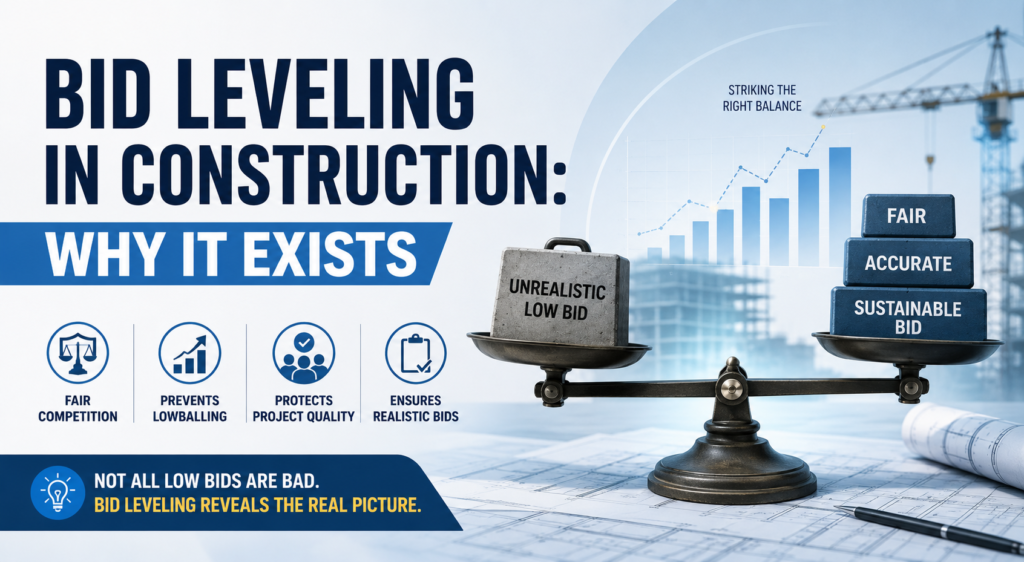
The core reason is risk. Owners and GCs need to make financially sound decisions, and that’s only possible when bids are genuinely comparable. There are four distinct purposes leveling serves in preconstruction.
- It enables true price comparison by putting proposals side by side on identical scope line items.
- It forces hidden gaps into the open, showing exactly what each contractor included and what they quietly left out.
- It reduces exposure to change orders by surfacing missing items before award, not after mobilization.
- It lets teams assess value beyond the bottom line, weighing scope completeness alongside the number itself.
That last point matters more than it gets credit for. A bid that’s $40,000 higher might represent better long-term value if it covers items the cheaper proposal deferred to allowances or excluded entirely. Leveling gives your team the visibility to make that call with confidence rather than guesswork.
What the Bid Leveling Process Looks Like in Practice
The standard approach centers on a bid leveling sheet, essentially a matrix where each bidder occupies a column and each scope item occupies a row. Estimators work through it systematically. It’s detailed, and it takes real time to do correctly.
The typical steps move in a logical sequence:
- Break each proposal into trades or defined scope areas
- Review line-by-line descriptions to confirm what’s included versus excluded
- Flag differences in quantities, unit costs, or assigned responsibilities
- Follow up with subs to clarify or revise pricing so all proposals reflect the same baseline
That clarification step is where teams most often underestimate the effort involved. Getting a sub to revise a proposal to match a specific scope baseline requires clear communication about what was missing and why the revision is needed. On a complex project with eight or ten trade packages, this easily consumes several days of estimator time before the bid tab is even finalized.
Structured approaches to the bid leveling template make that coordination faster by ensuring the comparison framework is consistent from the start, rather than improvised mid-process.
What Happens When You Skip It
The consequences aren’t subtle. Doing a superficial leveling job, or skipping it entirely, produces a predictable set of problems that hit later in the project lifecycle when they’re far more expensive to fix.
The most immediate risk is awarding to the wrong sub. A bid that looks competitive may have quietly excluded a significant scope item. You don’t find out until the project is underway and the sub presents a change order for work they never priced. At that point, your negotiating position is weak and the schedule is already moving.
Inaccurate budgeting is the second problem. If estimators can’t confirm that all proposals cover the full project requirements, the numbers they’re working with are unreliable. That uncertainty compounds across trade packages and makes it genuinely difficult to give owners or project executives a number they can stand behind.
Schedule risk is the third consequence, and it tends to be underweighted. When a missing scope item surfaces during construction, work can stop while the gap gets negotiated and assigned. That delay doesn’t stay contained to one trade. The framing crew waits on rough MEP, the drywall crew waits on framing, and a single unresolved exclusion can push substantial completion by weeks.
None of these are dramatic edge cases. They’re the normal result of selecting bids without confirming scope alignment first.
Where AI Is Changing the Bid Leveling Process
Historically, bid leveling has been a manual exercise. An estimator downloads PDFs from multiple subs, reads through each one, builds a spreadsheet by hand, and then contacts subs individually for clarifications. On a mid-size commercial project, that can run to 20 or more hours of work per bid cycle before follow-up rounds even start.
Document intelligence tools are starting to reduce that burden meaningfully. AI-powered platforms can parse proposal PDFs, extract line items and exclusions automatically, and populate a comparison matrix without manual data entry. That doesn’t eliminate the judgment calls. It compresses the data-gathering phase and reduces the likelihood that a buried exclusion gets missed because an estimator was working through a 40-page document on a Friday afternoon.
The practical adoption reality is that most teams are layering these tools onto existing workflows rather than replacing them wholesale. The estimator still reviews the output, still makes the calls, and still manages the sub relationships. Automation handles extraction and organization, which is where a large share of the time and error risk actually sits. Teams evaluating bid leveling software are often surprised to find that even partial automation of the intake step produces measurable time savings on the first project they run through it.
The longer-term shift is toward continuous scope gap detection, where the system flags not just differences between bids but items that appear in the drawings but don’t show up in any proposal. The tools solving that problem well are still relatively new. But it’s the direction preconstruction workflows are heading, and teams building those capabilities now are developing a real structural advantage in bid cycle efficiency.
Frequently Asked Questions
How long does bid leveling typically take on a commercial project?
For a mid-size commercial project with multiple trade packages, manual bid leveling commonly runs 15 to 25 hours of estimator time per bid cycle. That number climbs when sub clarifications require multiple rounds of back-and-forth. Teams using document intelligence tools to automate the extraction phase report cutting that time significantly, though the review and clarification work still requires human judgment.
What’s the difference between bid leveling and bid comparison?
Bid comparison is the act of placing proposals side by side to look at pricing. Bid leveling is what makes a real comparison possible by first normalizing scope across all proposals. You can compare bids without leveling them, but the result is misleading because you’re looking at different versions of the job rather than the same one. Leveling comes first; comparison follows.
Does bid leveling software replace the estimator’s judgment?
The better tools aren’t designed to. AI-assisted leveling platforms handle data extraction and matrix population, removing a large share of the manual labor from the intake phase. Decisions around scope gaps, sub qualifications, and award recommendations still belong to the estimator. The value is in speed and error reduction, not in automating the calls that actually require expertise.
How much does bid leveling software typically cost?
Lighter tools tend to run a few hundred dollars per month. Enterprise platforms with broader preconstruction capabilities can reach several thousand per month. Most vendors price by seat or by project volume. It’s worth asking about implementation time specifically, since a platform that takes six weeks to configure doesn’t deliver value at the same point in the budget cycle as one that’s operational in a few days.
At what project size does bid leveling start to matter most?
Even smaller commercial projects carry real exposure when bids go unleveled. That said, the complexity compounds quickly as project size grows and trade packages multiply. By the time a project has eight or more active bid packages, the manual effort required usually exceeds what a single estimator can absorb without something falling through the cracks. That’s typically when teams start evaluating structured tools or templates to manage the process.
See How Bid Leveling Works With AI Behind It
If your team is still building bid comparison matrices by hand, you already know how much time that takes and how easy it is to miss a buried exclusion. Palcode.ai automates the extraction and normalization work so your estimators can focus on the decisions that actually require their judgment. Book a demo to see how it handles a real bid package from your trade mix.
About the Author
Shikha is a Senior Product Growth Marketer at palcode.ai, where she focuses on driving product adoption and improving user engagement through strategic, data-driven marketing. She contributes to product growth initiatives through market research, user behavior analysis, growth experimentation, and the development of best practices that help teams improve customer experience and product performance. Her work focuses on turning complex product concepts into actionable insights that support adoption, retention, and long-term growth. Explore More Blogs Here.