You’ve probably run into this already: a sub looks great on paper, wins the bid, and then three weeks in you’re dealing with an expired insurance certificate or a cash flow problem stalling your schedule. That’s the cost of skipping a real prequalification process. The liability exposure and project delays compound fast, and it’s rarely a one-time hit.
A solid subcontractor prequalification checklist doesn’t just protect you legally. It gives your team a repeatable, defensible process for deciding who gets to work on your projects before a single contract is signed.
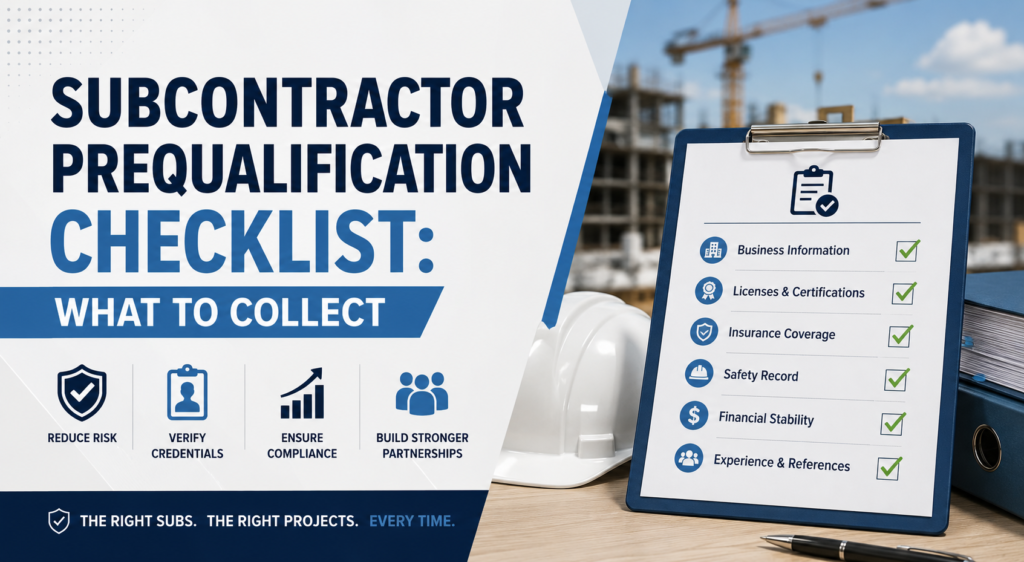
Start With Company Identity and Licensing
Before anything else, confirm you’re dealing with a legitimate, properly licensed business. This sounds basic, but it’s where a surprising number of GCs cut corners under schedule pressure.
Collect the full legal company name, physical address, year founded, and the geographic regions where they actively perform work. You also need the trade license number and the issuing state. Get the certifying agency and the expiration date too. An expired license is a real exposure, not a technicality.
Union affiliations matter, especially on prevailing wage or public projects. Get copies of general business licenses and verify that any active permits or certifications actually align with the specific scope they’d be covering on your job.
Insurance: The Non-Negotiables on Your Prequalification Documents Subcontractor File
This section of the prequalification package is where gaps hide most often. Certificates look clean on the surface until you check the limits or the expiration date.
Require certificates of insurance showing general liability coverage with both aggregate and per-occurrence limits clearly stated. Workers’ compensation is mandatory. Auto liability for any commercial vehicles on your site belongs in the file too.
Past claims history deserves a close look, since a pattern of incidents tells you something a clean certificate doesn’t. If your contract or owner requires specific endorsements, make those a hard requirement on the front end. Chasing endorsements after award wastes time and creates leverage problems you didn’t need to create.
Surety and Bonding Capacity
Bonding capacity is one of the clearest financial signals you have access to during prequalification. It tells you what a surety company is actually willing to back, which is usually a more honest number than what the sub tells you they can handle.
Collect the surety provider name and their agent’s contact information. Get both the single-project bond limit and the aggregate bonding capacity. Then ask about outstanding bond commitments, because a sub sitting at 90% of their aggregate limit is a meaningful risk on a large project even if their paperwork looks clean otherwise.
A history of bond defaults is disqualifying for most GCs. That information is worth asking for directly on your contractor prequalification form rather than hoping it surfaces in references.
Safety Record: OSHA Logs and EMR
A strong safety program protects your workforce and keeps OSHA off your site. It also affects your own EMR over time if you’re consistently bringing in high-incident subs.
Request OSHA 300 logs for the previous three years. The Experience Modification Rate is the most compressed signal of their safety history. An EMR above 1.0 means their losses have exceeded the industry average, and many owners and GCs set hard cutoffs around that threshold. Some set it tighter, at 0.95, for higher-risk trades.
Beyond the numbers, ask for their written safety manual and documentation of employee training programs. A sub who can’t produce a safety manual quickly is telling you something about how seriously they take it. Safety awards are a positive signal, but they don’t substitute for the underlying data.
Financial Stability: What the Numbers Actually Show
Financial instability is one of the most common reasons subs fail mid-project. A company running thin on working capital may start delaying supplier payments, which leads to material shortages on your site even if the sub is technically still on the job.
Request financial statements for the current fiscal year and the prior year. Third-party audited statements are preferable, because self-prepared financials have more room for optimistic interpretation. Key ratios to examine include the current ratio (current assets divided by current liabilities) and working capital turnover.
A Dun & Bradstreet number or credit report adds an independent data point. Banking and bonding references round out the picture. Ask directly whether the company has ever filed for bankruptcy. That history doesn’t automatically disqualify a sub, but it absolutely changes how you should evaluate their current financial position.
That’s the part most teams underestimate. It’s not about finding a perfect balance sheet. It’s about knowing enough to price your risk appropriately and structure payment terms accordingly. This is also where tools designed for assessing subcontractor risk can help teams surface red flags before award rather than after.
Project History and Workforce Capacity
Sub qualification requirements always include experience verification, but the quality of that verification varies widely. A list of project names means little without scope, size, and complexity context.
Ask for projects similar to yours in scale and trade complexity. Get their average project size and their largest completed project. Annual project sales volume gives you a sense of operational scale. You also want to know what percentage of work they self-perform versus subcontract out. A sub who pushes most of the labor to lower-tier subs introduces a separate layer of risk you may not have visibility into.
Workforce capacity and equipment holdings matter on projects with tight schedules. A sub with the right experience but insufficient crew size for your timeline is a problem waiting to happen, and it’s a problem you can usually spot during prequalification if you ask the right questions.
Litigation History and References
Legal history is uncomfortable to ask about. Skipping it is a mistake.
Active litigation with a GC or owner doesn’t automatically disqualify a sub, but it’s information you need before you sign a contract. Ask about current lawsuits and past contract defaults. History of liquidated damages and any record of being terminated from a project belong in that conversation too.
Labor law violations and suspended or revoked licenses should be dealbreakers in most cases. References matter, but only if you actually call them. Collect three to four contacts from previous GCs or owners and ask specific questions. Did they finish on schedule? Were there billing disputes? How did they handle problems when things went sideways? A reference who pauses before answering tells you more than one who reads off a list of compliments.
How to Structure the Collection Process
The checklist only works if the collection process is consistent. That means establishing your prequalification criteria before you start soliciting bids, not after submissions are already sitting in your inbox.
Build a standardized contractor prequalification form that every interested sub completes before they’re invited to bid. This levels the playing field and gives you comparable data across the board. Once submissions are in, use third-party sources to verify the financial and safety claims rather than taking them at face value.
The review step is where many teams compress too aggressively under deadline pressure. A quick scan of an insurance certificate is not verification. Neither is skimming a financial statement without checking the ratios. Given how much prequalification work overlaps with the broader challenge of managing subcontractors on complex projects, teams that build the habit of thorough upfront review tend to have fewer mid-project surprises.
Where AI Is Changing This Process
Prequalification has historically been manual, time-consuming, and inconsistently applied across different estimators on the same team. That’s starting to shift.
Document intelligence tools can now parse submitted prequalification packages, flag missing fields, and cross-reference stated EMR values or bonding limits against your minimum thresholds automatically. What used to take a senior estimator a few hours per sub can be compressed significantly. Some teams have cut prequalification cycle time from roughly two weeks to under 48 hours using AI-assisted workflows.
The practical reality is that these tools work best when the underlying criteria are already well-defined. Automation surfaces gaps and organizes data. It doesn’t substitute for the judgment calls your team needs to make on borderline submissions. The GCs seeing the most benefit are those who’ve already standardized their prequalification criteria and are using automation to enforce that standard consistently at volume, not to skip the thinking.
Frequently Asked Questions
What documents should a subcontractor submit for prequalification?
At minimum, expect certificates of insurance and a trade license with its expiration date. OSHA 300 logs for the past three years, financial statements for the current and prior fiscal year, and bonding capacity documentation from their surety round out the core package. References from previous GCs or owners should be included too, not treated as optional.
What EMR threshold do most GCs use to qualify or disqualify a sub?
An Experience Modification Rate at or below 1.0 is the most common benchmark, since anything above that means a sub’s safety losses have exceeded the industry average. Some owners and GCs set a harder cutoff at 0.95 for high-risk trades. Whatever threshold you choose, define it in your prequalification criteria before you start reviewing submissions, not during the review itself.
How much does a subcontractor prequalification software platform typically cost?
Entry-level platforms generally start around $200 to $500 per month for basic qualification tracking. More comprehensive tools with document parsing and third-party data integrations can run $1,000 or more monthly. The more relevant cost question for most teams is estimator time: manual prequalification for a single sub can take two to four hours, which adds up fast across a full bid list.
How often should prequalification status be renewed for existing subs?
Annual renewal is the most common practice. That said, key documents like insurance certificates and licenses should be tracked on their own expiration schedules rather than waiting for a yearly review cycle. A sub whose workers’ comp lapses mid-project is a live exposure, not a paperwork issue, and it won’t wait for your annual review date.
Can a subcontractor with a past bankruptcy still be prequalified?
A bankruptcy history doesn’t automatically disqualify a sub, but it does change how you evaluate their current financial position. Look at how long ago the bankruptcy occurred and what their current ratio and working capital position shows now. A surety company willing to bond them at a meaningful capacity is a useful signal that someone with underwriting expertise has already reviewed their recovery.
See How a Faster Prequalification Process Changes Your Bid Cycle
If your team is still running prequalification through email threads and spreadsheets, the gaps in your process are probably invisible until they become expensive. Palcode.ai helps preconstruction teams standardize what they collect, flag missing documents automatically, and get to a decision faster without cutting corners on the criteria that actually matter. Book a demo to see how it fits your workflow. Book a Demo
About the Author
Shikha is a Senior Product Growth Marketer at palcode.ai, where she focuses on driving product adoption and improving user engagement through strategic, data-driven marketing. She contributes to product growth initiatives through market research, user behavior analysis, growth experimentation, and the development of best practices that help teams improve customer experience and product performance. Her work focuses on turning complex product concepts into actionable insights that support adoption, retention, and long-term growth. Explore More Blogs Here.