
How One Commercial Contractor Reclaimed 40 Hours Monthly by Fixing Bid Solicitation
For this mid-sized commercial contractor, bid solicitation had become the job that ate every other job. With multiple active bid packages running simultaneously and a lean preconstruction team, the process had quietly grown into something unsustainable — and no amount of better spreadsheet organization was going to fix it.
Senior estimators were spending 4 to 6 hours daily just managing solicitations — tracking responses, chasing updated contact information, and maintaining spreadsheets that were outdated before they were finished. Critical time that should have gone toward specification review, quantity takeoffs, and the technical work that actually moves projects forward was disappearing into administrative work that never ended.
The numbers make the problem concrete:
- Nearly 20% of email solicitations bounced back due to outdated subcontractor contact information
- 2 to 4 hours every day spent on post-solicitation tracking and follow-up alone
- One person managing the entire bid solicitation process for over 500 active subcontractors
- Consistent data entry errors from manual spreadsheet tracking caused missed responses and incomplete bid coverage
This is exactly the problem purpose-built bid management software is designed to solve. Traditional platforms organize the process — centralized document storage, structured response tracking, standardized bid packages. But the contractor’s challenge ran deeper than organization. They needed a system that actively participated in the workflow: handling outreach, automating follow-up, verifying contact information, and consolidating responses without human intervention at every step.
AI-powered bid management software bridges that gap. Instead of giving estimators a better tool to manage the same manual process, it removes the manual process entirely — handling routine solicitation administration autonomously while your preconstruction team redirects recovered hours toward the technical work that requires their actual expertise.
For a team managing 500-plus subcontractors across multiple simultaneous bid packages, that difference isn’t incremental. It’s 40 hours back every month — and a bid solicitation process that finally scales with the workload instead of buckling under it.
Why Traditional Bid Management Software Wasn't Enough
The preconstruction bid management process in construction can be characterized as “death by a thousand spreadsheets.” With multiple active bid packages in progress and typically lean teams, bid management processes often become unsustainable.
Construction firms find themselves drowning in administrative work. Senior estimators commonly spend 4-6 hours daily just managing bid solicitations, tracking responses, and updating contact information in spreadsheets. This represents critical time that should be devoted to value-adding activities like specification review and quantity takeoffs.
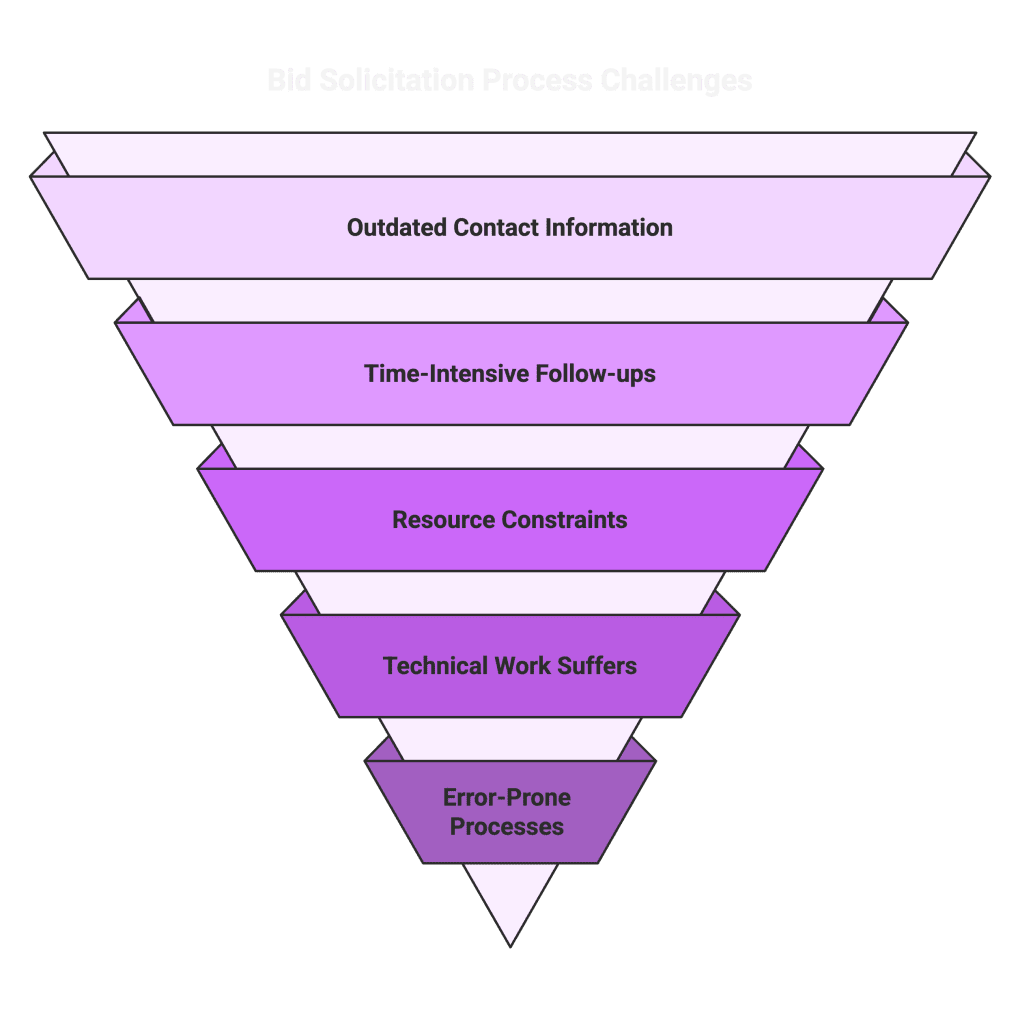
The problems are multi-faceted:
- Outdated Contact Information: Nearly 20% of manual email blasts result in kickbacks due to outdated contact information
- Time-Intensive Follow-ups: Post-solicitation typically requires 2-4 hours of tedious tracking work daily
- Resource Constraints: Often just one person handles the entire bid solicitation process for over 500 subcontractors
- Technical Work Suffers: Critical time is diverted from specification review and takeoff activities
- Error-Prone Processes: Manual tracking leads to missed responses and data entry errors
Managing 500+ subcontractors with Excel spreadsheets inevitably creates errors. Responses get missed, data is entered incorrectly, and follow-ups become inconsistent. These inefficiencies directly impact the ability to secure competitive bids.
How the AI Bid Management Assistant Actually Works
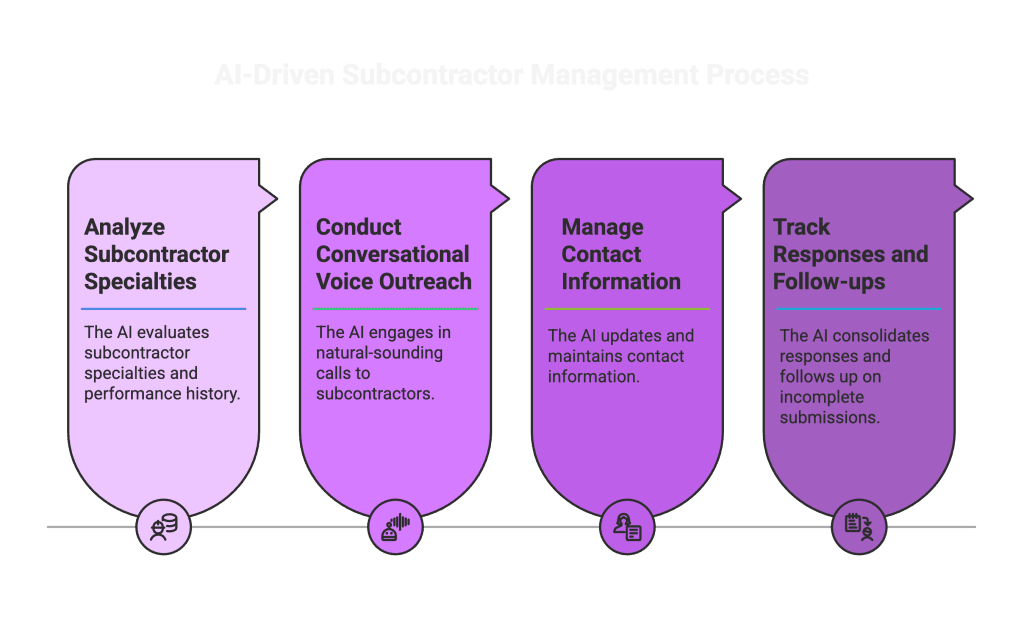
Our AI assistant offers a comprehensive approach to transforming bid management processes. Unlike traditional software platforms that merely organize data, this intelligent agent actively participates in the bid management process, working autonomously to handle routine tasks while learning from each interaction:
1. Intelligent Subcontractor Qualification
The assistant analyzes subcontractor specialties, performance history, and availability patterns to make data-driven recommendations for trade-specific outreach. It evaluates suitability for specific project aspects based on past performance and continuously learns from each interaction to refine future recommendations.
2. Conversational Voice Outreach
The system conducts natural-sounding calls using appropriate construction terminology and engages in two-way dialogue about project scope and timeline. It dynamically adapts questioning based on responses to qualify interest effectively, then prioritizes subcontractors based on detected interest levels.
3. Proactive Contact Management
Beyond simply flagging problems, the assistant identifies outdated contact information and autonomously searches for verified updates. It maintains sophisticated relationship mapping between companies and personnel while distinguishing between temporary absences and permanent staff changes.
4. Adaptive Response Tracking
The system consolidates responses from multiple channels into unified conversation threads and automatically follows up on incomplete submissions. It identifies potential errors through pattern recognition and intelligently prioritizes critical trade categories based on historical response patterns.
Implementation: From Onboarding to Autonomous Operation in Three Phases
The implementation process is remarkably simple for such a sophisticated AI system:
Initial onboarding and knowledge transfer The AI assistant ingests the existing subcontractor database and conducts a learning phase to understand specific terminology and workflows. It begins building a knowledge representation of typical project requirements while requiring minimal training for preconstruction staff—approximately 3 hours total.
Supervised intelligence gathering The assistant begins initial outreach under human supervision, rapidly learning from feedback to refine its conversation patterns. During this phase, it identifies knowledge gaps in the contractor database while preconstruction team members observe interactions and provide guidance.
Autonomous operation with oversight The AI assistant takes full ownership of initial bid solicitation and handles routine follow-ups independently, escalating only when human judgment is needed. It begins providing insights about bid package structure and subcontractor performance, allowing the preconstruction team to redirect attention to technical estimating tasks.
Results: What 40 Hours Back Every Month Actually Looks Like
When implementing the AI assistant for bid management processes, construction firms can anticipate transformative improvements:
- Time Reclamation: Potential to reduce administrative bid management time by 65%, saving approximately 40 hours monthly
- Contact Intelligence: Database accuracy typically improves from 80% to 97% without manual intervention
- Enhanced Engagement: Subcontractor response rates can increase by 30% or more through conversational interactions
- Strategic Refocus: Preconstruction staff can shift from administrative tasks to high-value technical activities
- Error Elimination: The AI’s pattern recognition capabilities virtually eliminate data entry errors
- Learning System: The assistant continues to improve with each project, requiring less oversight over time
The value goes beyond immediate time savings. Preconstruction teams can focus on what they were hired to do—detailed specification review and accurate quantity takeoffs. Just as importantly, the quality of subcontractor relationships improves. The AI assistant provides a level of attention and follow-up that’s simply not sustainable manually, making subcontractors feel more valued and engaged in the bidding process.
When implementing the AI assistant for bid management processes, construction firms can anticipate transformative improvements:
- Time Reclamation: Potential to reduce administrative bid management time by 65%, saving approximately 40 hours monthly
- Contact Intelligence: Database accuracy typically improves from 80% to 97% without manual intervention
- Enhanced Engagement: Subcontractor response rates can increase by 30% or more through conversational interactions
- Strategic Refocus: Preconstruction staff can shift from administrative tasks to high-value technical activities
- Error Elimination: The AI’s pattern recognition capabilities virtually eliminate data entry errors
- Learning System: The assistant continues to improve with each project, requiring less oversight over time
The value goes beyond immediate time savings. Preconstruction teams can focus on what they were hired to do—detailed specification review and accurate quantity takeoffs. Just as importantly, the quality of subcontractor relationships improves. The AI assistant provides a level of attention and follow-up that’s simply not sustainable manually, making subcontractors feel more valued and engaged in the bidding process.
Frequently Asked Questions
How is AI-powered bid management software different from traditional bid management platforms?
Traditional bid management software organizes your process — better document storage, cleaner dashboards, structured response tracking. AI-powered bid management software executes the process. It handles outreach, automates follow-up, verifies contact information, and consolidates responses autonomously — removing the manual work entirely rather than making it slightly more organized. For preconstruction teams managing high subcontractor volumes, that’s the difference between a tool that helps and a system that scales.
How long does implementation actually take?
Full implementation requires approximately three hours of preconstruction staff training. The system ingests your existing subcontractor database, conducts a learning phase to understand your project terminology and workflow, and moves through supervised outreach to autonomous operation across three structured phases. Most teams are running live solicitations within days — not weeks — of onboarding.
Will subcontractors respond differently to AI-driven outreach?
In practice, response rates increase — by 30% or more based on implementation data. The system conducts natural two-way conversations using construction-specific terminology rather than sending generic email blasts. Subcontractors engage with it the way they engage with a knowledgeable coordinator: they answer questions, ask about scope, and participate in the process. The consistency and follow-through the AI provides also builds credibility over time — subs who feel reliably communicated with show up more consistently on future bids.
What happens to data accuracy when the system takes over contact management?
Database accuracy improves from approximately 80% to 97% without manual intervention. When contact information is outdated — the source of nearly 20% of solicitation failures in manual workflows — the assistant searches for verified updates autonomously rather than flagging the problem and waiting for someone to fix it. Over time the database becomes self-maintaining rather than something your team has to actively manage.
Does AI bid management software work for smaller preconstruction teams?
Especially for smaller teams. When one person is managing the entire solicitation process for hundreds of subcontractors, the administrative overhead doesn’t scale — it compounds. AI bid management software removes the volume constraint entirely, allowing a lean preconstruction team to manage the same solicitation workload as a much larger one without adding headcount. The ROI shows up faster at smaller scale precisely because there’s less margin for the inefficiency that manual processes inevitably create.