You’ve probably looked at two bids that are suspiciously close in price and wondered which sub is actually the safer bet. The answer is rarely in the bid documents themselves. It’s in the subcontractor’s EMR score, a number that most GCs glance at but few use as aggressively as they should.
What EMR Actually Is for Subcontractors
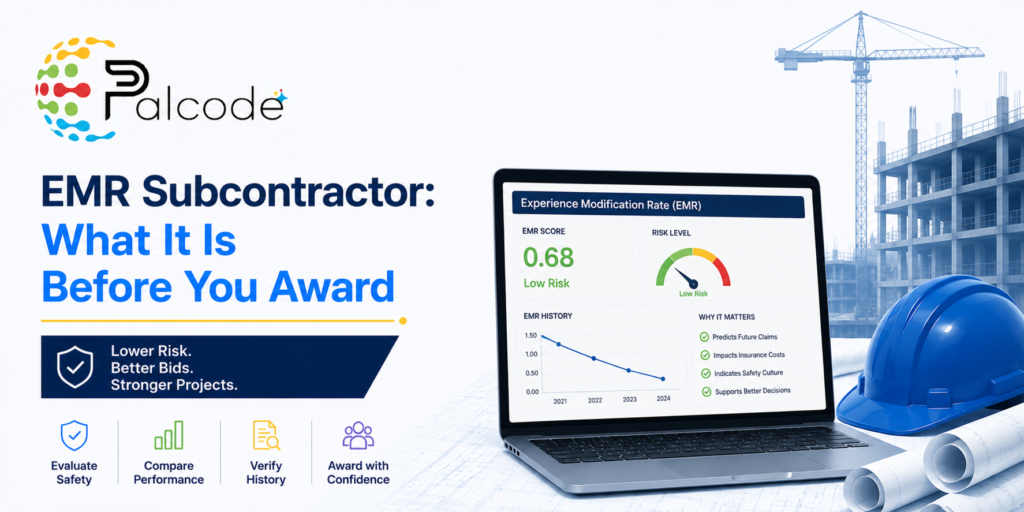
EMR stands for Experience Modification Rating, sometimes called a Mod Rate, E-Mod, or X-Mod. Insurers use it as a multiplier against a contractor’s workers’ compensation manual premium to determine what that sub actually pays for coverage. The analogy that holds up best is a driving record: a history of incidents raises your rate, a clean record lowers it. The industry average sits at 1.0, representing a contractor whose claims history is exactly in line with what the industry expects for their size and trade.
A score below 1.0 means the sub has had fewer compensable claims than predicted. They’re paying less for coverage, and that flows through to lower overhead. A score above 1.0 means the opposite: more claims, higher premiums, higher overhead baked into every number they hand you.
The score is calculated by the National Council on Compensation Insurance (NCCI) from actual claims data reported over the prior five years, though the calculation draws on only the three most recent policy years. Each claim is weighted by incident type and the dollar amount paid out, so a single catastrophic claim hits harder than several minor ones.
Why the EMR Score Is the Right Metric for Subcontractor Risk
Most qualification criteria are subjective. References can be curated. Financial statements can look fine right up until they don’t. EMR is different because it’s calculated by a third party from actual insurance data, not self-reported by the sub. That’s what makes it the closest thing construction has to an objective safety benchmark.
It also has real predictive value. A subcontractor with a history of compensable losses is statistically more likely to generate them on your job. That’s not a moral judgment; it’s what the data reflects. High-EMR subs bring a higher probability of project delays and workforce disruption if a serious incident occurs on your site.
The cost angle is the part most teams underestimate. When a sub’s EMR climbs, their workers’ comp premiums climb with it. That cost doesn’t disappear; it lands in their overhead and eventually in their pricing. A sub with an EMR of 0.78 is almost certainly carrying lower insurance overhead than one at 1.32, and that gap can show up meaningfully in a leveled bid comparison. Good subcontractor risk assessment means reading that cost signal, not just flagging the safety concern.
What Is a Good EMR Score for a Subcontractor?
Below 1.0 is the general target. Most GCs who set formal EMR requirements draw the line somewhere between 0.85 and 1.0 depending on project type and owner requirements. Some owners and public agencies require subs to demonstrate an EMR at or below 1.0 just to be eligible to bid. If a sub’s score climbs significantly above 1.0, they may be locked out of certain projects entirely, which is worth knowing before you get deep into scope negotiations with them.
A score in the 0.75 to 0.90 range is genuinely strong. It signals consistent safety management across multiple years, not just a lucky stretch. Anything above 1.15 warrants a direct conversation before award. Above 1.25 should be a hard flag unless there’s a documented explanation, such as a single outlier claim that has since been resolved.
EMR does have limitations. A very small contractor can see their score swing significantly from one incident simply because the statistical baseline used in the calculation is smaller. A sub with three employees and one bad year looks riskier on paper than a mid-size firm with the same actual incident rate spread across a larger workforce. Context still matters.
How EMR Requirements Factor Into Subcontractor Qualification
EMR is most valuable when it’s part of a structured prequalification process rather than a box checked at bid opening. By the time you’re leveling bids, you ideally already know which subs meet your threshold. Pulling the score late in the process creates the awkward situation of disqualifying a competitive bidder after you’ve already invested time in their proposal.
Setting EMR requirements upfront, and communicating them clearly in your invitation to bid, filters the field before anyone wastes time. It also signals to the market that safety compliance is a real criterion, which tends to attract subs who take it seriously.
For teams managing multiple active bids, keeping EMR data organized alongside insurance certificates and license verification is where things break down in practice. It’s manageable with one sub. At 40 or 50 active trade partners, the gaps start appearing. Platforms built for subcontractor prequalification increasingly centralize exactly this kind of data so the qualification decision doesn’t depend on one estimator remembering to check a folder.
Where Automation Is Changing EMR Tracking
The EMR number itself isn’t changing. It’s still issued by NCCI, calculated the same way it has been for decades. What’s shifting is how teams collect, store, and act on it.
Historically, verifying a sub’s EMR meant requesting a copy of their NCCI rating letter, then filing it somewhere. If the sub’s policy renewed and their score changed, you might not know until the next project cycle. Automated compliance platforms are starting to flag when certificates expire or when renewal data suggests a material change in a sub’s risk profile. That’s a real operational improvement, even if it’s not a dramatic one.
The broader shift is toward treating EMR as a live data point in a sub’s ongoing qualification record rather than a static document collected once. For GCs running large trade partner networks, manually chasing updated EMR documentation every year is a genuine capacity drain. Whether any given platform delivers consistently on that promise is still a fair question to ask in a demo.
For now, the fundamentals stay the same: get the number, verify it’s current, set a clear threshold, and apply it consistently before award. Most teams still have room to improve there, before any automation conversation is even relevant.
| EMR Range | What It Signals | Typical Premium Impact | Recommended Action at Award |
|---|---|---|---|
| Below 0.85 | Consistently strong safety performance over multiple years | Meaningfully below manual premium rate | Proceed; note as a positive qualifier |
| 0.85 to 1.0 | Better than industry average; manageable risk profile | Below or at manual premium rate | Acceptable for most project types |
| 1.0 to 1.15 | At or slightly above average; warrants a closer look | At or modestly above manual premium rate | Review recent claims history before award |
| Above 1.15 | Higher-than-average loss history; elevated project risk | Noticeably above manual premium rate | Require a documented explanation; consider disqualification depending on project requirements |
Frequently Asked Questions
How do I get a subcontractor’s EMR score before awarding a contract?
Require subs to submit a copy of their NCCI Experience Modification Rating letter as part of your prequalification or bid package. You can also request it through their insurance broker. Many GCs include EMR submission as a mandatory bid document, which filters out non-compliant subs before the leveling process starts.
What EMR score should I require from subcontractors on a commercial project?
Most GCs set the threshold at 1.0 or below, meaning the sub performs at or better than the industry average for their trade. On owner-mandated projects, especially public work, the required threshold is sometimes tighter, often 0.90 or below. Check your owner contracts for any stated EMR requirements, since discovering a violation post-award creates a much bigger headache than screening upfront.
How much does EMR compliance tracking typically cost to manage?
Dedicated prequalification platforms tend to run from a few hundred to several thousand dollars per month, depending on the size of your subcontractor network. Manual tracking costs almost nothing in software but is expensive in team time, particularly across a large trade partner pool. The real question is usually how many hours your estimators spend chasing updated certificates annually, and whether that volume justifies a platform.
Can a subcontractor improve their EMR score before bidding on your project?
Not quickly. The EMR calculation draws on three years of claims data, so meaningful improvement requires sustained safety performance over time. A sub can sometimes dispute individual claims that were improperly reported to NCCI, but that’s a slow process. If a sub claims their score has recently improved, ask for documentation directly from their insurer rather than taking their word for it.
Does a high EMR automatically disqualify a subcontractor?
Many GCs and owners treat it that way above a certain threshold, but automatic disqualification isn’t always the right call. For smaller contractors, a single large claim can push the EMR well above 1.0 even when their overall safety culture is strong, simply because the statistical baseline is smaller. The more defensible approach is to use a high EMR as a flag that triggers deeper review rather than an immediate cutoff, particularly when the score is in the 1.10 to 1.20 range and there’s a documented reason for the spike.
See How Palcode.ai Brings Compliance Data Into Your Bid Process
If your team is still chasing EMR letters and compliance documents manually across dozens of active trade partners, that’s a workflow problem worth solving before the next bid cycle. Palcode.ai centralizes subcontractor qualification data alongside your bid leveling and scope review process, so nothing gets missed under deadline pressure. Book a demo to see how it fits your preconstruction workflow. Book a Demo
About the Author
Mohit is the Founder and CEO of Palcode.ai — an AI-powered platform helping general contractors automate preconstruction, sub outreach, and bid management. Before building Palcode, he spent years inside the problem, watching estimators lose weeks to manual follow-ups that software should have handled a long time ago. Explore More Blogs Here.