
You’ve submitted an RFI, steel work is sitting idle, and three days have passed with no reply. The question you’re asking isn’t philosophical. It’s operational: how long does the other party actually have, and at what point does the delay become a contractual problem?
The answer has two layers. One is what the contract says. The other is what the industry actually does, and those two don’t always line up the way you’d expect.
What Construction Contracts Typically Require for RFI Response Time
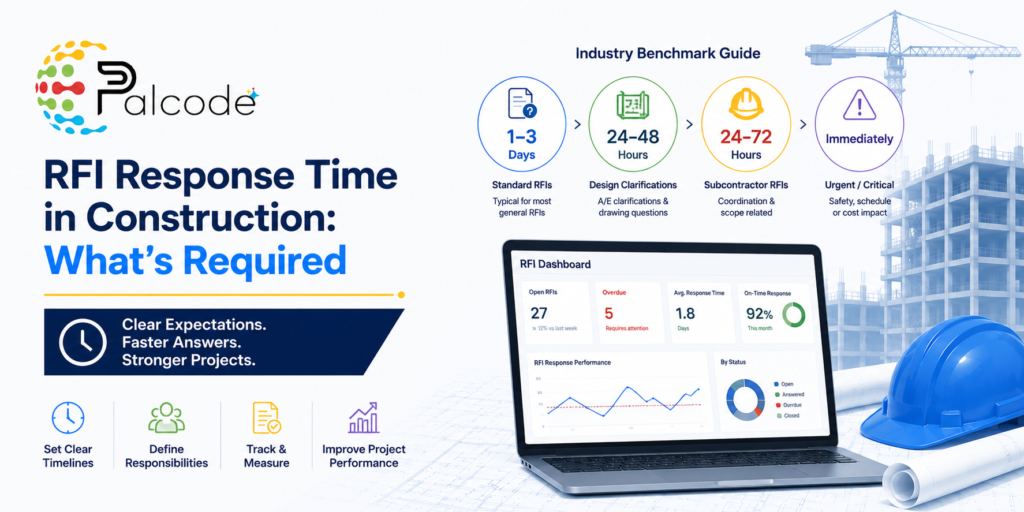
Most well-drafted construction contracts define a maximum response window rather than leaving it open-ended. The most common windows are 7 days for standard inquiries and 14 days for complex issues requiring genuine design review or research. Some contracts push further and assign role-specific timelines, such as granting an engineer a hard maximum of seven days regardless of how complex the question is.
That specificity matters more than most people give it credit for. A Navigant Consulting analysis found that actual response times tend to fall between 6.4 and 10 days across projects, meaning the contractual ceiling and real-world performance are often close but not identical. The contract sets the legal floor. Whether a team actually performs to it is a separate question entirely.
There’s also a clause worth watching in many contracts: if an RFI uncovers missing scope details or a design error, the response can trigger a formal change order. That makes the timeliness of the reply legally significant well beyond the original deadline. A slow response to that kind of RFI doesn’t just delay one trade. It can ripple into cost, schedule, and contract standing at the same time.
What’s Actually Reasonable: Industry Norms on RFI Turnaround Time
The widely cited industry average for RFI response time lands between 6 and 10 days, with the more specific figure often quoted as 6.4 to 10 days depending on region and project size. Design professionals estimate that a typical RFI takes roughly 8 hours to properly review and log, though that number climbs fast for anything requiring coordination across multiple drawings or consultants.
Eight hours of actual review time, spread across a reviewer’s existing workload, can easily translate to four or five calendar days on the receiving end alone. Add internal routing delays and that 7-day contractual window starts looking tight rather than generous. That’s the part most teams underestimate.
Reasonable performance, practically speaking, means differentiating between what genuinely holds field work and what can wait a few extra days. Teams that handle RFI turnaround well tend to use priority designations, flagging mission-critical issues separately rather than treating every request as equally urgent. Overusing high-priority status trains reviewers to ignore it. The designation only works when it’s genuinely reserved for work that is stopped.
On large, complex projects, average response times tend to stretch toward the higher end of that range. The contractual 14-day window for complex issues exists precisely because some RFIs legitimately need that time. The problem is when the 14-day window becomes the default rather than the ceiling it was intended to be.
How RFI Drafting Affects Response Speed
A slow response isn’t always the reviewer’s fault. Vague or multi-part RFIs create their own delays, because a poorly scoped request forces the reviewer to ask for clarification before they can answer. That back-and-forth adds days that don’t show up in anyone’s response time tracking but still affect your schedule.
A few drafting practices that consistently improve RFI turnaround in the field:
- One question per RFI. Bundling related issues into a single submission creates ambiguity about which part gets answered first, and which gets deferred.
- A clearly stated required response date in the body of the RFI itself. Something like “Steel install is on hold in this zone. Response needed by Thursday to avoid schedule impact” gives reviewers an explicit deadline rather than relying on the contract’s general window.
- Supporting documentation attached upfront. Relevant drawings or spec sections reduce back-and-forth that quietly inflates actual response time.
- If multiple related issues genuinely need to travel together, grouping them deliberately is more efficient than sending a fragmented sequence of requests that arrive days apart.
Submitting an RFI the moment a problem surfaces also matters more than most teams acknowledge. Waiting until an issue is critical before logging it compresses the available response window and eliminates the buffer the contract was drafted to provide.
When RFI Deadline Contract Language Becomes a Dispute Issue
If a party misses the contractually defined response window, the downstream effects depend heavily on how clearly the contract was drafted. A well-structured RFI process should document when each request was submitted, what the required response date was, and when a reply came back, or whether it did at all.
That documentation trail is what converts a schedule delay into a supportable claim, or defends against one. Without it, both sides end up arguing from memory about what was reasonable rather than what was required. RFI logs that capture submission dates, priority levels, and response timestamps aren’t just administrative housekeeping. They’re the evidentiary foundation for a delay claim.
Contracts that leave response time vague, using language like “within a reasonable time,” tend to generate more disputes. “Reasonable” becomes a negotiation at that point rather than a defined standard. The stronger the original contract language around response windows, the cleaner any downstream analysis will be.
How AI and Automation Are Changing RFI Response Tracking
Manually logging RFIs, tracking deadlines, and escalating overdue requests is genuinely time-consuming on active projects. Teams managing dozens of open RFIs at once often miss response deadlines not because anyone ignored the issue but because no one flagged that the clock was running.
AI-assisted RFI management tools are starting to address this by automating the tracking layer: capturing submission timestamps, calculating contractual due dates, and surfacing approaching deadlines before they’re missed. Some platforms can route RFIs to the right reviewer automatically based on trade or discipline, cutting the internal routing lag that often consumes two or three days of the available window. For a closer look at what to evaluate in those tools, the guide on RFI software for construction covers the key criteria worth checking before committing to a platform.
Adoption is still uneven. Smaller teams often rely on spreadsheets or platform-native logs that don’t automatically flag deadline risk. The shift toward purpose-built tracking is happening, but most projects still depend on a coordinator actively managing the queue rather than a system that surfaces exceptions on its own. That’s precisely where response times tend to slip, not from bad intent but from workload and visibility problems that accumulate quietly until a deadline is already past.
Frequently Asked Questions
What is the standard RFI response time in a construction contract?
Most contracts set 7 days for standard RFIs and 14 days for complex ones requiring significant design review. Some go further and assign role-specific timelines, such as a hard seven-day maximum for engineers regardless of the question’s complexity. The contractual window is a ceiling, not a target, though in practice many teams treat it as both.
What is the average RFI response time on construction projects?
Industry data puts the average between 6.4 and 10 days, varying by region and project size. Design professionals estimate that a typical RFI takes around 8 hours to properly review and document. Calendar time depends heavily on how full the reviewer’s queue is when the request lands.
How much does RFI management software typically cost, and is it worth it for mid-size GCs?
Purpose-built RFI tracking tools generally run from a few hundred to several thousand dollars per month, depending on team size and platform depth. For mid-size GCs managing 20 or more concurrent RFIs on active projects, the cost tends to be justified by fewer missed deadlines and a cleaner audit trail for potential claims. The harder calculation is switching cost if your team is already embedded in a platform like Procore, since adding a standalone tool means managing two systems.
Can a missed RFI response deadline support a delay claim?
Yes, provided the contract specifies a response window and your RFI log documents the submission date, required response date, and actual reply date. Vague contract language like “within a reasonable time” makes this harder to substantiate. That’s one reason precise RFI deadline language matters during contract negotiation, not just during execution.
What’s the best way to speed up RFI responses without creating more noise?
Limit each RFI to a single, clearly defined question and attach the relevant drawings or spec sections upfront so the reviewer doesn’t have to chase down context. Include a specific required response date tied to an actual schedule milestone rather than relying on the general contractual window. Reserve high-priority flags for work that is genuinely stopped; overusing them erodes their effect quickly.
Tired of Chasing RFI Deadlines Manually?
If your team is tracking RFI response times in a spreadsheet or relying on email threads to flag overdue requests, there’s a better way. Palcode.ai helps preconstruction and project teams manage document workflows with less manual follow-up and clearer visibility into what’s sitting unanswered. Book a demo to see how it fits your current process. Book a Demo
About the Author
Mohit is the Founder and CEO of Palcode.ai — an AI-powered platform helping general contractors automate preconstruction, sub outreach, and bid management. Before building Palcode, he spent years inside the problem, watching estimators lose weeks to manual follow-ups that software should have handled a long time ago. Explore More Blogs Here.