Request for Information issues can quietly drain profit from construction projects. When RFIs are managed through email threads, spreadsheets, and scattered PDFs, teams lose time, miss context, and create avoidable delays that ripple through the entire job.
AI RFI management changes that by organizing information faster, routing questions more intelligently, and giving teams clearer visibility across the bid and preconstruction process. For contractors, the difference is not just convenience; it can directly affect margin, schedule certainty, and win rates.
Why RFI tracking becomes a bottleneck
Most construction firms do not struggle because they lack effort. They struggle because manual RFI tracking is messy, repetitive, and highly dependent on individual memory. A single missed response can stall coordination, delay procurement, or create a chain reaction of change orders.
When RFIs are managed manually, teams often deal with:
Email overload and duplicated messages.
Spreadsheets that are hard to update in real time.
Version confusion across drawings, specs, and addenda.
Slow handoffs between estimators, project managers, and subcontractors.
Limited visibility into what is open, urgent, or at risk.
This is why many contractors start looking for rfi software once project complexity increases. The larger the job, the more manual tracking turns into a liability instead of a process.
Manual tracking costs more than time
Manual RFI tracking is often treated as an administrative issue, but it has real financial impact. When information moves slowly, crews wait, procurement decisions slip, and downstream work gets disrupted. That slows project delivery and increases the chances of costly rework.
It also affects preconstruction and estimating. If your team cannot quickly surface the right information, bids take longer to assemble and important scope gaps can be missed. In competitive environments, speed matters, and teams that can process information faster are often better positioned to submit cleaner bids and respond more confidently.
That is where modern rfi tools begin to create value. They reduce the time spent searching for answers and help teams keep momentum across the full bidding and project lifecycle.
What AI RFI management actually does
AI-powered rfi management is not just a digital inbox. It is a workflow layer that helps construction teams classify, summarize, prioritize, and route information more efficiently. Instead of relying on someone to manually sort every request, the system can help identify the issue, link it to the right documents, and guide the next action.
In practice, AI RFI management can support:
Automatic categorization of RFIs by trade, package, or urgency.
Faster search across plans, specs, and historical responses.
Drafting or suggesting responses based on project context.
Highlighting items that may impact schedule or budget.
Connecting RFIs to related decisions, submittals, and change order management software.
For contractors, this means less time spent administrating questions and more time making decisions. It also improves consistency, which matters when multiple people are touching the same project.
Why AI improves bid management
The strongest case for AI in construction is not just RFI handling. It is the way AI-powered bid management improves the entire preconstruction workflow. When teams can process information faster, they can review scope more thoroughly, identify risk sooner, and respond to opportunities with more confidence.
AI helps bid teams by:
Surfacing likely scope gaps before submission.
Organizing project information into a usable structure.
Reducing manual review time on repetitive documents.
Helping estimators focus on judgment instead of data hunting.
Creating a clearer connection between bid assumptions and downstream execution.
This matters because win rates are not only driven by price. They also depend on how well a firm understands the project, how cleanly it can respond, and how much confidence it gives the client. A team that uses rfi software and AI-supported workflows can often move faster without sacrificing accuracy.
Pain points contractors feel every day
Contractors do not need abstract promises. They need solutions to daily frustration. Manual tracking creates friction across the workday in ways that are easy to underestimate.
Common pain points include:
Missing a critical response buried in a long email thread.
Spending hours reconciling document versions.
Re-entering the same project information in multiple systems.
Losing track of who owns the next action.
Discovering risk too late to do anything about it.
These problems affect estimators, project managers, coordinators, and executives differently, but they all add up to the same result: lower efficiency and more uncertainty. Better rfi management reduces that friction and gives teams a cleaner operating rhythm.
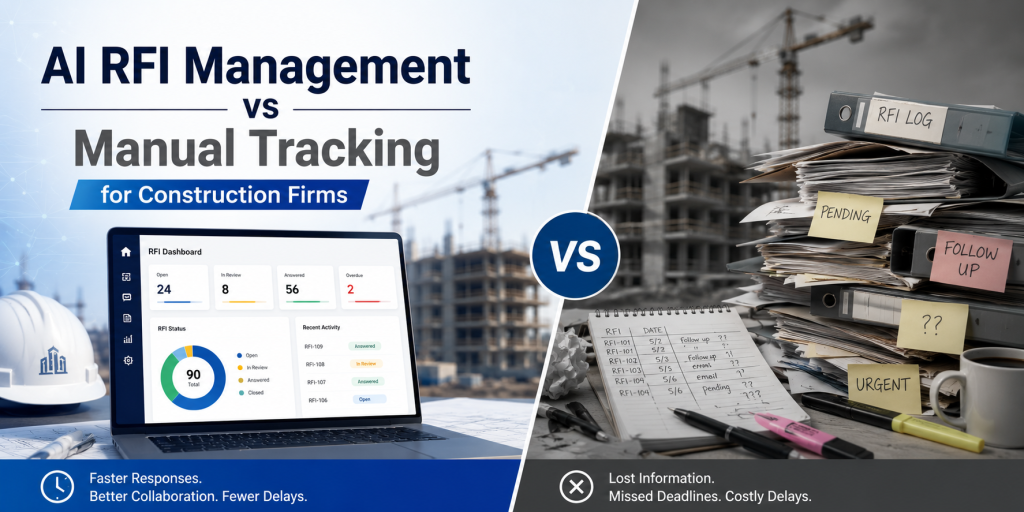
AI RFI management vs manual tracking
The difference between AI and manual methods becomes clearest when you compare them side by side.
| Area | Manual tracking | AI RFI management |
|---|---|---|
| Speed | Slow, dependent on human follow-up | Faster categorization and routing |
| Visibility | Fragmented across inboxes and sheets | Centralized and searchable |
| Accuracy | Higher chance of missed details | Better consistency and context capture |
| Scalability | Breaks down as project volume grows | Handles more requests with less overhead |
| Risk detection | Often reactive | More proactive and structured |
| Team workload | Heavy administrative burden | More focus on decision-making |
For smaller firms, manual tracking may feel manageable at first. But as project volume increases, the hidden cost becomes obvious. AI tools reduce the administrative load while improving the quality of information moving through the team.
Why change orders are part of the story
RFI issues do not stop at the question stage. They often lead directly to scope clarification, design adjustments, and change order conversations. That is why contractors should think beyond isolated RFI handling and look at the full workflow.
When rfi software is connected with change order management software, teams can trace the path from question to decision to financial impact. That traceability matters because it helps protect margin and reduce disputes. It also makes it easier to explain why a change happened and how it should be handled.
In other words, better rfi management improves more than communication. It supports stronger project controls.
How AI supports efficiency and win rates
Efficiency is only part of the value. AI can also help firms win more work by improving how they prepare and respond during the bid process. Teams that are faster, more organized, and more confident tend to produce stronger submissions.
AI-supported bid workflows can improve win rates by:
Helping teams respond faster to bidder questions.
Reducing the chance of overlooked scope items.
Improving coordination between estimating and operations.
Making it easier to reuse historical project knowledge.
Increasing confidence in pricing and risk assumptions.
This creates a compounding benefit. The more organized your information is, the easier it becomes to produce better bids. Over time, that can raise both bid quality and close rates.
What to look for in rfi tools
Not all rfi tools are equal. Some simply digitize the old process, while others use AI to actually improve it. Contractors evaluating software should focus on whether the system makes work easier across the entire workflow.
Look for rfi tools that offer:
Fast search across documents and project history.
Clear assignment and ownership of open items.
AI-assisted summarization and categorization.
Connections to change order management software.
Reporting that shows delays, response times, and bottlenecks.
Simple adoption for field and office teams.
The best rfi software should reduce manual effort, not just move it into a new interface. If the platform still depends on someone manually sorting everything, the value is limited.
When manual tracking still makes sense
Manual tracking is not always wrong. Very small firms with low project volume and simple scopes may not need a full platform on day one. If the team is small and the number of RFIs is limited, basic tracking can work for a while.
But that changes quickly once the firm starts taking on more projects, more trades, or more complex scopes. At that point, manual processes become harder to control and more expensive to maintain. Most firms reach a threshold where they need better rfi management to stay competitive.
The question is not whether manual tracking can work. The question is whether it can keep working as the business grows.
How to position this internally
If you are evaluating AI RFI management for your team, frame the conversation around business outcomes, not just software features. Leadership cares about margin, speed, predictability, and risk reduction.
A simple internal pitch could be:
We spend too much time chasing information manually.
We lose visibility across RFIs and change-related issues.
We need faster response cycles to protect schedules.
We want a more reliable way to support bids and project execution.
We need rfi software that connects with our broader workflow.
That framing helps move the discussion from “new tool” to “operational improvement.” It also makes it easier to justify adoption across preconstruction and operations.
If your team is still managing RFIs through email, spreadsheets, and manual follow-up, now is the time to modernize. AI RFI management can help you reduce delays, improve coordination, and support stronger bids with less administrative effort.
Book a demo today to see how AI-powered rfi management can streamline your bid process, connect with change order management software, and help your firm win more work with less chaos.
Frequently Asked Questions
What is AI RFI management in construction?
AI RFI management uses software to automatically organize, prioritize, and help respond to RFIs, reducing manual work and improving visibility across projects.
How is AI RFI management better than manual tracking?
Manual tracking depends on spreadsheets, emails, and human follow-up, while AI RFI management improves speed, accuracy, and consistency by centralizing information and reducing missed items.
Can RFI software help reduce change orders?
Yes. Better rfi management helps teams catch scope gaps, clarify issues earlier, and connect RFIs to change order management software, which can reduce avoidable change orders and disputes.
What should construction firms look for in RFI tools?
Construction firms should look for rfi tools with AI-assisted search, response tracking, document linking, reporting, and easy integration with existing project workflows.
Does AI-powered bid management improve win rates?
Yes. AI-powered bid management helps teams work faster, identify risks sooner, and prepare cleaner bids, which can improve both efficiency and win rates.
About the Author
Mohit Mohan is the founder of Palcode.ai and a builder of AI-first systems for commercial construction workflows. He works closely with preconstruction leaders to translate real field constraints coverage gaps, bid volatility, scope ambiguity, compliance friction, and estimator capacity limits into repeatable, governed operating workflows that scale across projects and teams.