
One mid-sized contractor found that a single estimator was spending nearly 40% of the workday on manual bid solicitation and subcontractor follow-ups, limiting the team to just four projects per month. After implementing AI-driven bid outreach and bid leveling software, solicitation time dropped to 10%, allowing the company to handle 50% more projects — increasing capacity from four to six projects monthly. At the same time, bid win rates improved from 15% to 18%, while estimate accuracy increased from 85% to 92%.
The Challenge
The construction industry is experiencing a significant staffing crisis, with 78% of contractors encountering substantial difficulties in filling estimating positions. This contractor found themselves in a common situation – relying on a single estimator to manage a comprehensive range of responsibilities, including takeoffs, bid solicitation, and estimate preparation.
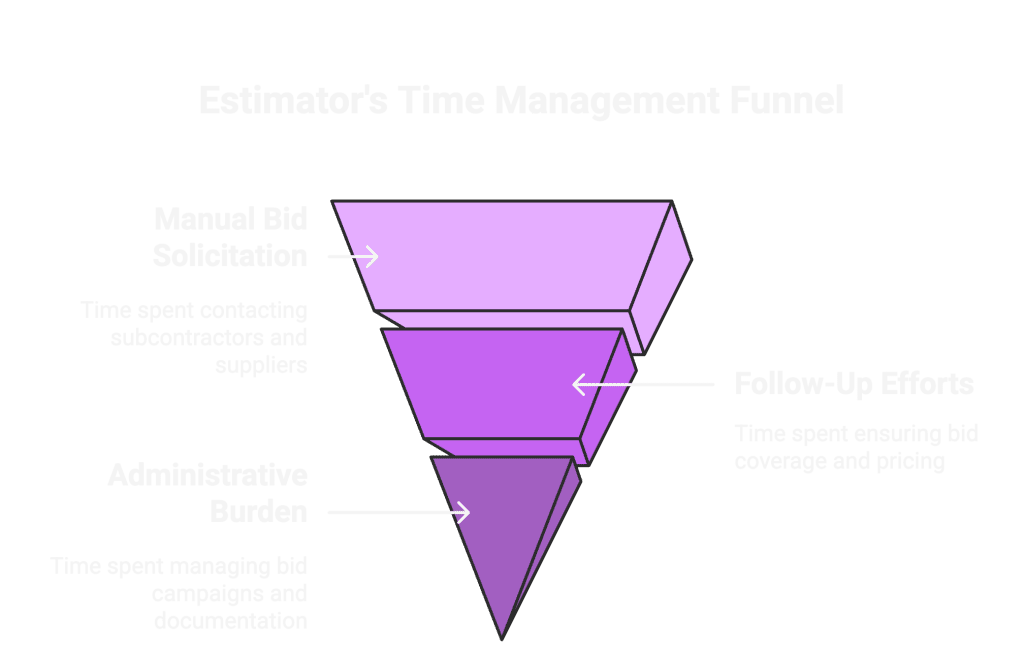
The burden of manual bid solicitation was consuming nearly half of the estimator’s workday. Traditional bid solicitation involves extensive phone outreach to numerous potential subcontractors and suppliers for each project, often requiring multiple attempts to reach contacts and detailed conversations. The process is notorious for its time-consuming nature, demanding significant effort in preparing detailed proposals within tight deadlines.
Manual follow-up added another considerable time drain, necessary to ensure comprehensive bid coverage and optimal pricing. The administrative burden of managing multiple simultaneous bid campaigns created additional complexity, with each project requiring meticulous documentation of outreach, response tracking, and coordinating submission deadlines across different trades and suppliers.
When the single estimator spent substantial time on administrative tasks like bid solicitation, their time for detailed technical analysis became restricted, leading to compromises in estimate depth and accuracy. The operational constraints limited both project throughput and estimate quality, forcing the contractor to be selective in bidding and potentially missing valuable opportunities.
The Solution
The contractor implemented an AI-driven bid solicitation tool designed to address these specific inefficiencies. The system leveraged natural language processing and machine learning to conduct conversations, replicating human communication at scale and speed impossible to achieve manually.
The AI solution provided several key capabilities:
Automated Initial Outreach: The system conducted initial trade partner contact calls to gauge interest and availability, handling the extensive phone outreach that previously consumed large portions of the estimator’s day.
Pre-Qualification Process: The AI conducted preliminary pre-qualification to assess capacity, bonding, and schedule alignment, ensuring only qualified bidders moved forward in the process.
Persistent Follow-Up: The system automatically followed up with hesitant bidders to maximize participation in critical divisions, maintaining the comprehensive coverage necessary for competitive pricing.
Strategic Resource Allocation: The AI prioritized direct preconstruction team involvement only after initial qualification, allowing human expertise to focus on value-added activities rather than routine administrative tasks.
Scalable Operations: The system dramatically reduced man-hours spent on bid solicitation calls while improving response rates through consistent, comprehensive outreach campaigns.
Implementation
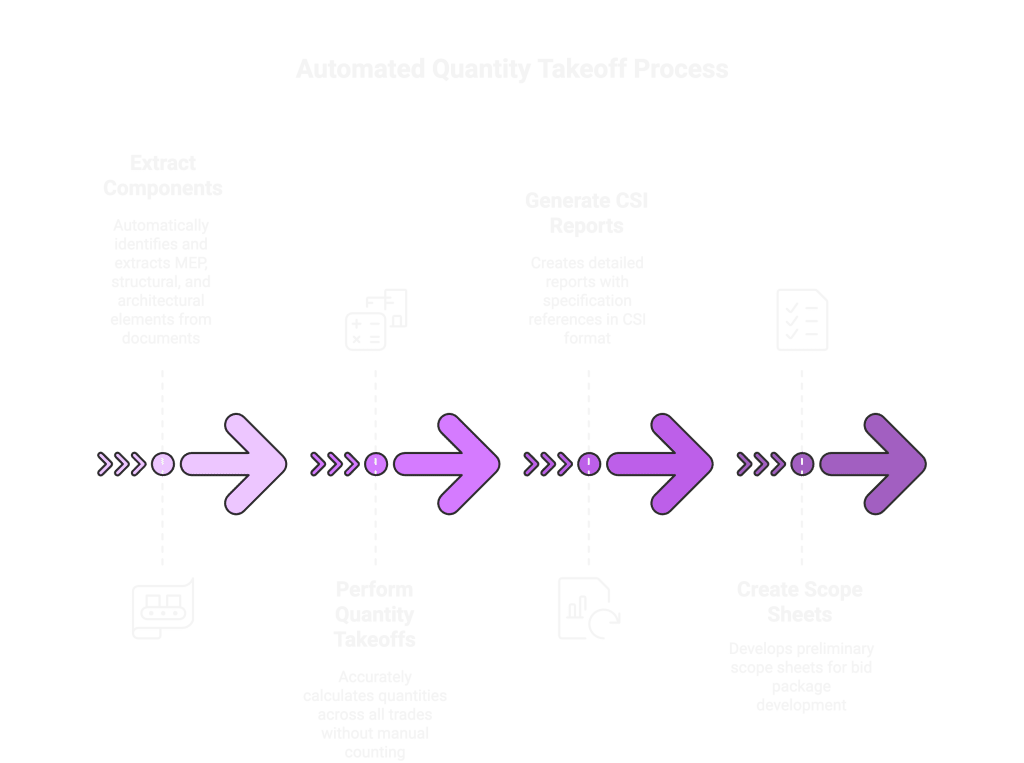
The implementation focused on integrating the AI automation with existing workflows. Modern bid management platforms are designed to automate bid estimate creation and project tracking while improving team collaboration – crucial capabilities for limited staff.
The scalability of the AI solution proved well-suited for variable estimating workloads. During peak periods, the automated system handled increased outreach without requiring additional human resources or compromising quality, allowing the contractor to pursue more opportunities without proportionally increasing staff.
Results
The implementation delivered significant measurable improvements across key performance indicators:
Time Savings: The estimator’s time spent on bid solicitation dropped from 40% to 10%, freeing up approximately 30% of their workday. This allowed reallocation of time to detailed takeoffs and cost analysis – the high-value analytical work that directly impacts estimate accuracy and competitiveness.
Increased Capacity: The firm increased its bidding capacity by 50%, handling 6 projects per month compared to 4 previously. This expansion in throughput addressed the fundamental limitation of single-estimator operations.
Improved Win Rates: The bid win rate increased from 15% to 18%, demonstrating that the improved time allocation enhanced competitive positioning without sacrificing quality.
Enhanced Accuracy: Estimate accuracy improved from 85% to 92%, showing that reallocating human resources from administrative tasks to analytical work significantly improved the quality of preconstruction deliverables.
| Metric | Before Automation | After Automation |
|---|---|---|
| Time Spent on Bid Solicitation | 40% | 10% |
| Projects Handled per Month | 4 | 6 |
| Bid Win Rate | 15% | 18% |
| Estimate Accuracy | 85% | 92% |
The Strategic Impact
The automation solution addressed the core challenge of understaffed preconstruction departments by enabling the contractor to do more with fewer people. By automating the time-intensive administrative aspects of bid solicitation, valuable human resources were redirected to technical analysis and strategic planning that directly impact competitive positioning and profitability.
The consistent information delivery and standardization from the automated system contributed to improved estimate quality and reduced variability. All bidders received consistent information, resulting in more comparable proposals that were easier to evaluate, reducing administrative burden and improving cost comparison reliability.
Looking Forward
This implementation demonstrates how AI-driven automation can transform preconstruction operations even with limited staffing. The proven benefits – reduced administrative burden, improved project throughput, enhanced estimate quality, and better resource utilization – make a compelling case for automation adoption.
The scalability and consistency of automated systems address the fundamental limitations of single-estimator operations while providing data for continuous improvement. As the construction industry becomes increasingly technology-driven, contractors who successfully implement AI-driven bid solicitation automation position themselves to handle staffing challenges and capitalize on market opportunities unavailable to less automated competitors.
For firms facing similar staffing constraints, this case study illustrates that automation isn’t just about efficiency – it’s about maintaining competitive viability in a challenging market while building a foundation for sustained competitive advantage.
FAQ
How can AI bid outreach reduce bid solicitation time for estimators?
AI bid outreach automates subcontractor calls, follow-ups, and reminders, helping estimators spend less time on repetitive outreach and more time on bid analysis and project strategy.
What are the benefits of using bid leveling software with AI outreach tools?
Bid leveling software helps contractors compare subcontractor bids faster, identify scope gaps, improve estimate accuracy, and streamline preconstruction decision-making.
Can automated bid solicitation improve bid coverage and win rates?
Yes. Automated bid solicitation systems increase subcontractor response rates, improve bid coverage, and help general contractors submit more competitive and accurate bids.