If you’ve been watching AI in construction over the last few years, you’ve probably noticed the conversation has shifted. It’s less about whether AI belongs on a job site and more about which capabilities are delivering results now versus which ones are still a product cycle or two away. That distinction matters if you’re making real budget and tooling decisions.
This post covers what AI for construction management has genuinely changed already, what’s still emerging, and how to think about adoption without getting ahead of what the technology can reliably do today.
What AI for Construction Management Has Already Changed
The clearest shift over the past several years is the move from reactive documentation to forward-looking analysis. Traditional project management waited for problems to surface, then scrambled to respond. AI-driven tools now analyze historical data and supply chain trends to flag budget overruns or schedule slippages before they happen, sometimes days or weeks before a human reviewer would catch them.
That’s not a minor efficiency gain. It’s a fundamentally different posture toward project risk.
Scheduling and Resource Allocation
Automated scheduling tools can now assign tasks and adjust timelines in real time based on live site data. The critical path logic that used to require an experienced scheduler’s full attention is increasingly handled in the background, freeing up PMs to focus on judgment calls rather than data entry.
In practice, this helps most on complex multi-trade projects where manual schedule updates tend to lag reality by several days. The automation isn’t perfect. But it’s usually faster and more consistent than relying on weekly update cycles, and that gap compounds over a long project.
Real-Time Site Visibility
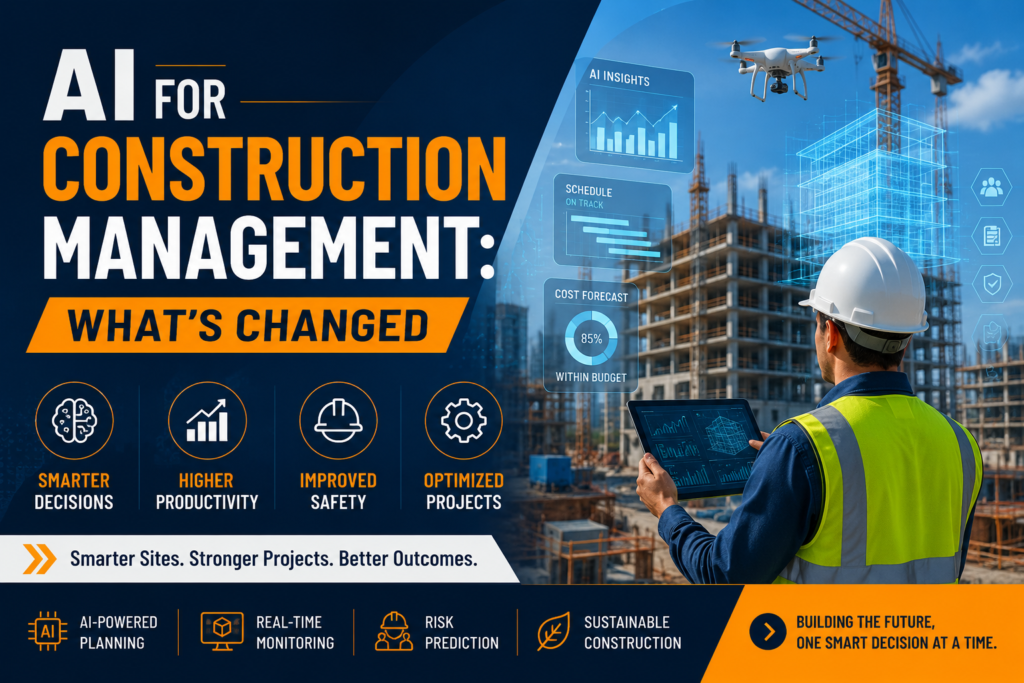
IoT sensors, drones, and connected equipment have given site leadership something that didn’t exist at scale five years ago: a continuous feed of what’s actually happening on site. AI aggregates those inputs into something usable, replacing the weekly manual report with a live dashboard. Safety incidents, equipment utilization, and progress against plan are all visible in near-real time.
The honest caveat here is that this level of visibility requires upfront investment in hardware and integration. Teams running one or two active projects may not see the ROI as quickly as larger operations managing several sites at once. That’s the part most teams underestimate when they’re evaluating these tools.
BIM and Design-Stage Risk Reduction
AI-enabled Building Information Modeling now does more than produce 3D visualizations. It verifies design integrity before construction begins, identifies root causes of RFIs, and can optimize layouts for structural safety. The practical impact is fewer surprises during construction and a shorter RFI cycle, which matters a lot on fast-track projects where RFI management can easily become a schedule bottleneck if it isn’t tightly controlled.
Administrative Automation
Document control, submittals, and O&M manual drafting are now partially or fully automated on projects using modern construction management platforms. The hours that used to go into compiling and cross-referencing documents are being redirected toward higher-value work.
This isn’t glamorous, but it’s one of the areas where adoption has been fastest. The ROI is direct and measurable in a way that’s harder to argue with than, say, a predictive risk score.
Where AI Construction Trends Are Heading Next
The current wave of AI adoption has focused heavily on automating what already existed: scheduling, document management, site reporting. The next wave is starting to tackle problems that were previously too complex to systematize at all.
Digital Twins and Predictive Maintenance
Digital twins, virtual models that mirror a building’s real-world performance, are moving from experimental to practical. They simulate energy use, predict maintenance needs, and track asset health over the facility’s lifespan. For owners and facility managers, that’s a meaningful shift in what they receive at closeout. For GCs, it’s starting to affect how projects are scoped and handed off, since the digital deliverable is becoming as important as the physical one.
Predictive Safety Systems
Machine learning models trained on project progress patterns are getting better at identifying high-risk conditions before incidents occur. This moves safety management away from a compliance checkbox toward something closer to continuous monitoring. Early adopters are already reporting measurable reductions in incident rates, though broad adoption is still uneven across the industry.
AI Workflows Embedded in Vertical Software
Major construction software platforms are integrating AI capabilities directly into procurement, contract management, and scheduling modules. This matters because it reduces the pressure on GCs to stitch together custom AI solutions. The tradeoff is less flexibility, but for most mid-market firms, a well-integrated native feature tends to beat a standalone tool that requires separate onboarding and a separate contract.
It also raises the bar for general contractors to justify margin, since AI-assisted cost analysis makes pricing more transparent across the supply chain. That pressure is already showing up in how subs and GCs negotiate scope.
Supply Chain Optimization
AI is getting meaningfully better at predicting material needs and flagging supply chain risks before they affect the schedule. Given how much the past few years exposed the fragility of construction supply chains, investment in this area is accelerating. The tools are still maturing, but the directional shift is clear and the business case is easy to make after what most GCs lived through between 2020 and 2023.
The Adoption Reality for 2026
AI in construction isn’t going to arrive uniformly. Firms with dedicated preconstruction teams, consistent data practices, and structured estimating workflows will extract value from these tools far faster than firms still running on spreadsheets and tribal knowledge.
That gap is widening. Companies that have invested in structured AI workflow software for construction are already compressing tasks that used to take days into hours, particularly in estimating, scope review, and bid analysis. Companies that haven’t started yet aren’t just behind on features. They’re building a data deficit that will take real time to close.
AI adoption in construction also tends to succeed in increments. Teams seeing the best results usually started with one high-friction workflow, proved the value there, and expanded from that foothold. Starting with a tool that addresses a pain you feel every week is a better entry point than trying to deploy a comprehensive platform on day one.
Heading into 2026, AI for construction management has moved well past proof-of-concept. For most teams, the question isn’t whether to adopt. It’s where to start given current capacity, and how fast to move given the data maturity you actually have today, not the data maturity you’d like to have.
Frequently Asked Questions
How is AI actually being used in construction management today?
Predictive scheduling and automated document control are the most common active uses right now, along with real-time site monitoring through IoT and drone integration. AI tools analyze historical project data to forecast budget overruns or schedule slippages before they become problems. That’s a meaningful shift from the traditional reactive approach most teams still ran on five years ago.
What does it cost to implement AI tools for construction project management?
Entry-level AI features embedded in existing platforms typically come as part of a subscription upgrade, often ranging from a few hundred to a few thousand dollars per month depending on seat count. Standalone AI tools with deeper capabilities usually require a separate contract and vary based on project volume. The more relevant cost question is usually implementation time and data readiness, not just the licensing fee line item.
What are the biggest barriers to AI adoption in construction firms?
Data consistency is the most common obstacle. AI tools perform better when fed structured, reliable inputs, and many construction firms still run on fragmented spreadsheets and inconsistent document naming conventions. Beyond data quality, team capacity for onboarding new software is a real constraint, especially for mid-sized GCs without dedicated IT support. Firms that start with a single high-friction workflow tend to see faster ROI than those attempting a full-platform rollout at once.
How will digital twins change construction project delivery?
A virtual model that tracks energy use, predicts maintenance needs, and simulates real-world performance gives owners and facility managers something genuinely new at closeout. For GCs, this is starting to redefine what gets delivered at project closeout, since the digital model is increasingly part of the contractual deliverable. It’s a shift that’s already affecting how some contracts are written, not just how projects are operated after handoff.
Is AI in construction only practical for large firms?
Not anymore. Many current platforms are designed for mid-market GCs and offer modular adoption that doesn’t require significant IT infrastructure to get started. The real differentiator tends to be workflow structure rather than firm size. A smaller firm with consistent estimating processes and clean project data will usually get more out of AI tools than a larger firm with siloed teams and inconsistent documentation.
See How AI Changes the Estimating and Bid Review Workflow
If you’re evaluating where AI fits into your preconstruction process, Palcode.ai is built specifically for the workflows where construction teams lose the most time: bid leveling, scope extraction from blueprints, and coverage gap detection. Book a demo to see how it works on real project documents, not a demo dataset.