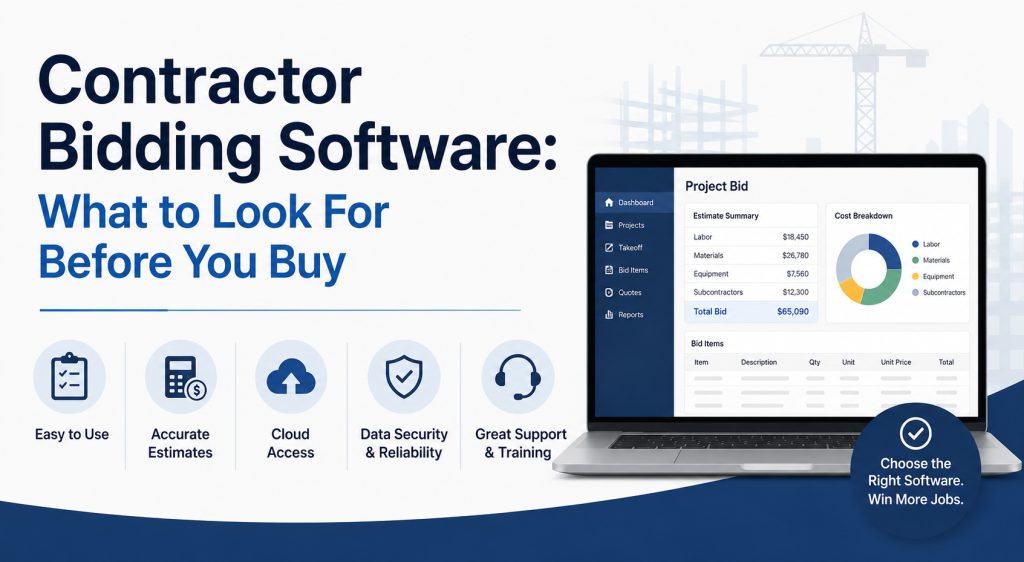
You’ve sat through the demos. You’ve compared pricing tiers. You’ve had the internal conversations about “going digital.” Now you’re close to pulling the trigger on contractor bidding software and you want to make sure you’re not buying the wrong thing.
That’s the right instinct. The wrong platform doesn’t just waste budget. It creates friction in your preconstruction workflow that estimators, PMs, and operations leaders feel on every single bid cycle.
This guide is for GCs, chief estimators, preconstruction managers, and construction operations leaders who are actively evaluating software and want a clear-eyed view of what actually matters before committing.
Why Most Contractors Evaluate Bidding Software the Wrong Way
The first mistake most teams make is letting the demo drive the evaluation. A polished UI feels compelling in a 45-minute sales call. But the real test is whether the platform holds up when your estimating team is juggling addenda drops on a tight deadline, your subcontractor coverage is thin, and bid day is two weeks out.
It can be tempting to focus on a clean interface over workflow fit but a sleek design isn’t helpful if estimators have to fight with it to do their day-to-day work. Similarly, a large project count is meaningless if listings are incomplete, outdated, or missing documents. And free or cheap tools can get expensive once you bolt on separate systems for takeoff, estimating, and analytics.
The better approach: define what your team actually does and then evaluate how well each platform supports it.
The Core Jobs Bidding Software Should Do
At its core, construction bidding software should cover three big jobs across preconstruction: project discovery (helping you find relevant opportunities early enough to be competitive), bid management (centralizing invitations, documents, subcontractor outreach, and communication), and estimating integration (connecting seamlessly to digital takeoff and estimating so your numbers stay accurate).
If a platform is strong in one of these areas but weak in the other two, you’re either buying a point tool or planning to stitch together multiple systems. Both have real costs financial and operational.
Key Features to Evaluate Before You Buy
1. Document Control and Version Management
This is non-negotiable. Estimating off an outdated plan set is one of the most expensive mistakes a team can make, and it happens more often than anyone wants to admit.
Effective bid management platforms centralize plans, specs, and addenda with structured organization and search so teams can quickly open the right documents from the platform. When evaluating this feature, ask specifically how addenda are handled whether updates are pushed automatically to all team members and whether version history is clearly tracked and accessible.
2. Subcontractor Database and Qualification Tracking
Coverage is the hidden variable in most bid outcomes. A GC can have a solid estimate and still lose competitiveness if sub coverage is thin or unqualified.
Many modern bid management tools include built-in functionality to search, vet, and contact subtrades and suppliers directly from the system, keeping everything centralized and improving efficiency. Beyond a simple database, look for platforms that support prequalification workflows the ability to track insurance certificates, safety records, and financial stability directly alongside contact and bid history.
3. Bid Invitation Management and Coverage Tracking
A common pain point for estimating teams is bid-day chaos: scattered email threads, incomplete sub coverage, and no clear view of who’s responded. Good construction bidding software eliminates that.
Platforms with solid bid invitation management let you create, send, and track bid invitations within the platform, with subs able to view docs and respond without requiring multiple logins or file transfers. The key question: can your team see real-time coverage status across all active bids from a single dashboard?
4. Integration with Takeoff and Estimating Tools
Bid management and estimating are not the same workflow, but they need to connect. If your estimators are manually transferring quantities from one system to another, you’re creating rework and introducing error.
Tight integration between bid management and takeoff tools lets users send drawings directly from the platform into estimating software reducing manual setup and rework, particularly when addenda drop and quantities need to be rerun quickly.
5. Construction Workflow Automation and Deadline Tracking
Missed deadlines kill bids. Construction workflow automation in this context means automated reminders, calendar visibility across active bids, and task assignment that keeps every stakeholder internal and external on track.
The best bid management platforms allow teams to assign specific sections to specific people, create and assign granular deadlines for each action item, and use push or email notifications so team members stay on top of bid processes even when not logged in. If you’re managing more than a handful of simultaneous bids, this feature moves from “nice to have” to operationally essential.
6. Audit Trails and Compliance Support
This one gets underestimated until something goes wrong.
Audit trails aren’t about assigning blame they’re about finding weaknesses and improving on them. A bid management system that allows teams to assign tasks, build accountability into every process, and audit everything when something doesn’t go according to plan is key to continuous improvement in construction bidding.
For GCs working on public projects or prevailing wage work, this becomes a compliance requirement, not just a best practice.
7. Market Analytics and Win/Loss Visibility
Most teams bid on instinct and historical relationships. The ones gaining ground are using data. Look for platforms that show you which project types, geographies, and owner relationships produce the highest win rates and which are burning estimating hours with nothing to show.
Market analytics functionality should give you visibility into metrics on projects and companies in your market and allow you to easily export data for executive reporting. If your preconstruction leadership can’t answer “where are we winning and why,” your software isn’t giving you enough.
Ready to streamline your bidding process and win more profitable projects? Explore the right contractor bidding software today and make every bid faster, smarter, and more accurate. Click Here
The Buy vs. Build Decision: Standalone vs. Integrated Platforms
One of the more consequential choices is whether to buy a standalone bidding tool or invest in a platform where bid management is part of a broader construction operations automation suite.
Construction bid management software can be a standalone package, but there are also options integrated into larger, enterprise-level construction management platforms. These days, it’s most common for them to be cloud-based.
The practical consideration: if your team is already running project management, financials, and field operations in one system, a disconnected bidding tool creates another data silo. Construction admin automation works best when preconstruction data flows forward bid documents becoming project contracts, sub coverage becoming subcontractor management, estimates becoming project budgets.
The question isn’t just “does this platform do bidding well?” It’s “does this platform fit where we’re going operationally?”
Red Flags to Watch For in the Evaluation Process
A few things that should slow you down before you sign:
Vague answers on integrations. If a vendor can’t clearly explain how their tool connects to your estimating or accounting software, assume it doesn’t or that the integration is shallow and manual.
Overpromised project databases. A high project count without researcher-verified data quality means your team is filtering noise, not finding opportunities.
Pricing that changes at scale. Many platforms look affordable at one or two seats and get expensive fast as your team grows. Get the pricing structure for where you’ll be in two years, not where you are today.
Implementation left to you. Even software that’s easy to learn will produce adoption issues if there’s no structured onboarding. Look for vendors who offer implementation support, a training hub, and an accessible customer success team not just a help center FAQ.
Before You Sign: A Final Evaluation Framework
Here’s the honest checklist to run before committing to any contractor bidding software:
- Does it support how your team actually finds projects, invites subs, and submits bids not just the ideal version of that workflow?
- Can it scale to higher bid volume, more users, and multiple offices without becoming a different product at a different price?
- Does it connect to your existing estimating, takeoff, and project management tools or does it create new silos?
- What does implementation actually look like, and who owns that process?
- Can you get a real demo with your own data, not a scripted walkthrough?
Price shouldn’t be the first consideration. Good bid management software can save significant man-hours, so the cost is almost always balanced by increased productivity but only if the platform is the right fit.
Ready to See How Modern Preconstruction Workflows Actually Run?
If you’re evaluating construction bidding software and want to see what it looks like when bid management, subcontractor coordination, and preconstruction workflows run in a single automated system Palcode.ai is worth a look. Book a 30-minute demo and walk through how GCs and preconstruction teams are cutting coordination overhead and improving sub coverage without adding headcount. Book Your Demo here.
Frequently Asked Questions
What is the difference between bid management software and estimating software?
Bid management software handles the pipeline and communication side of preconstruction project discovery, sub invitations, document distribution, and bid status tracking. Estimating software focuses on the numbers: quantities, labor, materials, and pricing. The two are distinct workflows but need to connect. Most construction teams are looking for platforms where bid data flows cleanly into estimating rather than living in disconnected tools.
What features matter most for general contractors versus subcontractors?
GCs typically prioritize sub invitation management, coverage tracking, document version control, and market analytics. Subs care more about ease of response clean invitations, accessible documents, and simple bid submission without friction. For GCs evaluating how to automate construction workflows, the sub management and compliance tracking features are often where the most operational leverage lives.
When should a construction team upgrade from manual bidding to software?
The clearest signals: multiple estimators are touching the same bids without shared visibility, you’re managing more than a handful of simultaneous bids in spreadsheets, you’ve missed a deadline or bid off a wrong plan set in the last 12 months, or leadership can’t easily answer where the team’s win rate stands and why.
How does construction workflow automation actually work in bid management?
At a practical level, construction workflow automation in bidding means automated deadline reminders, task assignment with notifications, document distribution that updates automatically when addenda are issued, and bid status visibility across all active projects in a single dashboard. It removes the manual coordination burden from estimating and preconstruction teams so they can focus on bid quality, not logistics.
How long does bidding software implementation typically take?
Most teams move through three phases: setup (1–3 weeks for user configuration, contact imports, and integrations), a pilot phase (2–4 weeks running live bids through the new workflow), and ongoing rollout. The software itself isn’t usually the bottleneck aligning people and processes around a consistent way of working is.
About the Author
Mohit Mohan is the founder of Palcode.ai and a builder of AI-first systems for commercial construction workflows. He works closely with preconstruction leaders to translate real field constraints—coverage gaps, bid volatility, scope ambiguity, compliance friction, and estimator capacity limits—into repeatable, governed operating workflows that scale across projects and teams.