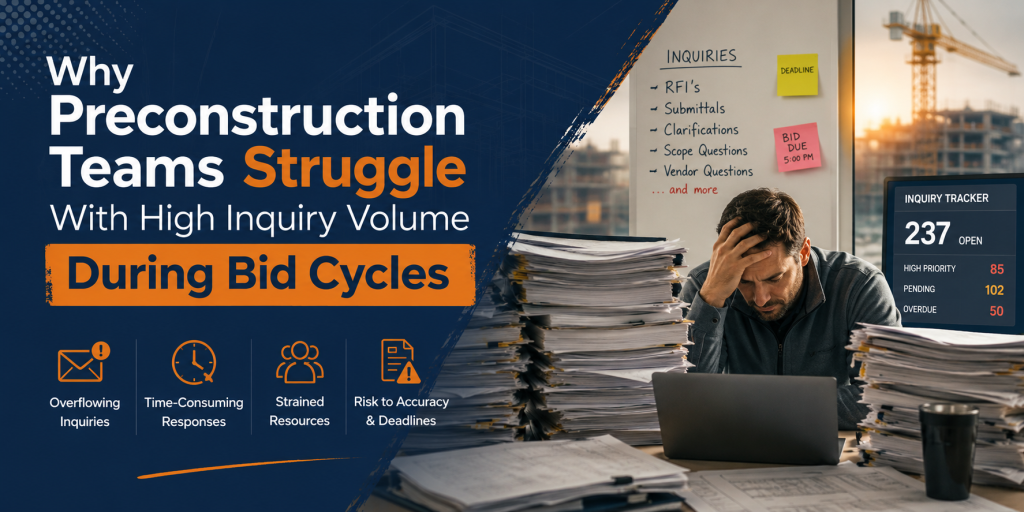
Ask any preconstruction manager what peak bid season feels like, and you’ll get some version of the same answer: controlled chaos at best, a complete breakdown at worst.
Subcontractor inquiries stacking up across three different inboxes. Addenda buried in email threads nobody can trace. Field teams texting the office with scope questions while the estimator is still building the takeoff. And somewhere in the middle of all that noise, a qualified lead slips through—unanswered, unlogged, and ultimately won by a competitor who simply responded faster.
This is exactly why modern teams are shifting toward purpose-built construction software for contractors to bring structure to the chaos. Tools like Procore, Autodesk Construction Cloud, Buildertrend, and PlanGrid help centralize communication, track RFIs, manage addenda, and ensure no lead or bid opportunity falls through the cracks during high-volume cycles.
This isn’t a people problem. Most preconstruction teams work brutal hours during bid season. It’s a construction workflow management problem — the systems underneath the work haven’t scaled with the volume of modern competitive bidding. In 2025, that gap is costing firms real money and real contracts.
The Numbers That Should Concern Every GC
Before diagnosing the root cause, it helps to see how widespread the problem actually is:
- 38% of bid inquiries receive no response within 24 hours during peak cycles
- Firms that respond within 1 hour are 2.4× more likely to win versus those responding 24+ hours later
- 60% of estimators identify manual coordination — not estimating complexity — as their biggest bottleneck during bid prep
Those aren’t fringe scenarios. They’re the norm across mid-market and enterprise general contracting operations running multiple simultaneous bids without automated workflow support.
The Anatomy of a Bid Cycle Breakdown
To fix the problem, you have to understand where it actually breaks down — because “we’re overwhelmed” isn’t a root cause, it’s a symptom.
Most preconstruction teams manage three to four active bids simultaneously during peak season. Each bid carries its own owner-provided documents, subcontractor invitation list, RFI queue, addenda log, and bid day coordination requirements. Multiply that by team size and the structural problem becomes obvious: there’s no single system governing the flow of information. Data lives in email, in Procore, in a shared drive, in someone’s notes, and occasionally on a sticky note on a monitor.
Here’s how that plays out in practice.
1. Missed Inquiries and Slow Response Windows
Subcontractor inquiries arrive simultaneously across email, phone, and plan room portals. Without centralized intake, responses are inconsistent — and a slow or missed response signals to subs that you’re not a reliable partner. That reputation compounds over time in ways that hurt coverage on future bids.
2. Manual Coordination Consuming Estimator Time
Estimators spend 30–40% of their bid week on pure coordination work: chasing sub confirmations, forwarding addenda, answering scope clarification questions that could have been handled automatically. That’s your highest-value preconstruction resource doing administrative labor. From a pure cost standpoint, it’s one of the most expensive inefficiencies in your operation.
3. Scattered Communication Across Channels
When the project manager is in Microsoft Teams, the superintendent is texting, and subcontractors are emailing the main inbox, no single person has the full communication picture. Addenda get missed. Scope revisions don’t reach every relevant party. Bid day surprises become structurally inevitable rather than occasional exceptions.
4. Inefficient Bid Tracking With No Real-Time Visibility
Most firms still track bid status in spreadsheets or general project management tools never designed for preconstruction workflows. There’s no live dashboard showing which trade packages have adequate subcontractor coverage, which packages are at risk, and which bids are trending toward a no-go decision — until it’s too late to course correct.
5. The Field-to-Office Information Gap
Preconstruction doesn’t happen entirely in the office. Site walks, scope reviews, and field RFIs generate real-time intelligence that estimators need to price accurately. In most firms today, that information travels by text message, gets verbally decoded into a scope assumption, and maybe makes it into an email chain. Three filters. Three opportunities for critical information to degrade before it reaches the estimate.
Why Traditional Workflows Cannot Scale
The construction industry is built on relationships and reputation — and that’s not changing. But relationships don’t compensate for a 36-hour response delay on a sub inquiry, and reputation doesn’t rescue an addenda that landed in the wrong inbox and never got distributed.
Traditional bid cycle workflows were engineered for lower inquiry volumes, smaller sub invitation lists, and simpler document control environments. Today’s competitive bid landscape looks fundamentally different. A mid-size GC pursuing commercial work in a competitive market can receive 200+ subcontractor inquiries across a single bid package. Managing that volume manually — even with a disciplined, experienced team — creates compounding operational risk with every hour that passes.
The field-to-office gap makes this worse. Project superintendents and site visit personnel generate real-time observations during the bid phase — existing structural conditions, access constraints, utility conflicts, phasing requirements — that directly affect pricing. When that intelligence travels through a text message chain and a verbal debrief, the estimator prices from an incomplete picture. That is not a human error problem. That is a systems architecture problem. And it has a systems-level solution.
What Construction Operations Automation Actually Changes
The promise of AI workflow construction in the preconstruction context isn’t replacing estimator judgment. It’s eliminating the coordination tax on their time — freeing the people who build your bids to actually focus on building competitive bids.
Here’s what construction operations automation concretely delivers during a bid cycle:
Automated Subcontractor Inquiry Intake and Routing
Incoming inquiries — regardless of channel — are logged, categorized by trade package, and routed to the appropriate team member automatically. Response SLAs become measurable and manageable. Nothing falls through because no one individual was responsible for watching a shared inbox.
Real-Time Addenda Distribution With Confirmation Tracking
Document updates push simultaneously to all invited subcontractors, with read confirmation tracked at the individual level. The “did you get the addenda?” phone call on the morning of bid day disappears entirely — replaced by a dashboard showing exactly who has and hasn’t confirmed receipt.
Sub Coverage Visibility Before Bid Day
Know in real time which trade packages have adequate subcontractor coverage and which are dangerously thin — days before submission, not hours. That visibility enables proactive outreach and prevents the scramble that leads to accepting unfamiliar subs with unknown risk profiles.
Automated Bid Status Follow-Up
The system handles follow-up with subcontractors who haven’t confirmed bid intent, so your team isn’t making 40 phone calls the morning of bid day. That outreach happens on a defined schedule, with responses logged automatically into the bid record.
Field-to-Office Data Sync via Dedicated Construction Software
This is where field to office construction software delivers its most direct impact on bid quality. Site walk observations, RFI responses, constructability flags, and scope notes from field personnel flow directly into the preconstruction record in real time. No manual transfer. No information lost in translation. The estimator prices from complete, current intelligence — not whatever survived the text message chain.
Bid Cycle Performance Analytics
Track which bids consumed the most coordination hours, which subcontractor relationships perform reliably across cycles, and where your win/loss rate correlates with response speed and coverage quality. Over time, this data transforms go/no-go decisions from instinct-driven to evidence-driven.
The Field-to-Office Layer: The Most Underestimated Bottleneck in Preconstruction
Most conversations about preconstruction technology focus on estimating software and bid management platforms. The field-to-office information layer gets far less attention — and it’s frequently where bids are won or lost.
Consider a site walk on a renovation or adaptive reuse bid. The superintendent notices something that afternoon — an existing structural condition, a buried utility conflict, a staging constraint that changes the entire phasing approach. That observation needs to reach the estimator within hours. In most firms today, it arrives two days later, filtered through a text message and a verbal conversation, reduced to a single line item adjustment that may or may not reflect the actual risk.
A purpose-built field to office construction software layer closes that gap structurally. Field observations are logged directly into the bid record — tagged by trade package, timestamped, and immediately visible to the estimating team. The preconstruction team works from the complete information picture, not the version that survived the relay chain.
On a complex bid, that difference can mean the gap between a competitive number and one that prices in unnecessary contingency — or worse, one that misses a risk entirely and creates a margin problem six months into the project.
From Reactive to Strategic: What Better Construction Workflow Management Makes Possible
When construction workflow management handles the coordination layer automatically, something tangible happens to your preconstruction operation: your team gets their time back. Not abstractly — concretely. The hours previously spent on inquiry triage, subcontractor chasing, manual document distribution, and status tracking shift back to the work that actually builds a competitive advantage.
Estimators spend more time on scope analysis, value engineering opportunities, and buyout strategy. Preconstruction managers gain real-time visibility across multiple active bids instead of living inside individual email threads. Operations leaders make informed go/no-go decisions early — when there’s still time to redirect resources — rather than at 4pm the day before a bid is due.
Firms implementing automated bid cycle workflows consistently report measurable improvements across three dimensions that directly affect win rate:
- Faster subcontractor response rates — subs receive timely, consistent communication and stay engaged through bid day
- Fewer bid day surprises — coverage gaps, missed addenda, and scope ambiguities are surfaced and resolved days in advance
- Higher qualified sub participation — a professional, well-organized bid process attracts better subcontractor relationships over time
This shifts the preconstruction operation from reactive to genuinely strategic. The team isn’t scrambling to answer the last question and chase the last confirmation. They’re analyzing the bid, building the right subcontractor team, and submitting with confidence in the number.
The Compounding Data Advantage
Here’s the dimension that most conversations about construction task automation undervalue: the data asset built over time.
Every bid cycle run through an automated platform generates structured, queryable data. Which subcontractors responded at what coverage rates. How long response windows actually took. How final bid costs compared to initial estimate assumptions. Where addenda created the most downstream coordination burden.
That data doesn’t disappear when the bid is submitted.
Over six months, you know which subcontractor relationships are genuinely reliable under time pressure. Over a year, you understand which project types and market sectors your preconstruction team prices most accurately. Over two years, you have a historical cost database calibrated to your specific work type, geography, labor market, and subcontractor network — a competitive asset that manual processes structurally cannot build.
Signs Your Preconstruction Operation Has Outgrown Its Current Workflow
The following scenarios are common. They’re also not inevitable.
- Bids slip through the cracks because no one person had clear ownership of inquiry response
- Estimators regularly work weekends not on estimating, but on coordination and administrative follow-up
- Sub coverage isn’t fully known until 24 hours before bid submission
- Field observations from site walks don’t reliably make it into the final estimate
- There’s no consistent way to measure why certain bids win and others lose
If three or more of these describe your current operation, the constraint isn’t team effort or talent. It’s the workflow architecture underneath the team.
The right construction operations automation platform doesn’t require rebuilding how you bid. It sits as a layer between your existing tools and your team — handling intake, routing, document distribution, sub follow-up, field data sync, and analytics while your team focuses on the judgment, relationships, and strategy that no software replaces.
Frequently Asked Questions
What is construction workflow management in the context of preconstruction?
Construction workflow management refers to the systems and processes that govern how bid-related information — subcontractor inquiries, addenda, RFIs, field observations, and bid status — moves through a preconstruction team during a bid cycle. Effective workflow management ensures nothing is missed, responses are timely, and the estimating team works from complete, current information.
How does AI workflow construction improve bid win rates?
AI workflow construction improves win rates primarily by reducing response time and increasing bid quality. Automated intake and routing ensures subcontractor inquiries are answered faster. Automated addenda distribution and coverage tracking reduces bid day surprises. Field-to-office data sync improves estimate accuracy. Together, these factors produce bids that are more competitive and better supported by subcontractor participation.
What is field to office construction software?
Field to office construction software enables real-time data transfer between field personnel — superintendents, site walk teams, project managers — and the office-based preconstruction and estimating team. Rather than relying on text messages and verbal debriefs, field observations, scope flags, and RFI responses are logged directly into the bid record and immediately accessible to the estimating team.
How does construction task automation differ from general project management software?
General project management software is designed for in-construction workflows: RFI tracking, submittals, daily reports, and schedule management. Construction task automation in the preconstruction context is specifically designed for bid cycle workflows — sub invitation management, inquiry intake, addenda distribution, bid status tracking, and field-to-office information transfer. The use cases and data structures are fundamentally different.
Ready to See What Automated Preconstruction Looks Like in Practice?
Palcode.ai is built specifically for construction teams managing high inquiry volume, fragmented communication, and the field-to-office gap that quietly erodes bid margins and win rates.
If your preconstruction team is ready to stop losing bids to slower coordination and start winning on the quality of your numbers and relationships — we’d like to show you what that looks like in your operation.
Book a Demo at Palcode.ai No commitment. No generic walkthrough. A conversation built around how your team actually bids.
About the Author
Mohit Mohan is the founder of Palcode.ai and a builder of AI-first systems for commercial construction workflows. He works closely with preconstruction leaders to translate real field constraints coverage gaps, bid volatility, scope ambiguity, compliance friction, and estimator capacity limits into repeatable, governed operating workflows that scale across projects and teams.