Managing one bid package is manageable. Managing five simultaneously each with its own subcontractor list, deadline, scope package, and follow-up sequence is where manual processes don’t just slow down. They break. Spreadsheets multiply. Inboxes overflow. Follow-ups fall through. And somewhere between the third and fourth active package, your senior estimators stop estimating and start administrating — which is exactly the problem purpose-built bid management software is designed to prevent.
For general contractors running multiple active projects at once, the bid management bottleneck isn’t a minor inefficiency. It’s a direct constraint on how many opportunities you can realistically pursue, how competitive your pricing can be, and how defensible your award decisions are when ownership asks why you went with a particular number.
The right construction bid software removes that constraint entirely. This guide covers what separates platforms built for multi-project volume from those that buckle under it — and why AI bid management is changing what’s possible for preconstruction teams operating at scale.
Why Multi-Project Bid Management Breaks Down Without the Right Software
The math on manual bid management is straightforward — and brutal.
A typical mid-sized commercial contractor managing five simultaneous bid packages is coordinating 400 to 600 subcontractor relationships across multiple trades, deadlines, and document sets. Each package requires its own invitation sequence, follow-up cadence, proposal collection, bid leveling process, and award documentation.
Run that manually and you get:
- Estimators spending 4 to 6 hours daily on solicitation administration instead of specification review and quantity takeoffs
- Nearly 20% of solicitations bouncing because subcontractor contact databases drift toward inaccuracy faster than anyone manually maintains them
- Scope gaps surviving to award stage because side-by-side proposal comparison across multiple simultaneous packages is genuinely impossible to do accurately in spreadsheets
- Inconsistent follow-up that reduces subcontractor response rates and narrows your competitive pricing coverage on every trade
- No audit trail when award decisions get questioned and documentation is scattered across inboxes and shared drives
The problem compounds with every project added to the pipeline. What’s manageable at three simultaneous bids becomes genuinely risky at seven — and the contractors who figure that out after a bad award decision pay more for the lesson than those who solve the infrastructure problem before it becomes a crisis.
What to Look for in Construction Bid Software Built for Multi-Project Volume
Not every bid software platform is built for the operational reality of managing multiple projects simultaneously. Many are designed for single-project workflows with features that don’t scale — and the gap between “works for one project” and “works for seven” is wider than most vendors acknowledge in a demo.
Here’s what actually matters at volume:
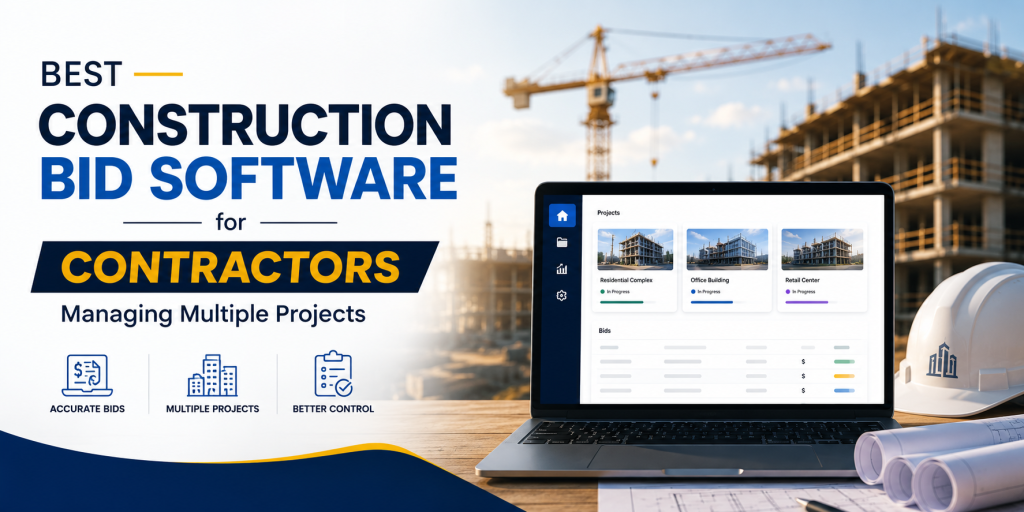
Concurrent Bid Package Management The platform needs to handle multiple active bid packages simultaneously without requiring your team to context-switch between separate workflows. Look for a unified dashboard that gives estimators clear visibility across all active packages — deadlines, response rates, open items, and award status — in a single view.
Subcontractor Database Scale and Accuracy A bid software platform managing 500-plus subcontractor relationships needs more than a contact list. It needs tools that maintain database accuracy automatically — flagging outdated contact information, updating records from real interaction data, and segmenting your sub list by trade, geography, and performance history so the right subs get invited to the right packages without manual curation every time.
Automated Solicitation and Follow-Up Manual follow-up doesn’t scale. At single-project volume it’s time-consuming. At multi-project volume it becomes the bottleneck that determines how many competitive proposals you actually receive. Purpose-built bid management software automates the entire follow-up sequence — initial invitation, reminder cadence, deadline notifications, and incomplete submission follow-up — without human intervention at each step.
Structured Bid Leveling Across All Active Packages Bid leveling across multiple simultaneous trade packages is where manual processes fail most visibly. Spreadsheet-based leveling works when you’re comparing three proposals for one trade on one project. It breaks down when you’re comparing twelve trades across five projects with overlapping deadlines. The platform should enforce consistent comparison structure, flag scope gaps automatically, and produce exportable award documentation that holds up under scrutiny.
Reporting and Analytics Across the Full Portfolio Single-project reporting tells you how a bid went. Portfolio-level reporting tells you how your bidding process is performing — win rates by project type, sub response rates by trade, scope gap frequency by package structure, and time spent per bid cycle. That data is what allows preconstruction directors to make process improvements that compound across every future bid.
How AI Bid Management Changes What’s Possible at Scale
Traditional bid management software organizes the multi-project problem. AI bid management software solves it.
The distinction matters because the volume challenge in multi-project bid management isn’t primarily a storage or organization problem — it’s a labor problem. The work of managing solicitations across multiple simultaneous packages at full quality requires more human attention than a lean preconstruction team can realistically provide. AI bid management removes that constraint by handling the routine work autonomously.
Here’s what that looks like in practice:
Intelligent Subcontractor Qualification Rather than manually curating invitation lists for each new package, AI bid management software analyzes subcontractor specialties, past performance, and availability patterns to recommend the right subs for each trade automatically. Recommendations improve with every project as the system builds a richer performance profile for each subcontractor in your database.
Conversational Outreach at Scale Instead of broadcasting generic solicitation emails that generate low response rates, AI-powered bid software conducts natural two-way conversations with subcontractors — qualifying interest, answering scope questions, and gathering the information your estimating team needs without a human coordinator managing each exchange. Response rates consistently increase by 30% or more compared to manual email solicitation.
Autonomous Contact Management Across five simultaneous bid packages, maintaining accurate subcontractor contact information manually is effectively impossible. AI bid management software identifies outdated records automatically, searches for verified updates, and maintains relationship mapping between companies and personnel — keeping database accuracy above 95% without administrative overhead.
Adaptive Response Consolidation Responses arrive through multiple channels — email, phone, online forms — across overlapping timelines on different packages. AI bid management software consolidates everything into unified conversation threads by package and trade, follows up on incomplete submissions automatically, and surfaces the responses that need human attention rather than requiring your team to monitor everything in parallel.
Continuous Learning Across Projects Unlike static software platforms that perform the same way on project 50 as they did on project one, AI bid management systems learn from every interaction. Sub response patterns, scope question frequency, package structure performance, and contact accuracy all feed back into the system — making each successive bid cycle more efficient than the last.
The Measurable Impact on Multi-Project Operations
For contractors who have made the transition from manual processes or traditional bid software to AI-powered bid management, the operational impact falls into four consistent categories:
Time reclamation at scale. Administrative bid management time drops by 50 to 65% — approximately 40 hours recovered monthly per preconstruction team. Across multiple simultaneous projects, that’s the difference between a team that’s constantly behind and one that has capacity to pursue additional opportunities without adding headcount.
Higher subcontractor response rates. Conversational AI outreach consistently generates 30% or higher response rates compared to manual solicitation. Across five simultaneous packages, that improvement in sub coverage directly translates to more competitive pricing and better award decisions on every trade.
Fewer post-award surprises. Automated bid leveling and scope gap detection across multiple packages reduces the scope errors that survive to award stage — and the change orders that follow. For contractors where a single post-award scope dispute can eliminate profitability on an entire project, this protection is worth more than the time savings alone.
Scalable preconstruction capacity. The most significant long-term impact is operational: AI bid management software allows preconstruction teams to manage a higher volume of simultaneous bid packages without proportional increases in administrative headcount. That scalability is what allows growing contractors to pursue more opportunities, win more work, and grow revenue without growing overhead at the same rate.
Ready to See What AI Bid Management Does for Your Pipeline?
If your preconstruction team is managing multiple simultaneous bid packages and still running solicitation manually, the gap between your current process and what Palcode.ai delivers is measurable in hours per week, response rates per package, and margin protected per project.
See Palcode.ai in action. Book your demo today and find out exactly what 40 hours back every month looks like for your team.
Frequently Asked Questions
What is the difference between traditional bid software and AI bid management software?
Traditional bid software organizes your solicitation process — centralized document storage, structured dashboards, cleaner response tracking. AI bid management software executes the process autonomously — handling outreach, automating follow-up sequences, verifying contact information, and consolidating responses without human intervention at every step. For contractors managing multiple simultaneous bid packages, that distinction isn’t marginal. It’s the difference between a tool that requires your team to do the work and a system that does the work while your team focuses on the decisions that actually require their expertise.
How does construction bid software handle multiple simultaneous bid packages without creating more complexity?
Purpose-built construction bid software manages multiple active packages through a unified dashboard that gives your preconstruction team clear visibility across every concurrent solicitation — deadlines, response rates, open items, and award status in a single view. Instead of context-switching between separate spreadsheets and email threads for each package, estimators work from one centralized system where every trade package, subcontractor response, and follow-up sequence runs in parallel without manual coordination between them.
How quickly can a preconstruction team get up and running on AI bid management software?
Faster than most contractors expect. Purpose-built AI bid management platforms like Palcode.ai require approximately three hours of preconstruction staff training — deliberately lightweight to avoid disrupting active bid cycles. Most teams are running live bid packages through the platform within 72 hours of setup. There’s no complex data migration, no extended IT involvement, and no months-long rollout before the time savings start showing up. The first active bid cycle through the platform typically shows a 30 to 40% reduction in administrative time — before the system has fully learned your workflow.
Will subcontractors actually respond to AI-powered bid outreach?
Consistently better than they respond to manual email blasts — and the data backs it up. AI bid management software conducts natural two-way conversations using construction-specific terminology rather than broadcasting generic solicitation emails that subs have learned to ignore. The system qualifies interest, answers scope questions, and follows up with the consistency that a lean preconstruction team simply can’t sustain manually across multiple simultaneous packages. The result is subcontractor response rates 30% higher than manual solicitation — which means more competitive pricing coverage on every trade package you send out.
Is construction bid software worth the investment for contractors managing three to five projects simultaneously?
At three to five simultaneous bid packages, manual bid management is already creating risk your team may not be fully accounting for — scope gaps that survive to award stage, inconsistent follow-up that narrows competitive pricing coverage, and senior estimator time consumed by administrative work that never required their expertise. Purpose-built construction bid software pays for itself within the first active bid cycle for most contractors at this volume — through time savings alone, before accounting for the margin protection that comes from better bid leveling and higher subcontractor response rates. The question isn’t whether the ROI is there. It’s how many bid cycles you can afford to run at current efficiency before capturing it.
About the Author
Mohit Mohan is the founder of Palcode.ai and a builder of AI-first systems for commercial construction workflows. He works closely with preconstruction leaders to translate real field constraints coverage gaps, bid volatility, scope ambiguity, compliance friction, and estimator capacity limits into repeatable, governed operating workflows that scale across projects and teams.